🏬Supersize Online Funeral Retailer🪦1000's of Headstones⚱️Over 10,000 Cremation Urns⚰️Caskets Overnight Delivery🛒Funeral & Memorial Superstore🚚FREE Shipping on ALL Orders👨👩👧👦Helping Families for over 20 Years💰Lowest Price Guarantee🏬Supersize Online Funeral Retailer🪦1000's of Headstones⚱️Over 10,000 Cremation Urns⚰️Caskets Overnight Delivery🛒Funeral & Memorial Superstore🚚FREE Shipping on ALL Orders👨👩👧👦Helping Families for over 20 Years💰Lowest Price Guarantee
🏬Supersize Online Funeral Retailer🪦1000's of Headstones⚱️Over 10,000 Cremation Urns⚰️Caskets Overnight Delivery🛒Funeral & Memorial Superstore🚚FREE Shipping on ALL Orders👨👩👧👦Helping Families for over 20 Years💰Lowest Price Guarantee🏬Supersize Online Funeral Retailer🪦1000's of Headstones⚱️Over 10,000 Cremation Urns⚰️Caskets Overnight Delivery🛒Funeral & Memorial Superstore🚚FREE Shipping on ALL Orders👨👩👧👦Helping Families for over 20 Years💰Lowest Price Guarantee
The condolences meaning most people are looking for is simply this: an expression of sorrow for someone else's loss. When you offer your condolences, you are telling a grieving person that their loss registers with you and that you are sorry it happened. Nothing more complicated than that — and the fact that so many people search for the definition before writing a card says something true about the moment, which is that nobody wants to get this wrong.
The word carries a little more than the plain gloss, though, and the extra part is worth knowing before you use it. This page covers what the word actually says, why it is almost always plural, the difference between condolences and sympathy, and the moments when "my condolences" is exactly right — and the moments when it lands as stiff.
For the words themselves rather than the etymology, the sympathy and condolences guide is the starting point, and has the lines most people end up using.
The definition of condolence is an expression of sympathy with someone who is suffering sorrow, misfortune, or grief. That is the condolence definition every major dictionary gives, and it is accurate as far as it goes.
The etymology says more. Condolence comes from the Latin condolere — con, meaning "with", and dolere, meaning "to suffer" or "to feel pain". To offer condolences is, literally, to suffer alongside someone.
That is not a decorative fact. It is the difference between a word that means I am sorry this happened to you and a word that means I am carrying a small piece of this with you. When people ask what does condolences mean and get only the dictionary line, they miss the part that makes the word worth using.
To condole is literally to suffer with — which is why the word survives in a language that has dropped most of its Latin.
One more thing the etymology settles. Because the root is to suffer with, condolences are something you give rather than something you feel — which is why "you have my condolences" works and "I feel condolences" does not. The word names an act.
You send condolences, not a condolence. The singular exists and is grammatically correct, but almost nobody uses it in speech — you will hear "a condolence call" or "a condolence letter" as a compound, and very little else.
The plural survives because the word describes a set of feelings rather than one, and because the standard phrases fixed themselves in the plural centuries ago. Please accept my condolences.Our deepest condolences.With sincerest condolences. Those are the forms people recognize, and using the singular where the plural is expected reads as a small error even to someone who could not explain why.
"My Condolences" — What It Means and When to Say It
The my condolences meaning is not different from the plain definition; the possessive just makes it personal. My condolences means my sorrow is with you. It is the shortest complete thing you can say to someone who has lost a person, which is exactly why it survives.
It is formal, and that is its strength and its limitation. Formality is a kind of respect, and at a funeral, in a receiving line, or in a message to someone you do not know well, formal is right. The phrase does the job without asking the grieving person to respond to anything.
Where it goes wrong is closeness. To a good friend, my condolences can read as a step backwards — the language of a colleague rather than someone who knew the person who died. There, saying something specific about the person, or simply I am so sorry, I loved her too, does far more work.
Sending, Offering, Passing On
Three verbs attach to this word and they are not interchangeable.
Offer is the most formal and the most common in writing. I offer my condolences to you and your family. It suits a letter, a formal card, or an official message.
Send implies distance — you send condolences when you cannot be there. Searches for sending condolences meaning and send my condolences meaning are usually asking exactly this: whether it is acceptable to say it from far away. It is. Sending my condolences is a complete and appropriate message when you cannot attend, and it is better than silence by a very wide margin.
Pass on is the indirect form. You ask someone to pass on condolences when you do not know the bereaved person directly — please pass on my condolences to your mother. It is correct, it is common, and it is the right choice when reaching out yourself would be an intrusion.
Two smaller ones are worth knowing because they are easy to get slightly wrong. Extend is the most formal of all and belongs in official or corporate messages — the board extends its condolences to the family. Convey is the same register and is what you use when the message travels through an institution rather than a person. Neither belongs in a card from one human being to another; they sound like a press release, and at close range that is exactly how they read.
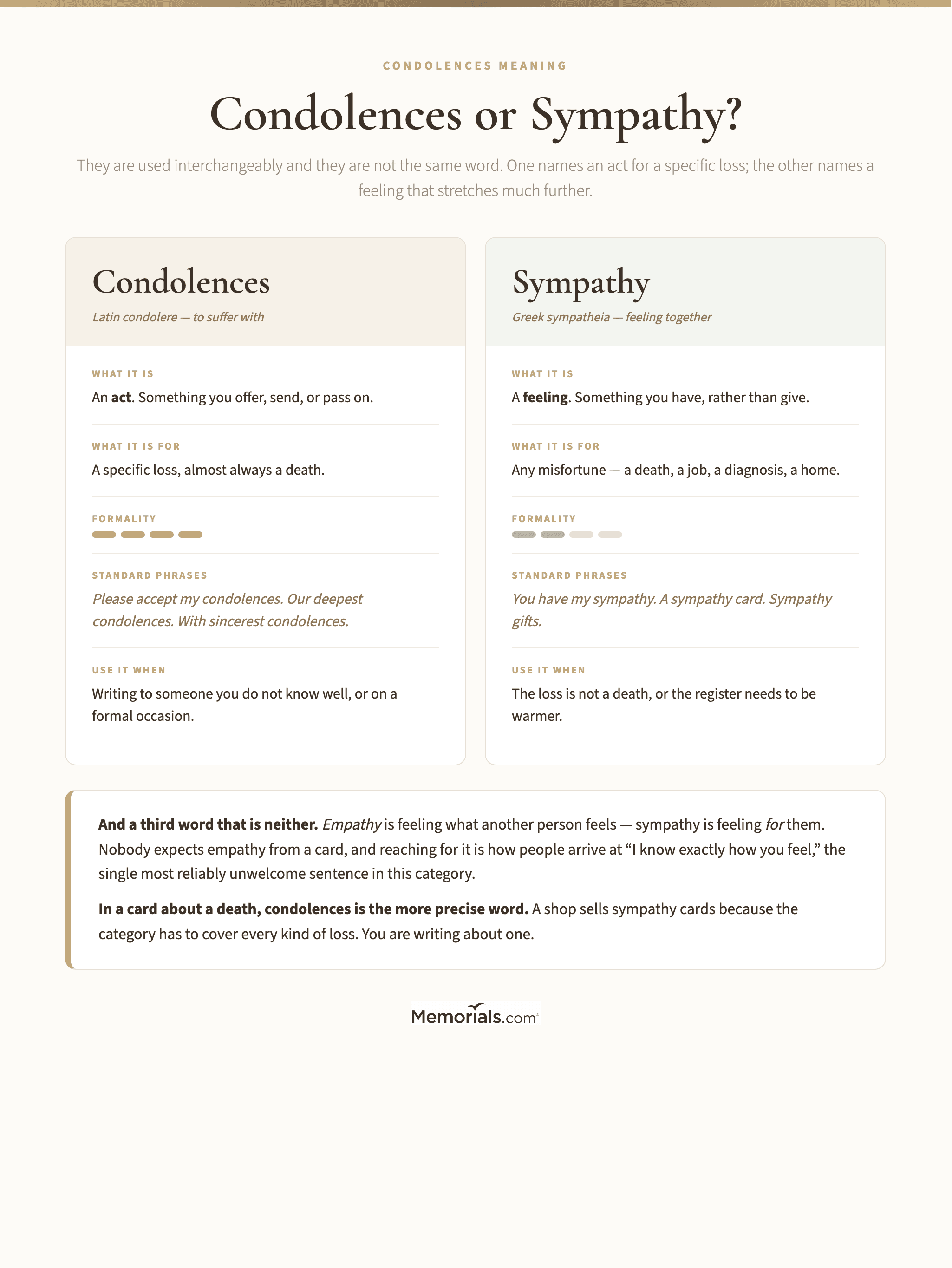
The two words are not synonyms. Condolences are offered for a specific loss; sympathy is the broader feeling, and the one that stretches to circumstances no death is involved in.
Condolences and Sympathy Are Not the Same Word
They are used interchangeably and they should not be.
Condolences are tied to a specific loss, almost always a death. They are something you offer — an act, directed at a person, on an occasion.
Sympathy is the underlying feeling, and it stretches much further. You can feel sympathy for someone who lost a job, a house, or a case in court. It is a state rather than an act.
That is why a shop sells sympathy cards rather than condolence cards, and why our own memorial gift ideas sit under sympathy rather than condolence — the category has to cover every kind of loss, and condolence is the narrower word. In a card, though, the narrower word is usually the better one, because a specific person has died and naming that is the point.
There is a third word worth separating out. Empathy is feeling what another person feels; sympathy is feeling for them. Nobody expects empathy from a card, and reaching for it is how people end up writing "I know exactly how you feel", which is the single most reliably unwelcome sentence in this whole category.
When "Condolences" Is the Wrong Word
Three situations where reaching for it does not serve you.
When you knew the person well. Formality creates distance, and distance is the opposite of what a close friend needs. Say the specific thing instead. Our page on what to say instead of sorry for your loss covers the alternatives properly.
When the loss is not a death. A miscarriage, a divorce, a diagnosis, a beloved pet — condolences is technically defensible for some of these and lands oddly on most. Sympathy is the safer word, and plain language is safer still.
When you are writing to a colleague.My condolences is not wrong here, but it is doing the minimum. A short line acknowledging that work is covered does more, which is what condolence messages for a coworker is about.
There is also a timing question the word itself cannot answer. Condolences belong to the days and weeks immediately after a death — that is the window everyone knows about, and it is also the window in which the bereaved person is least able to take anything in. The message that lands hardest usually arrives later, when the house has emptied and the calls have stopped, and it does not need the word at all. Thinking of you today in the sixth week is worth more than a perfectly phrased card in the first.
The word has outlived the letter it used to arrive in. Condolences now travel by card, by text, by email, by a comment under a post, and occasionally still by a telephone call.
A card remains the form that gets kept. It arrives once, it can be reread months later, and it holds three or four sentences comfortably — what to write in a sympathy card covers the structure.
A text should be short and should not ask for a reply. This is now the most common channel by a distance, and there is nothing lesser about it; the guidance in condolence text messages is mostly about timing rather than wording.
In person, say less than you planned to. I am so sorry with eye contact beats a prepared paragraph.
If you are choosing whether to send something alongside the words, sympathy gift etiquette covers what suits and what does not, and many families now ask for a donation in lieu of flowers instead.
Because the word is Latin, most of Europe has a close cousin of it, and the phrases translate more cleanly than you would expect. Spanish is the one most often needed in the United States — mis condolencias and mi más sentido pésame are the two standard forms, and condolence messages in Spanish covers when each is used.
French uses toutes mes condoléances, Italian le mie condoglianze, German mein herzliches Beileid — the first two are visibly the same word, the German is not, and all three are used the way English uses the phrase.
Hebrew has no equivalent phrase at all, which is worth knowing: the standard line at a Jewish house of mourning is may their memory be a blessing, and offering condolences in the English sense is not the custom. Islamic practice is similar — inna lillahi wa inna ilayhi raji'un is a statement of faith rather than a message to the bereaved, though it functions in the same moment. In both cases the safest thing is to use the family's own form if you know it and plain English if you do not.
Most of Europe kept a version of the Latin word; Hebrew and Arabic never had one, and use a blessing where English uses a phrase.
Frequently Asked Questions
What does condolences mean in simple terms? It means an expression of sorrow for someone's loss. Saying "my condolences" is a short, formal way of saying "I am sorry this happened to you."
Is it "condolences" or "condolence"? Both are words, but the plural is what people use. My condolences, not my condolence. The singular appears mainly in compounds like condolence letter.
Can I say "my condolences" in a text message? Yes. It is slightly formal for a text, but it is never wrong, and sending something formal beats sending nothing. Add one specific line about the person if you can — a detail proves you knew them, and a detail is what gets reread.
Is it too late to send condolences? No. A message at six weeks or six months often means more than one in the first week, because by then everyone else has stopped. Open with I have been thinking about you rather than an apology for the delay — the apology makes the message about you.
What is the difference between condolences and sympathy? Condolences are offered for a specific loss, usually a death. Sympathy is the broader feeling and applies to any misfortune. In a card about a death, condolences is the more precise word.
How do I respond when someone offers me condolences?Thank you is complete. Nothing more is required of you, and nobody is expecting a considered reply.
Do I have to write back to everyone who sent a card? No, and there is no deadline. Many families send a short note to those who sent flowers, gave a donation, or did something practical, and nothing at all to the rest. That is normal and nobody is counting.
Is "condolences" appropriate for the loss of a pet? It is not wrong, but it reads as stiff to most people. Plainer language works better — say the animal's name and something true about them.
In Closing
The word is old, it is a little formal, and it carries an idea worth keeping — that grief is lighter when somebody else agrees to hold part of it. Whether you use the word itself or something plainer, that is the thing you are actually sending, and it is the part that survives being said imperfectly.
Nobody has ever been hurt by a clumsy sympathy card. Plenty of people remember the ones that never came.