🏬Supersize Online Funeral Retailer🪦1000's of Headstones⚱️Over 10,000 Cremation Urns⚰️Caskets Overnight Delivery🛒Funeral & Memorial Superstore🚚FREE Shipping on ALL Orders👨👩👧👦Helping Families for over 20 Years💰Lowest Price Guarantee🏬Supersize Online Funeral Retailer🪦1000's of Headstones⚱️Over 10,000 Cremation Urns⚰️Caskets Overnight Delivery🛒Funeral & Memorial Superstore🚚FREE Shipping on ALL Orders👨👩👧👦Helping Families for over 20 Years💰Lowest Price Guarantee
🏬Supersize Online Funeral Retailer🪦1000's of Headstones⚱️Over 10,000 Cremation Urns⚰️Caskets Overnight Delivery🛒Funeral & Memorial Superstore🚚FREE Shipping on ALL Orders👨👩👧👦Helping Families for over 20 Years💰Lowest Price Guarantee🏬Supersize Online Funeral Retailer🪦1000's of Headstones⚱️Over 10,000 Cremation Urns⚰️Caskets Overnight Delivery🛒Funeral & Memorial Superstore🚚FREE Shipping on ALL Orders👨👩👧👦Helping Families for over 20 Years💰Lowest Price Guarantee
Search how long after death is funeral and the answer you will get is three to seven days. That is right, and it is a custom rather than a rule — for a burial, almost nothing about the timing is fixed by law.
What actually decides the date is paperwork and people: who has to sign the death certificate, whether a medical examiner is involved, when the family can gather, and what the cemetery, crematory or clergy can schedule. Preservation is rarely the constraint — a funeral home can hold someone safely for weeks.
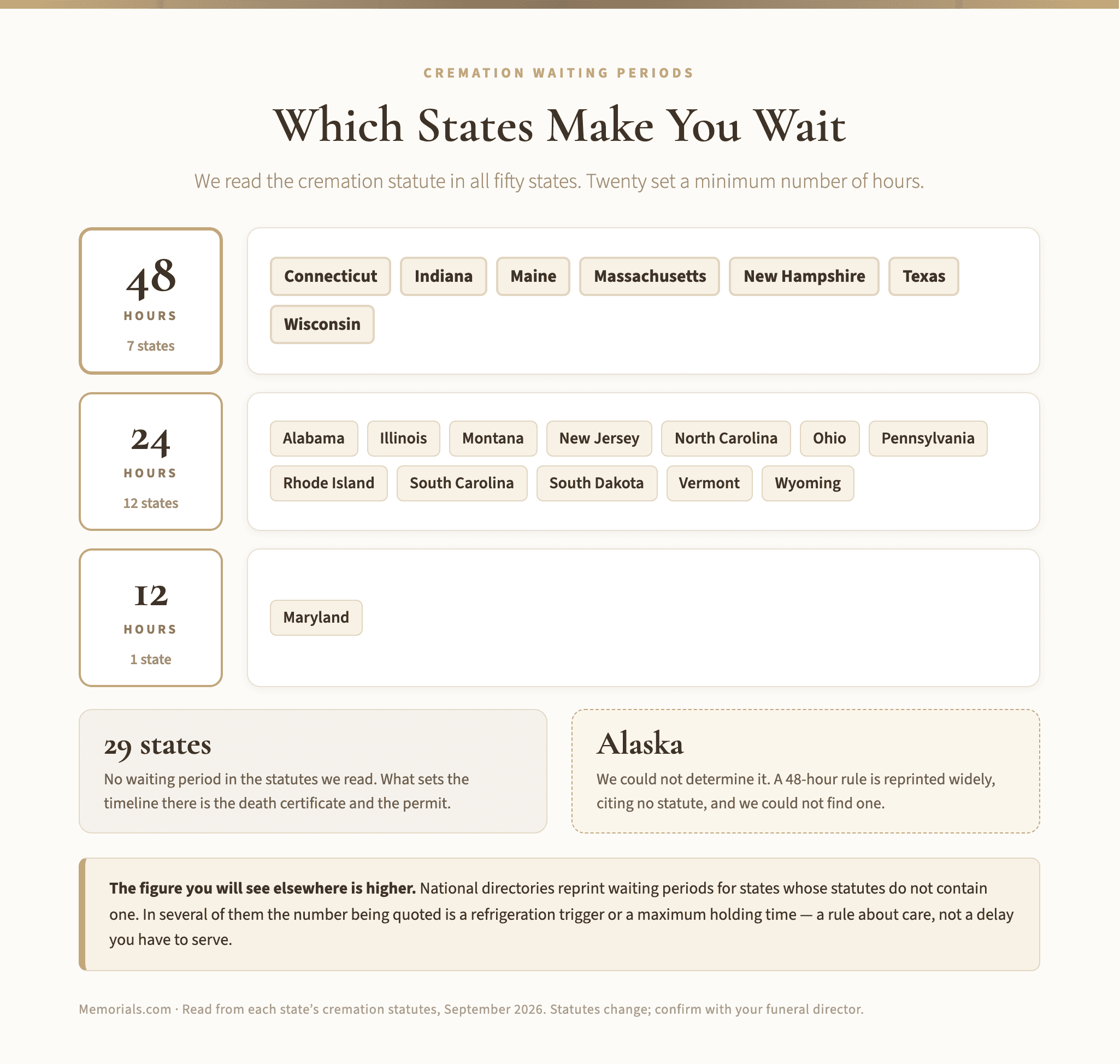
There is one real legal constraint, and it applies only to cremation. Twenty states set a minimum number of hours that must pass before someone may be cremated. We read the cremation statutes in all fifty states for our cremation cost research: the floor is 24 hours in twelve states and 48 hours in seven more, with Maryland the outlier at twelve hours. In twenty-nine states we read the law and found no waiting period at all.
That count is lower than the figure most sites give, and deliberately so. National directories reprint waiting periods for states whose statutes do not contain one — we could not find the rule in Arkansas, Hawaii, Idaho, Iowa, Louisiana, Michigan, Mississippi, Missouri or Nebraska, and in several of those the number being quoted is a refrigeration trigger or a maximum holding time, which is a rule about care rather than a delay you have to serve.
The Short Answer, by Situation
Situation
Typical time from death
Burial with a viewing
4 to 7 days
Burial, no viewing
3 to 5 days
Direct cremation, no service
7 to 14 days before ashes are returned
Cremation with a memorial afterward
The cremation in days; the service weeks or months later
Jewish funeral
Within 24 hours where possible
Muslim funeral
As soon as possible, often within 24 hours
Military honors at a national cemetery
1 to 3 weeks, scheduled
The spread is mostly about how many people have to agree on a date.
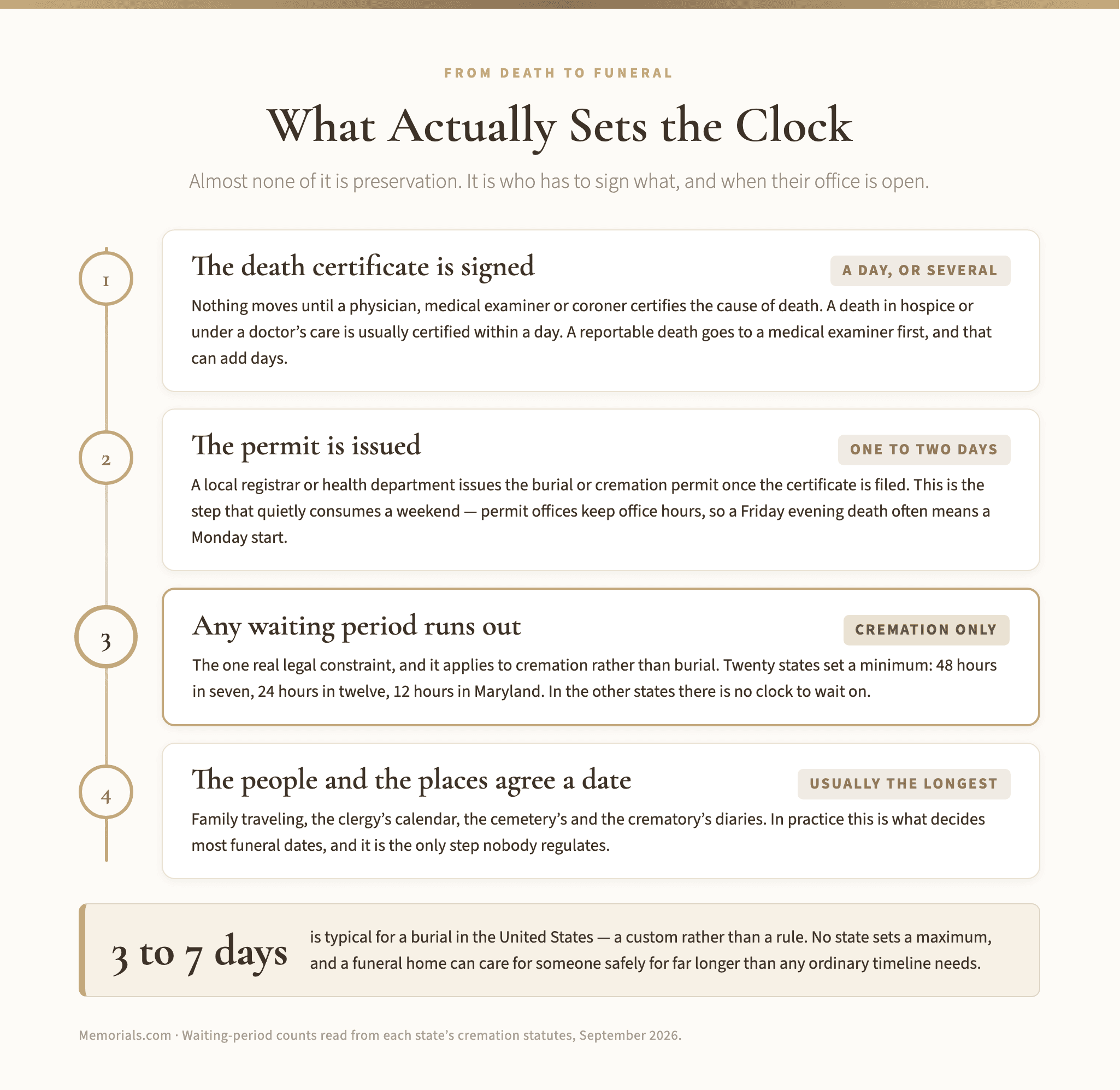
Nothing else moves until it is. A physician, medical examiner or coroner has to certify the cause of death, and how quickly that happens depends entirely on where and how the person died.
A death in hospice or under a doctor's care is usually certified within a day. An unattended death, a death at work, a death by accident or any death the state considers reportable goes to a medical examiner first — and that can add days. Our state-by-state reading turned up several places where the examiner is involved in every cremation regardless of circumstance, which is why two families in different states can experience very different waits for identical arrangements.
You will also need certified copies, and more of them than most people expect. Our guide to how many death certificates you need covers who asks for one.
Nothing in a funeral timeline moves before this signature. Where the death was expected and attended, it is usually a day; where it is reportable, a medical examiner sees it first.
Then the permit
Most states require a burial or cremation permit, issued by a local registrar or health department once the certificate is filed. In practice this is a day, sometimes two, and it is the step that quietly consumes a weekend — offices that issue permits keep office hours, and a Friday evening death often means a Monday start.
The permit is the step that quietly consumes a weekend. Offices that issue them keep office hours, which is why a Friday evening death often means a Monday start.
And in twenty states, a legal wait before cremation
This is the one hard floor, and it surprises families who have chosen cremation precisely because they wanted something simple and quick.
Waiting period before cremation
States
48 hours
7 — Connecticut, Indiana, Maine, Massachusetts, New Hampshire, Texas, Wisconsin
24 hours
12 — Alabama, Illinois, Montana, New Jersey, North Carolina, Ohio, Pennsylvania, Rhode Island, South Carolina, South Dakota, Vermont, Wyoming
12 hours
1 — Maryland
None found in the statutes
29
We could not determine
1 — Alaska
Alaska is in its own row on purpose. A 48-hour Alaska waiting period is reprinted across national directories citing no statute, and we could not find one in Alaska law — so we say we do not know rather than repeat it.
Every state named here was read from its own cremation statute. Alaska sits in its own row because we could not find the rule that national directories keep reprinting, and saying so is more useful than guessing.
Massachusetts is the clearest about it. M.G.L. c. 114, § 44 says the body "shall not be cremated within 48 hours after his decease unless he died of a contagious or infectious disease" — one exception, and no official can waive it. Texas also holds a 48-hour wait, and in its largest counties a medical examiner must sign before any cremation at all. Wisconsin is stricter still: its 48 hours can be waived by nobody at all — not the family, not the coroner — where Massachusetts, Indiana and Texas each allow a narrow waiver. Maryland requires only twelve hours, but requires the crematory to document that they elapsed.
The wait is not only a delay. It is usually a charge, because the funeral home is holding your loved one through it. In Massachusetts, where two days of holding are guaranteed by statute, that is two days of refrigeration on the bill whether the family wanted them or not.
Four steps, and the one most people worry about — preservation — is not among them. The longest is usually the last, which is also the only one nobody regulates.
What Makes It Take Longer
Family travel. The single commonest reason a funeral is on day six rather than day three. It is also the easiest to plan around if someone asks early who has to fly.
Venue and clergy availability. A church, a funeral home chapel and a cemetery all have to be free at once, and a specific officiant often has to be too. Saturday is the most requested day and the first to fill.
An autopsy. Adds several days, and occasionally longer if toxicology is involved. A funeral can still be scheduled around it; the funeral director will tell you when.
Holidays and weekends. Registrars, county offices and cemeteries close. A death on the Wednesday before a long weekend can push a funeral nearly a week out on office hours alone.
A death away from home. Transporting someone across state lines or back from abroad adds paperwork and days, and some states require embalming for interstate transport.
A grave that has to be opened. Cemeteries schedule openings, and in hard winter ground some northern cemeteries delay burial until spring, holding the casket in a receiving vault. This is normal and the cemetery will explain it.
A plot that has not been bought yet. If the family does not already own a grave, that purchase has to happen before a date can be set, and it is a decision worth a day rather than an hour. Cemeteries differ on price, on what is included, and on whether an outer burial container is required.
What Makes It Shorter
Religious requirement. Jewish tradition calls for burial within 24 hours where practical, and Muslim tradition for burial as soon as possible after death. Funeral homes in most areas are used to both and will work overnight and on weekends.
Direct cremation. No viewing means no embalming and no scheduling around a service — the cremation happens as soon as the paperwork and any statutory wait allow. Our guide to direct cremation covers what is and is not included, and the ashes typically come back seven to fourteen days after death.
Separating the disposition from the service. This is the change that has done most to relieve time pressure on families. Cremate first, then hold the memorial when everyone can actually be there — a month later, on a Saturday, in summer. The difference between a wake, a funeral and a viewing is worth understanding before deciding which you are scheduling.
Faith Traditions Set Their Own Clock
Where a religious tradition has a view on timing, it usually overrides the civil convention — and funeral homes are used to working to it.
Jewish. Burial within 24 hours where practical, and as soon as possible otherwise. Embalming and viewing are generally not part of the tradition, which removes the two steps that most often add days. Burial is avoided on Shabbat and major festivals, which can shift a date by a day.
Muslim. Burial as soon as possible after death, frequently within 24 hours. The body is washed and shrouded rather than embalmed, and cremation is not practiced.
Catholic. This is the tradition people most often ask about, and the answer surprises them: there is no fixed interval. People searching for how long after death is funeral catholic are usually looking for a rule that does not exist. What the Church sets out is a sequence — the vigil (often called the wake), then the Funeral Mass, then the committal at the graveside — and in practice the Mass falls within the same three-to-seven-day window as everyone else's, scheduled around the parish calendar. Cremation is permitted, and since 1963 the Church has allowed the funeral rites to be celebrated with the cremated remains present. Our guide to planning a Catholic funeral covers the three rites and what each involves.
Hindu and Sikh. Cremation, traditionally within 24 hours where circumstances allow — which is precisely where a state waiting period can create genuine difficulty, and worth raising with the funeral director immediately.
If the Plan Is Cremation: The Two Clocks
Cremation has two timelines and families routinely conflate them. The first is how long until the cremation happens. The second is how long until the ashes come home, and the second is nearly always the one people are actually asking about.
How long after death is funeral if cremated? The question splits in two, because cremation separates the disposition from the service in a way burial does not.
How long does it take to get a body cremated, once the decision is made? Two to seven days from death in most of the country, and the variance is almost entirely paperwork rather than crematory capacity. The sequence is: the death certificate is signed, a cremation authorization is obtained from the legal next of kin, a permit is issued, and any state waiting period runs out. Crematories themselves are rarely the bottleneck — the burn takes two to three hours.
Where it runs long, it is usually one of three things. A medical examiner has to sign and has not. The authorizing relative is not the one standing in the funeral home, and consent has to be chased across a family. Or the state is one of the twenty with a statutory wait, and the clock simply has not finished.
How long does it take to receive ashes after cremation
How long does it take to receive ashes after cremation? Seven to fourteen days after death is the usual answer, which is a few days after the cremation itself. The gap is processing and identification: cremated remains are reduced, checked against the identification tag that travels with the body, and placed in a temporary container before the funeral home calls you.
Some crematories are faster and some regions run slower, and a funeral home acting as middleman adds a day or two at each handoff. If the timing matters — a scattering with family in town, a burial of ashes on a booked date — say so when you make the arrangements. It is a reasonable request and it is much easier to accommodate in advance than to chase afterward.
A practical note: ashes are returned in a plain temporary container, usually plastic or cardboard, and that is deliberate. Nobody expects a family to have chosen a permanent urn within two weeks of a death, and there is no deadline for doing so. Families commonly take a month or more, and some keep the temporary container until the first anniversary. Neither the crematory nor the funeral home is waiting on the decision.
Do You Have to Embalm While You Wait?
Usually not, and this is where families are most often told something that is a funeral home's policy rather than the law.
No state requires embalming simply because time has passed. What most states require is embalming or refrigeration if burial or cremation has not happened within roughly 24 to 48 hours, and refrigeration is the cheaper and commoner answer. A funeral home can hold someone refrigerated for three to four weeks — far longer than any ordinary funeral timeline needs.
Where embalming genuinely comes up is an open-casket viewing, especially several days out, and interstate transport. Our guide to the embalming process covers when it is required, what it costs, and what refrigeration does instead.
If you are told embalming is necessary, it is entirely reasonable to ask whether that is state law or house policy, and to ask for it in writing on the itemized price list.
All of this is easier when the person left burial instructions — not in a will, which is usually read after the funeral, but in a document that takes effect at death.
Planning Backward From the Date
Once a date is set, most of what remains is ordering things with lead times. Two are worth starting early:
The casket. Funeral homes stock a limited selection and anything ordered in takes days. You are also free to buy elsewhere — the FTC's Funeral Rule requires the funeral home to accept a casket you supply without charging a handling fee. Comparing casket prices before the arrangement conference is the single easiest way to avoid deciding under pressure.
Printed materials. Programs, prayer cards and register books all have print lead times, and they are usually the last thing anyone thinks of.
If cremation is the plan, the urn for ashes is the one decision that does not have to be rushed. Crematories return ashes in a temporary container, and families often take weeks choosing the permanent one. That is normal and nobody is waiting on you.
Most of what is left after the date is set has a lead time attached. The urn is the exception — crematories return ashes in a temporary container, and nobody is waiting on that decision.
Three to seven days in the United States. Four to seven is common where there is a viewing, three to five without one. Nothing in law fixes this for a burial — it is set by paperwork, family travel and what the cemetery and clergy can schedule.
Is there a legal maximum time to wait before a funeral?
No state sets an outside limit. What states regulate is the care of the body in the meantime: most require embalming or refrigeration if burial or cremation has not happened within about 24 to 48 hours. Families occasionally wait weeks for a relative to return from overseas, and that is lawful and manageable.
How long after death is a funeral if the person is cremated?
The cremation itself usually happens within two to seven days, after the paperwork clears and any state waiting period has passed. Ashes are typically returned seven to fourteen days after death. Many families then hold the memorial service weeks or months later, which is one of the practical advantages of cremation.
Which states make you wait before cremation?
Twenty do, on our reading of the statutes. The 48-hour states are Connecticut, Indiana, Maine, Massachusetts, New Hampshire, Texas and Wisconsin. The 24-hour states are Alabama, Illinois, Montana, New Jersey, North Carolina, Ohio, Pennsylvania, Rhode Island, South Carolina, South Dakota, Vermont and Wyoming. Maryland requires 12 hours. Twenty-nine states have no waiting period in their statutes, and Alaska we could not determine. Our cremation cost guide has the rule for each state alongside what it costs there, with the citation.
Can a funeral be held the day after someone dies?
Sometimes. Jewish and Muslim funerals routinely are, and funeral homes accommodate them. It requires the death certificate to be signed quickly, which generally means an expected death under a doctor's care, and it rules out cremation in the 20 states with a waiting period.
Why is the funeral taking so long?
Nine times out of ten it is one of three things: a medical examiner has not released the certificate, the family is waiting on someone to travel, or the cemetery and officiant cannot both be free before the weekend. Your funeral director knows which it is, and it is a fair question to ask directly.
A Note on Being Rushed
The three-to-seven-day convention exists for practical reasons, not moral ones. There is no deadline you are failing to meet, and the parts that feel urgent — choosing a casket, choosing an urn, deciding on a service — are mostly decisions that can be made carefully rather than quickly.
If the schedule is being driven by something other than the family's needs, it is worth asking what. A funeral home's calendar is a real constraint and a reasonable one. A price that expires, or a decision that has to be made today, is not.