🏬Supersize Online Funeral Retailer🪦1000's of Headstones⚱️Over 10,000 Cremation Urns⚰️Caskets Overnight Delivery🛒Funeral & Memorial Superstore🚚FREE Shipping on ALL Orders👨👩👧👦Helping Families for over 20 Years💰Lowest Price Guarantee🏬Supersize Online Funeral Retailer🪦1000's of Headstones⚱️Over 10,000 Cremation Urns⚰️Caskets Overnight Delivery🛒Funeral & Memorial Superstore🚚FREE Shipping on ALL Orders👨👩👧👦Helping Families for over 20 Years💰Lowest Price Guarantee
🏬Supersize Online Funeral Retailer🪦1000's of Headstones⚱️Over 10,000 Cremation Urns⚰️Caskets Overnight Delivery🛒Funeral & Memorial Superstore🚚FREE Shipping on ALL Orders👨👩👧👦Helping Families for over 20 Years💰Lowest Price Guarantee🏬Supersize Online Funeral Retailer🪦1000's of Headstones⚱️Over 10,000 Cremation Urns⚰️Caskets Overnight Delivery🛒Funeral & Memorial Superstore🚚FREE Shipping on ALL Orders👨👩👧👦Helping Families for over 20 Years💰Lowest Price Guarantee
Yes, Jehovah's Witnesses hold funerals, and if you have been invited to one you are welcome to attend. A Jehovah Witness funeral is short — usually fifteen to thirty minutes — led by a congregation elder rather than by paid clergy, built around scripture rather than around a personal eulogy, and held at a Kingdom Hall, a funeral home, the family's home or at the graveside. You will not be asked to take part in anything. No collection is taken and no offering is passed.
That is the whole answer for most people who come to this page, and if you are going tomorrow it may be all you need. What follows fills it in: what actually happens minute by minute, what to wear, what to send, what to say, and what the congregation does for the family in the weeks after. This article is part of our funeral traditions guide, which covers how different faiths and cultures mark a death.
Do Jehovah's Witnesses Have Funerals?
It is the most-searched question on this whole subject, and it arrives typed a dozen different ways — do Jehovah's Witnesses have funerals, do Jehovah Witness have funerals, what is a Jehovah's Witness funeral like. Almost nobody asking it wants doctrine. They are checking that they are not about to walk into a room and do something wrong.
Yes. Jehovah Witness funerals are held for members of the congregation in much the same circumstances as any other funeral: a death occurs, the family speaks with the elders, a time and place are arranged, and people come. What differs is emphasis rather than existence. The service is deliberately modest, deliberately brief, and deliberately focused on a message rather than on a life story.
One point of vocabulary causes real confusion and is worth clearing up before you go. Witnesses generally call the service a memorial service or simply a funeral. That is not the same thing as the Memorial — with a capital M — which is a single annual observance of Jesus' death that Witnesses keep each spring. If someone in the family mentions the Memorial, they may be talking about that yearly event and not about the service you were invited to.
Most Jehovah's Witness funeral customs come down to one instinct, and once you have hold of it the rest follows without much explaining: simplicity. Not austerity, and not solemnity for its own sake — simplicity, in the sense of a service that does not draw attention to itself, to the family's means, or to the deceased as a personality. Display of any kind is understood to sit at odds with the occasion.
What Happens at a Jehovah's Witness Funeral Service
A Jehovah Witness funeral service runs about fifteen to thirty minutes from beginning to end. That surprises people who are used to an hour or more, and it is the single most useful fact to carry in with you, because it changes what you expect and how you plan the rest of your day.
You arrive and are shown to a seat. There is usually no processional and no ushering party. The casket, if the family has chosen to have one present, sits at the front of the room; whether it is open or closed is entirely the family's decision and both are common. Embalming is treated as a practical matter rather than a religious one, and families decide it the way anyone else does.
An elder from the congregation opens with a prayer, then gives what Witnesses call the talk, or the discourse. It is a scripture-based address about death and the resurrection hope, drawn from the New World Translation, which is the Bible translation Witnesses read from. The deceased is named, and there will usually be a short, plain account of their life and their faith — but the talk is not a eulogy in the usual sense, and it will not be a sequence of personal tributes from friends and relatives. The elder is speaking about the hope, and the person who died is the reason he is speaking about it.
Music is uncommon. Some services include one short song sung by the congregation; many have none at all. There is no communion, no ritual to follow along with, and no point at which visitors are asked to stand and speak. A closing prayer ends the service, and the elder may say a few words about a graveside service if one is to follow.
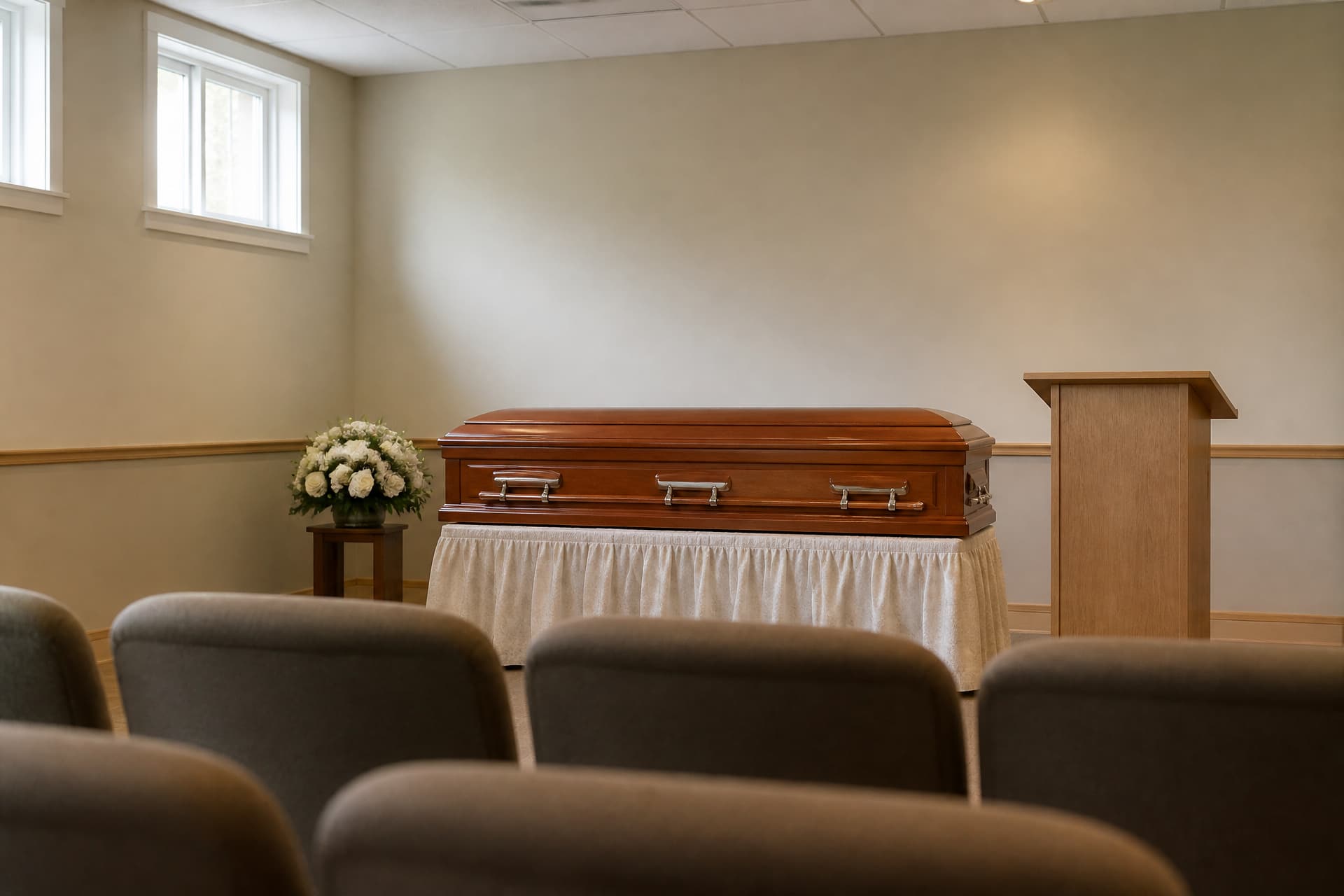
The casket sits at the front of the room and the elder speaks from a lectern beside it. Whether it is open or closed is entirely the family's decision, and both are common.
At the graveside, a second short talk and prayer are usual. The gathering is small and there is no fixed order for guests to follow. When it ends, people generally leave quietly; the family may invite you back for refreshments, and that invitation is genuine.
Nothing is collected. There is no offering plate, no envelope passed, and no donation expected at any point in the service or after it. If you have been to funerals where a collection is normal, this is the difference most likely to catch you out.
The whole service runs fifteen to thirty minutes: an opening prayer, a scripture-based talk given by a congregation elder, and a closing prayer, with a short graveside service and an informal gathering afterwards if the family has arranged them.
What Jehovah's Witnesses Believe Happens When You Die
So what do Jehovah Witnesses believe happens when you die? The service makes far more sense once you know, because its length and its plainness both come directly from the answer.
Witnesses believe that the dead are unconscious — asleep, in the language they use — and that death is a temporary condition rather than a passage to somewhere else. They do not believe in an immortal soul that survives the body, and they do not believe in hell as a place of conscious torment. On their reading, someone who has died is not watching, not waiting somewhere, and not suffering. They are simply not conscious.
What they hope for is resurrection: that God will restore the dead to life on a paradise earth, and that the separation is therefore real but not permanent. A smaller group, which Witnesses understand from scripture to number 144,000, is believed to be raised to rule with Christ in heaven; everyone else is understood to be resurrected to life here. That distinction comes up in the talk fairly often and can be confusing to a guest hearing it cold.
Two things follow from this that are worth knowing before you sit down. The first is that the service is short because there is, in this understanding, less to resolve — the message is that the person is not gone permanently, and the message does not take long to deliver. The second is that grief is not treated as a failure of faith. Witnesses mourn, cry and miss people the way anyone does, and the family will not think less of you for being visibly upset.
Do Jehovah's Witnesses Believe in Cremation?
So, do Jehovah Witnesses believe in cremation? It is permitted. Witnesses treat the choice between burial and cremation as a matter of personal conscience for the family rather than as a rule handed down to them, and no doctrinal objection attaches to either. Since the resurrection hope does not depend on the body being preserved, what happens to the body afterwards is not understood to affect it.
In practice, burial is common and cremation is chosen by plenty of families for the same practical and financial reasons anyone chooses it. The decision does not change the shape of the service: the same talk is given, by the same elder, in the same fifteen to thirty minutes, whether the body is buried or cremated and whether the memorial is held before or after. If the cremation happens first, the service may be held with an urn present or with nothing at the front of the room at all.
If you are weighing this question for your own family and want the wider Christian picture rather than the Witness one specifically, we have written separately about whether Christians can be cremated, which covers where the different denominations stand and how those positions have moved.
The honest summary for a guest is that you cannot tell from the invitation which was chosen, it is not your business to ask, and it makes no difference to how you should behave when you get there.
What to Wear to a Jehovah's Witness Funeral
Jehovah Witness funeral attire is not a dress code. There is no required color, no covering for the head, no garment to borrow and nothing you have to buy. What is expected is that you look like you took the occasion seriously: modest, conservative, and not the most noticeable person in the room.
For men, a dark suit and tie is the safe standard, and a jacket with dress pants and a collared shirt is entirely acceptable where a suit is not available. For women, a modest dress, a skirt and blouse, or dress pants — with sleeves, and at or below the knee. Black is usual but not required; navy, charcoal and other dark neutrals are all ordinary. Keep jewelry and makeup restrained, and leave anything that reads as festive at home.
Conservative and unremarkable is the whole standard — a dark suit or a modest dress, nothing that draws the eye, and no head covering required of guests.
One thing to avoid is deliberately dressing as a member of the congregation would. You are attending as yourself, and adopting someone else's practice is more awkward than simply turning up neatly in your own clothes. If you want the general ground rules that apply at almost any service, our guide to what to wear to a funeral covers the wider question, and nothing in it conflicts with what is said here.
If you are genuinely unsure — a very casual workplace, a service at the graveside in bad weather, a teenager with nothing suitable — ask whoever invited you. It is an ordinary question, it is asked constantly, and nobody will be offended by it.
Flowers, Gifts and What Not to Send
Flowers are welcome, with one specific and important exception. Simple arrangements are ordinary and appreciated, and the safest thing to send is a modest hand-tied arrangement or a plain vase of white or cream flowers, delivered to the family's home rather than staged at the service. Large sprays, easels and elaborate casket displays sit badly against the tradition's preference for restraint, and the family may quietly find them a burden rather than a comfort.
The exception: never send an arrangement shaped as a cross. Witnesses do not use the cross as a religious symbol — they understand Jesus to have died on a single upright stake, and they regard veneration of the cross as something to avoid rather than as a mark of faith. A cross-shaped arrangement is the one floral choice that will genuinely land wrong, and it is an easy mistake because so many florists offer it as the default sympathy shape. Say when you order that you do not want any religious symbols in the design.
Simple, modest and sent to the family's home is exactly right; the one arrangement to avoid is anything shaped as a cross, which the tradition does not use as a symbol.
Money is a different matter. No collection is taken at the service, no donation is expected, and there is no memorial fund to contribute to in the way some traditions expect. Sending an envelope of cash is not customary and can be uncomfortable to receive. If you want to give something practical, food is always welcome, and so is a specific offer of help with a specific job.
Gifts of any kind should be quiet. A card, a meal, a plant, an offer to drive someone to the service — these are the things that fit. Anything that would sit on display in the room where the funeral is held probably does not.
Funeral Etiquette for Non-Witnesses
You are welcome. That is worth saying plainly, because a great many people arrive at this page half-expecting to find that they are not. Non-Witnesses attend these services constantly, and the congregation is used to guests who have never been inside a Kingdom Hall before.
Arrive five or ten minutes early and take a seat wherever you are shown or wherever there is room. Stand and sit with everyone else. When the elder prays, the ordinary thing is to sit or stand quietly with your head bowed; you are not expected to join in, cross yourself, or say amen, and nobody is watching to see whether you do. Silence your phone before you go in, and do not photograph the service.
What to say to the family is the same as anywhere else, and simpler than people fear. "I am so sorry" is complete. Saying something specific and true about the person — that she was kind to you when you started, that he fixed your car twice and never let you pay — is better than anything you could compose in advance. What to avoid is the register of consolation that assumes a different belief: "she is in a better place", "God needed another angel", "he is looking down on you". Those are meant kindly and they do not match what the family believes, so they land as a small jarring note at a bad moment. The general rules in our guide to funeral etiquette apply here without modification.
If you cannot attend, a card is the right thing, and it does not need to be long. Our guidance on writing a message of sympathy has wording you can adapt; keep it plain, name the person who died, and avoid the afterlife phrasing above.
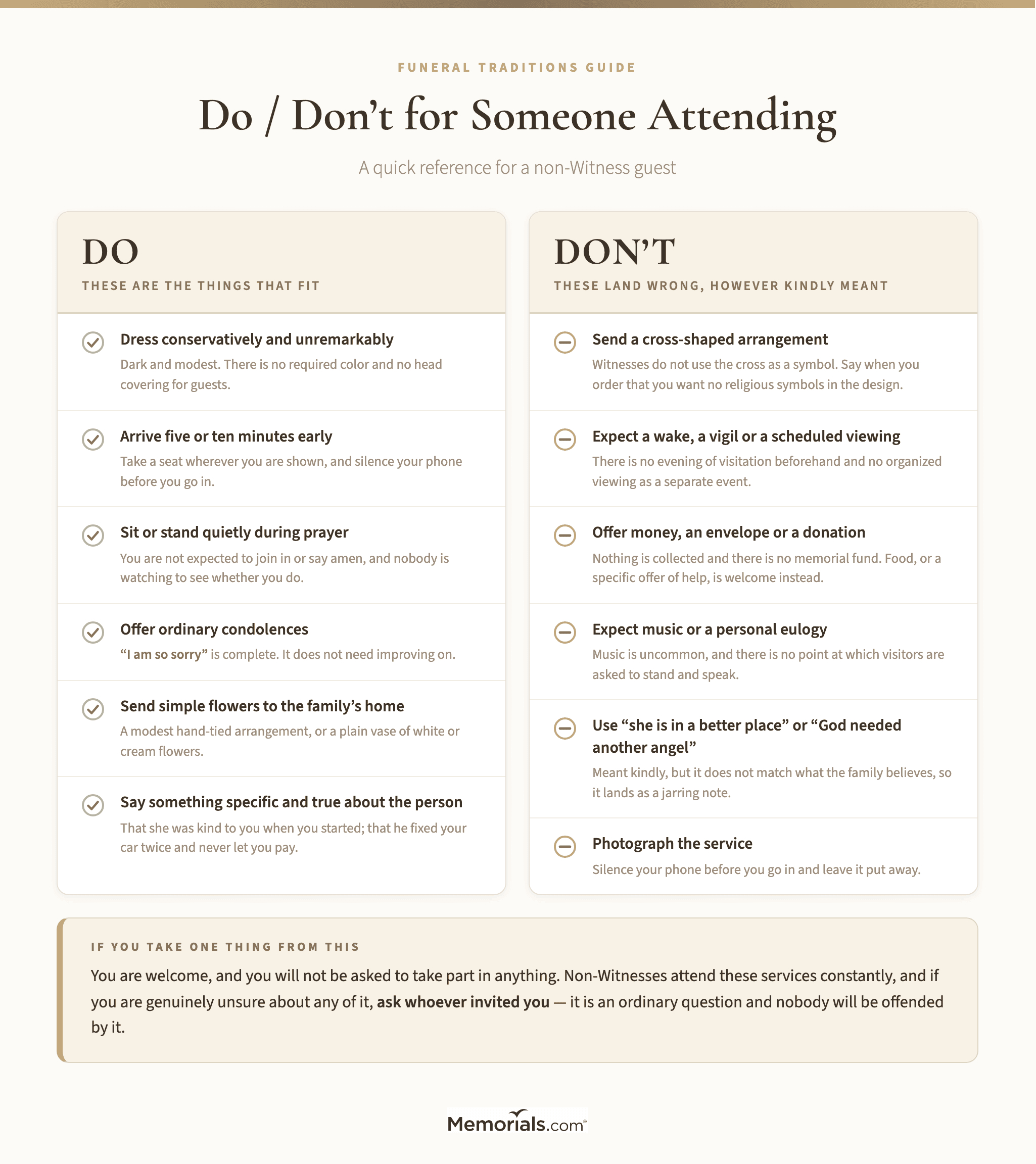
Do dress conservatively, arrive a few minutes early, offer ordinary condolences and send simple flowers to the family's home. Do not send a cross-shaped arrangement, expect a wake or a viewing tradition, offer money, or expect music or a personal eulogy.
After the Service: the Congregation, the Family, and the Days That Follow
There is no wake in the sense many families expect — no evening of visitation before the funeral, and no organized viewing as a separate event. Some families arrange a short private time to see the body beforehand, and that is a family decision rather than a fixture. What usually happens afterwards is a gathering: refreshments at the Kingdom Hall or at someone's home, informal, unstructured, and often quite short.
The congregation itself does most of the practical work. Elders and other members organize meals, transportation, childcare and the ordinary business of a household that has stopped functioning, and they generally keep doing it well past the point at which outside sympathy tapers off. This is one of the genuine strengths of the tradition, and it is also why an outside friend can feel superfluous in the first two weeks. You are not. The month after everyone else has gone back to normal is when a call from a coworker matters most.
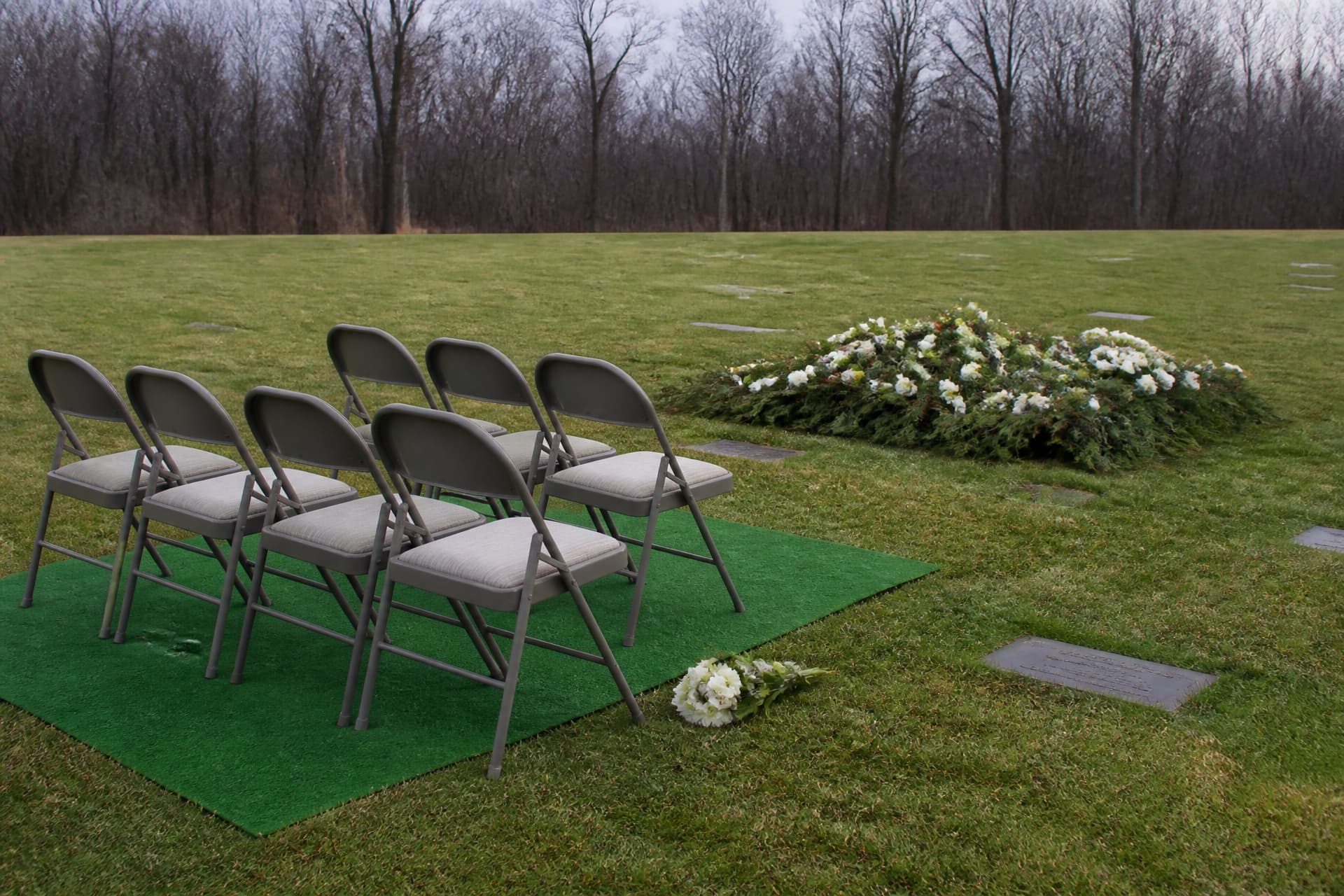
Graveside gatherings are small and brief — a second short talk, a prayer, and no fixed order for guests to follow. When it ends, people generally leave quietly.
Practical matters come later and unevenly. Sorting through possessions is one of the tasks that takes the longest to begin, and families vary enormously in how they feel about it; if you have wondered what happens to a loved one's clothes afterwards, the answers owe more to individual feeling than to any rule. Offer to help with it, and take no for an answer the first three times.
How a Jehovah's Witness Funeral Compares to Other Faith Traditions
If this is your first funeral outside your own tradition, it helps to know that the instinct toward plainness is not unusual. A Muslim funeral is also simple, also fast, and also resistant to display: a plain shroud, a prompt burial, and no elaborate casket. The reasoning is different in each case, but the result a guest sees — restraint, brevity, no theater — is recognizably similar.
Buddhist funeral customs and Hindu funeral traditions run the other way on ritual — both give a guest more to observe and, often, more days to observe it over — but both share the sense that the service is doing something for the person who died rather than performing for the people watching. That is the thread. What varies is how much of it is visible.
The nearest comparison for most American readers is Catholic practice, and the contrast there is instructive: how a Catholic funeral is planned involves a vigil, a Mass with its own fixed order, and a committal — three events over several days, with a formal liturgy that guests are expected to follow. A Witness funeral collapses all of that into one short talk. If you have only ever been to Catholic services, the brevity can read as coldness on the day. It is not; it is a different reading of what the service is for.
The gathering afterwards is informal and unstructured — refreshments at the Kingdom Hall or at a family member's home, and no reception in the formal sense.
Frequently Asked Questions
Where is a Jehovah's Witness funeral held?
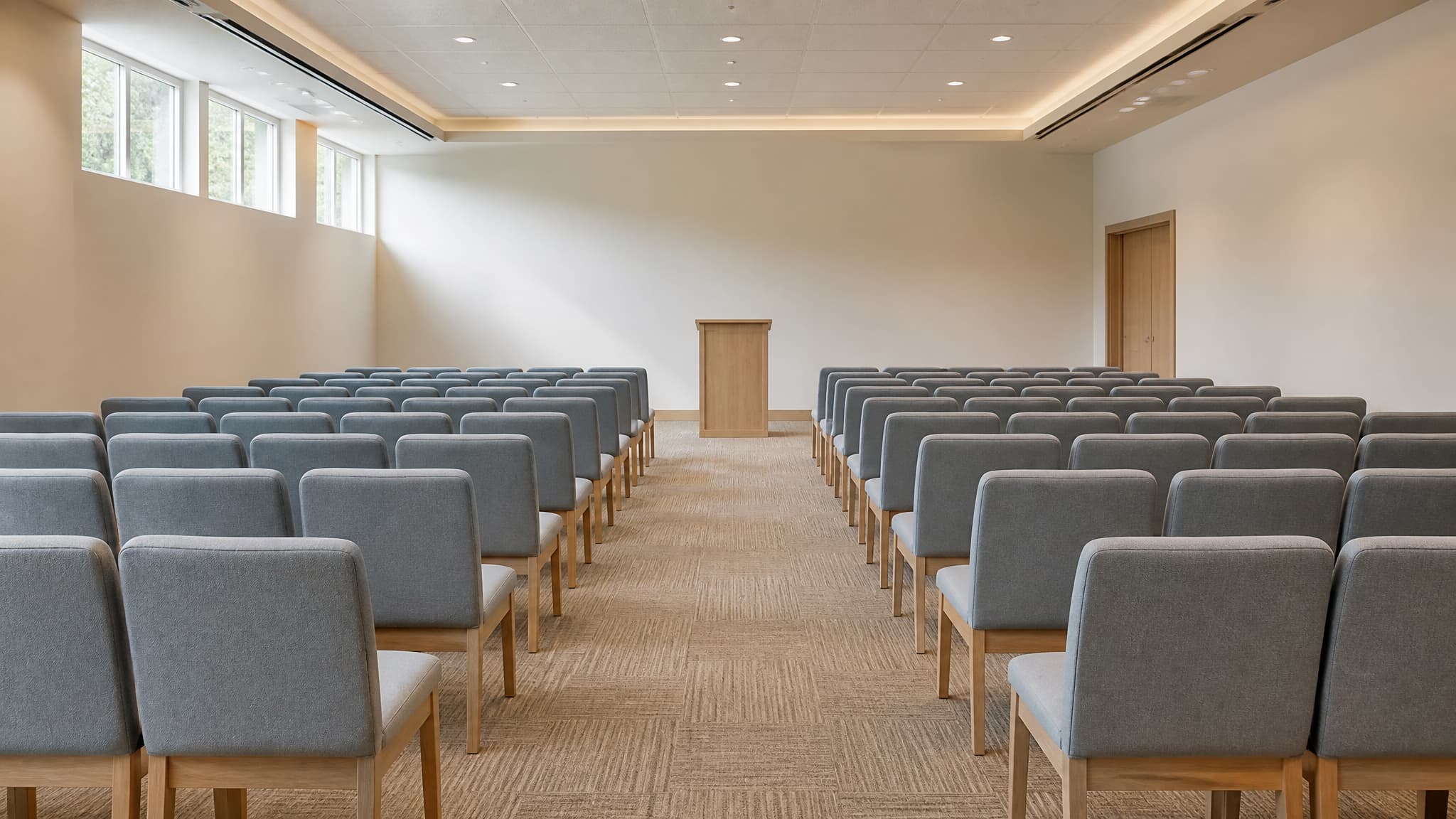
Most often at a Kingdom Hall, which is the congregation's meeting place, or at a funeral home. Some are held at the family's home and some entirely at the graveside. The invitation will name the place; if it names a Kingdom Hall, expect a plain modern meeting room with rows of chairs, no religious imagery and no altar.
Are non-Witnesses welcome at the service?
Yes, without qualification. Friends, coworkers, neighbors and relatives outside the faith attend routinely, and nobody will approach you about joining anything. You may be offered a printed publication on the way out; taking it or declining it are both perfectly normal.
Do Jehovah's Witnesses have wakes or viewings?
Not as a tradition. There is no vigil the night before and no scheduled visitation. Some families arrange a short private viewing for close relatives, and whether the casket is open during the service is their choice.
Is the casket open or closed?
Either. It is a family decision rather than a religious one, and you will find out when you walk in. If it is open and you would rather not approach it, you do not have to; there is no filing past the casket as a formal part of the service.
How should I support the family in the weeks afterwards?
The same way you would anyone else, with one adjustment: the congregation will be very present at first, so the useful window is often later. Call in the second month. Say the person's name. Offer one specific, concrete thing — a meal on a named day, a ride to an appointment — instead of asking them to think of something for you to do.
Going, and Getting It Right
The anxiety that brings most people to this page is out of proportion to the risk. You are not going to give offense by attending a service in good clothes, sitting quietly, and telling the family you are sorry. There is no ritual to get wrong, no response to learn, and no moment where a guest is put on the spot.
Three things to carry in, and they cover almost everything: dress conservatively and unremarkably; send simple flowers to the family's home and never in the shape of a cross; expect a short, plain, scripture-based service with no collection and no eulogy in the form you are used to. If something comes up that this page does not answer, ask whoever invited you. Every family in every tradition would rather be asked than have a guest guess.
And when the service is over and the crowd around the family thins out, stay in touch. That is the part nobody needs a guide for and the part most people skip. Our other guides to how different faiths and cultures mark a death cover the traditions you are most likely to encounter next.