🏬Supersize Online Funeral Retailer🪦1000's of Headstones⚱️Over 10,000 Cremation Urns⚰️Caskets Overnight Delivery🛒Funeral & Memorial Superstore🚚FREE Shipping on ALL Orders👨👩👧👦Helping Families for over 20 Years💰Lowest Price Guarantee🏬Supersize Online Funeral Retailer🪦1000's of Headstones⚱️Over 10,000 Cremation Urns⚰️Caskets Overnight Delivery🛒Funeral & Memorial Superstore🚚FREE Shipping on ALL Orders👨👩👧👦Helping Families for over 20 Years💰Lowest Price Guarantee
🏬Supersize Online Funeral Retailer🪦1000's of Headstones⚱️Over 10,000 Cremation Urns⚰️Caskets Overnight Delivery🛒Funeral & Memorial Superstore🚚FREE Shipping on ALL Orders👨👩👧👦Helping Families for over 20 Years💰Lowest Price Guarantee🏬Supersize Online Funeral Retailer🪦1000's of Headstones⚱️Over 10,000 Cremation Urns⚰️Caskets Overnight Delivery🛒Funeral & Memorial Superstore🚚FREE Shipping on ALL Orders👨👩👧👦Helping Families for over 20 Years💰Lowest Price Guarantee
Somebody has died and your phone has not stopped. Forty messages, most of them kind, and you cannot make yourself open a single one. So you look up how to respond to condolences, which is what almost everybody does at this point.
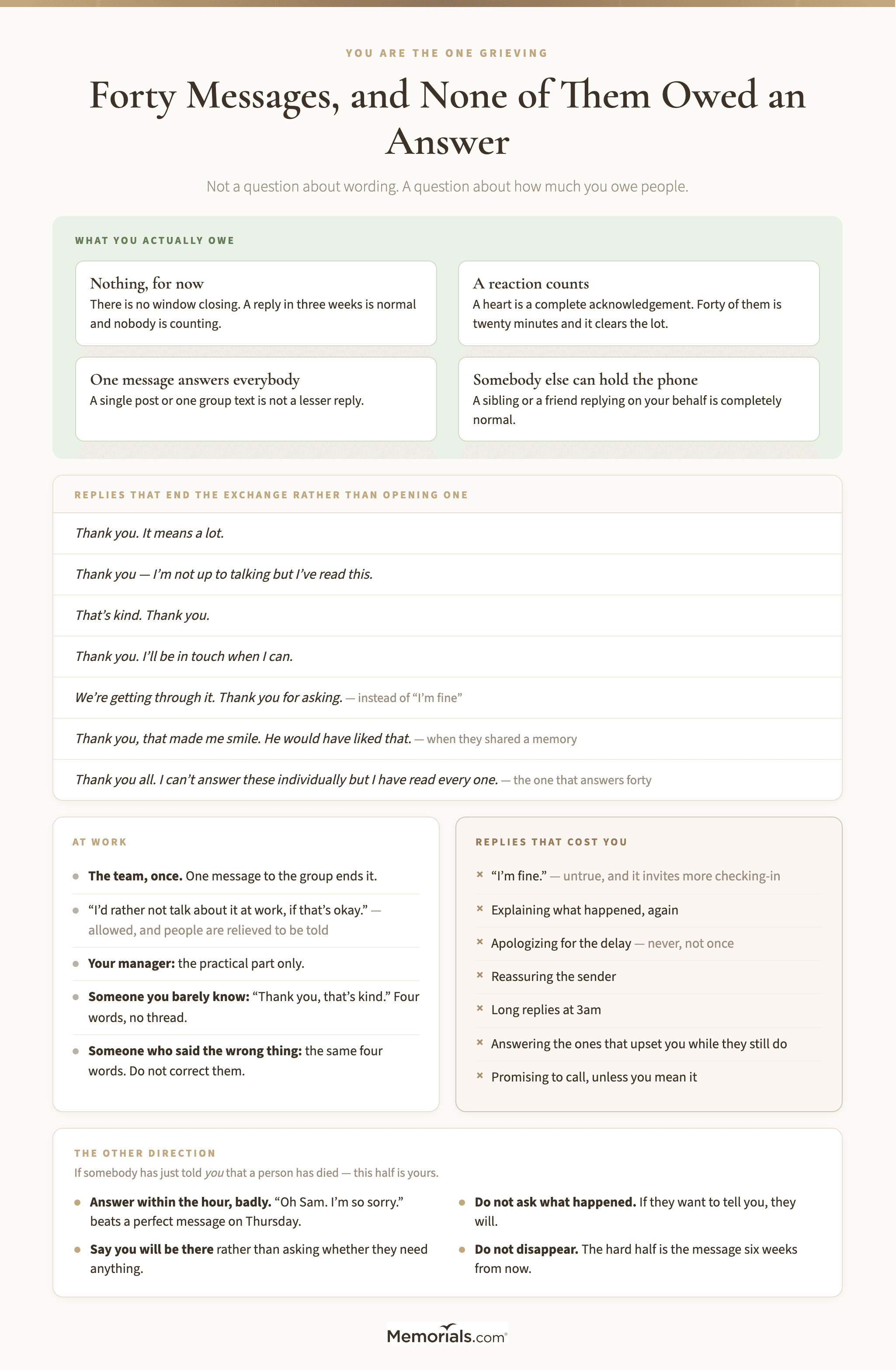
Working out how to respond to condolences is not really a question about wording. It is a question about how much you owe people, and the answer is: much less than you think. Nobody is owed a reply. Nothing has to be answered today. A reaction is a reply. Everything below is for the messages you do want to answer.
A reaction counts. A heart on a message is a complete acknowledgement and everyone understands it that way. Forty hearts is twenty minutes of work and it clears the whole thing. Which emoji to use covers what each one signals if you would rather not think about it.
One message can answer everybody. A single post, or one text to a group, is not a lesser reply. Thank you all. I can't answer these individually but I have read every one.
Somebody else can hold the phone. A sibling, a friend, an adult child answering on your behalf is completely normal and worth asking for. This is Ana's sister — she's seen your message and she's grateful.
And you can say the true thing.I can't do this yet is a reply. So is silence.
Nobody is owed a reply. A heart reaction is a complete acknowledgement, and forty of them is twenty minutes.
Keepsakes for What the Messages Leave Behind
Somewhere for the cards, and something for the shelf
The problem with most replies is that they open a conversation. These do not.
Thank you. It means a lot.
Thank you — I'm not up to talking but I've read this.
Thank you for thinking of us.
That's kind. Thank you.
Thank you. I'll be in touch when I can.
We're getting through it. Thank you for asking.
Thank you, that made me smile. He would have liked that.
Reuse the same one. You do not have to write forty different sentences. Nobody compares notes.
Add the exit if you need it.No need to reply to this works in your direction too, and it stops a thread you cannot maintain.
And if they said something specific about the person who died, that is the one worth two extra words. Thank you — I didn't know that story. The people who bother to share a memory notice when it lands.
When They Told You the News
The other half of this question is the reverse: somebody has texted Mom died last night and you are staring at it.
People arrive at this page from both sides and in a dozen phrasings — how to respond to a death text, how to respond to death text, how to respond to a death message, how to respond to news of death, how to respond to sad news of death, how to respond to someone's death — and if you are the one who has just been told, this section is your half.
Answer within the hour if you can, badly. Working out how to respond to death news is mostly about speed over polish. Oh Sam. I'm so sorry. is enough, and it beats a perfect message that arrives on Thursday.
Do not ask what happened. How to respond when someone tells you someone died starts with not making them narrate it. If they want to tell you, they will.
Say you will be there rather than asking if they need anything.I'm coming over Saturday unless you tell me not to.
And do not disappear afterward. Knowing how to respond when someone dies is the easy half; the hard half is the message in six weeks. The same goes for how to respond to a death in the family when it is your own extended family and everybody is texting everybody.
If you are on this side of it, sending condolences by text is the page for you, and it covers what to send when you hear, what not to, and when. Comforting someone over text covers the live conversation if it turns into one.
A reaction is a reply. One message can answer forty. And the replies that work are the ones that close the exchange rather than opening it.
At Work
Replies to colleagues are their own problem, because you will see these people again and the register is harder.
To the whole team, once. A single message to the group ends it. Thank you all for the messages — I've read them and they helped. I'm back on the 14th and I'd rather not talk about it at work, if that's okay.
That last clause is allowed. Saying what you want is the most useful thing you can do, and people are relieved to be told.
To your manager, answer the practical part only. Thank you. I'll know more after Thursday about coming back. Nothing else is required of you.
How to respond to condolences from coworkers you barely know is the easiest case: Thank you, that's kind. Four words, no thread.
And to the person who says the wrong thing — and someone will — you owe them nothing more than the same four words. Do not correct them, do not educate them, and do not carry it. Grief at work covers the return in more depth.
"I'd rather not talk about it at work, if that's okay." Saying what you want is the most useful thing you can do.
Answering Everybody at Once
If the volume is genuinely unmanageable, one message is the right answer and it is not a cop-out.
A post, if the news was public.Thank you for the messages, cards and flowers. There are too many to answer and I have read every one. It has helped more than I can say.
A group text, for the wider family or a team. Same words, smaller room.
An out-of-office, if the messages are arriving at work. Say when you are back and who to contact.
Name what you cannot do.I'm not up to phone calls yet saves you twenty conversations and nobody minds being told.
And say what would help, if anything would. People are desperate to be useful and completely stuck for what to offer. If you want to do something, we could use meals in about three weeks when everyone has gone home is a gift to them.
Replying Later, and to the Written Ones
Cards, letters and the messages you never got to are a separate problem with a longer fuse.
Keep them in one place, unopened if you need to. They are also the list you will write from.
Keep the cards in one place as they arrive, unopened if you cannot read them. You will want them later, and they are also the list you will write from.
Do not attempt the backlog in one sitting. Five a day, or five a week.
Skip the ones that do not need it. A colleague's two-line email does not require a written reply.
And accept that some will go unanswered. They will. This is normal, nobody is keeping score, and the people who sent them are not waiting.
These are different from the messages, and they are the ones worth answering properly.
The person who brought food, drove somebody, sat with you, or answered the door. Two sentences, and name what they did. Thank you for Tuesday. I don't think we'd have got through the day without you there.
Food is most of that list in most households — the grief groceries that turn up unasked, milk and bread and coffee more than casseroles. Naming the specific thing that arrived is enough of a thank-you for any of it.
The person who did something you did not see. Somebody called the utility company, somebody printed the order of service, somebody kept the children occupied. Ask whoever was organizing, because you will not know.
Anyone who traveled. Distance is effort and it is easy to overlook when forty people were in one room.
The professionals. The hospice nurse, the ward, the funeral director. A note weeks later means a great deal to people who are thanked far less often than they deserve, and it is the one families most often mean to write and never do.
These can wait, and they are better late than rushed. This is also where the written thank-you note belongs rather than a text.
When Somebody Does Not Know
A specific and horrible category: the message that arrives from someone who has not heard.
A normal text about something ordinary. A question about the weekend, an invoice, a group chat carrying on. You do not have to answer it, and you do not have to be the one who tells them.
When you do tell them, keep it to a line.I should say — Dad died on the 3rd. I'm not really up to messages but thank you. Then let their reply sit as long as you need.
Somebody else can do this too. Ask a sibling or a friend to work through the list of people who need telling.
And the automated ones are not your problem. Subscription renewals, birthday reminders, appointment texts. Nobody is on the other end.
The Replies to Avoid
Not because they are rude — because they cost you.
"I'm fine." It is not true and it invites more checking-in. We're getting through it does the same job honestly.
Explaining what happened, again. You are allowed to write thank you and nothing else. How to reply for death message purposes, that is a complete sentence.
Apologizing for the delay. Never. Not once.
Reassuring them. You do not have to make the sender feel better about having brought it up.
Long replies at 3am. They will still be there at nine, and so will you.
Answering the ones that upset you while they still upset you. Leave those.
Promising to call. Only say it if you mean it, because a promise you do not keep becomes another thing on your list.
If You Cannot Face Any of It
Sometimes the phone is genuinely unbearable, and that is worth taking seriously rather than pushing through.
Turn off notifications for a week. Not the phone — the badges and the buzzing. The messages will keep.
Hand it to somebody. Ask one person to read everything and tell you if there is anything you actually need to see.
Archive rather than delete. You may want them in a year, and people do.
And know what is ordinary here. Not being able to open a message is a completely standard part of early grief, and so is crying at a text about a casserole. Physical symptoms of grief covers what it does to a body, and the first week after a loss covers what actually has to be done in the days when everything feels compulsory.
If the messages keep coming and you want something to do with the ones that meant most, the keepsake gifts range includes small boxes that end up holding exactly this — the cards, the order of service, the two texts somebody printed out.
Frequently Asked Questions
Do I have to reply to condolence messages? No. Not to any of them, and not on any timetable. A heart reaction is a complete acknowledgement, and one message can answer everybody.
What do I say when someone says sorry for your loss?Thank you. It means a lot. Four words end the exchange without ending the relationship.
How do I respond to a death text if I am the one who has been told? Fast rather than well. Oh Sam, I'm so sorry. Do not ask what happened, and do not vanish afterward.
Is it rude to reply to everybody with the same message? No, and nobody compares. Reuse one sentence, or post once and let it cover the lot.
How long do I have to reply? There is no window. Three weeks is normal, and so is never.
What about the formal thank-you notes? Different job, done later. Cards for flowers, donations and the people who did something practical, written a few at a time over the following weeks.
Someone said something awful. Do I have to answer? No. And if you do, four polite words are the whole obligation. Do not correct them.
In Closing
Send hearts. Reuse one sentence. Post once and let it cover forty people.
The messages are evidence that somebody was loved, and they will still be evidence in a month, when you might actually want to read them.