🏬Supersize Online Funeral Retailer🪦1000's of Headstones⚱️Over 10,000 Cremation Urns⚰️Caskets Overnight Delivery🛒Funeral & Memorial Superstore🚚FREE Shipping on ALL Orders👨👩👧👦Helping Families for over 20 Years💰Lowest Price Guarantee🏬Supersize Online Funeral Retailer🪦1000's of Headstones⚱️Over 10,000 Cremation Urns⚰️Caskets Overnight Delivery🛒Funeral & Memorial Superstore🚚FREE Shipping on ALL Orders👨👩👧👦Helping Families for over 20 Years💰Lowest Price Guarantee
🏬Supersize Online Funeral Retailer🪦1000's of Headstones⚱️Over 10,000 Cremation Urns⚰️Caskets Overnight Delivery🛒Funeral & Memorial Superstore🚚FREE Shipping on ALL Orders👨👩👧👦Helping Families for over 20 Years💰Lowest Price Guarantee🏬Supersize Online Funeral Retailer🪦1000's of Headstones⚱️Over 10,000 Cremation Urns⚰️Caskets Overnight Delivery🛒Funeral & Memorial Superstore🚚FREE Shipping on ALL Orders👨👩👧👦Helping Families for over 20 Years💰Lowest Price Guarantee
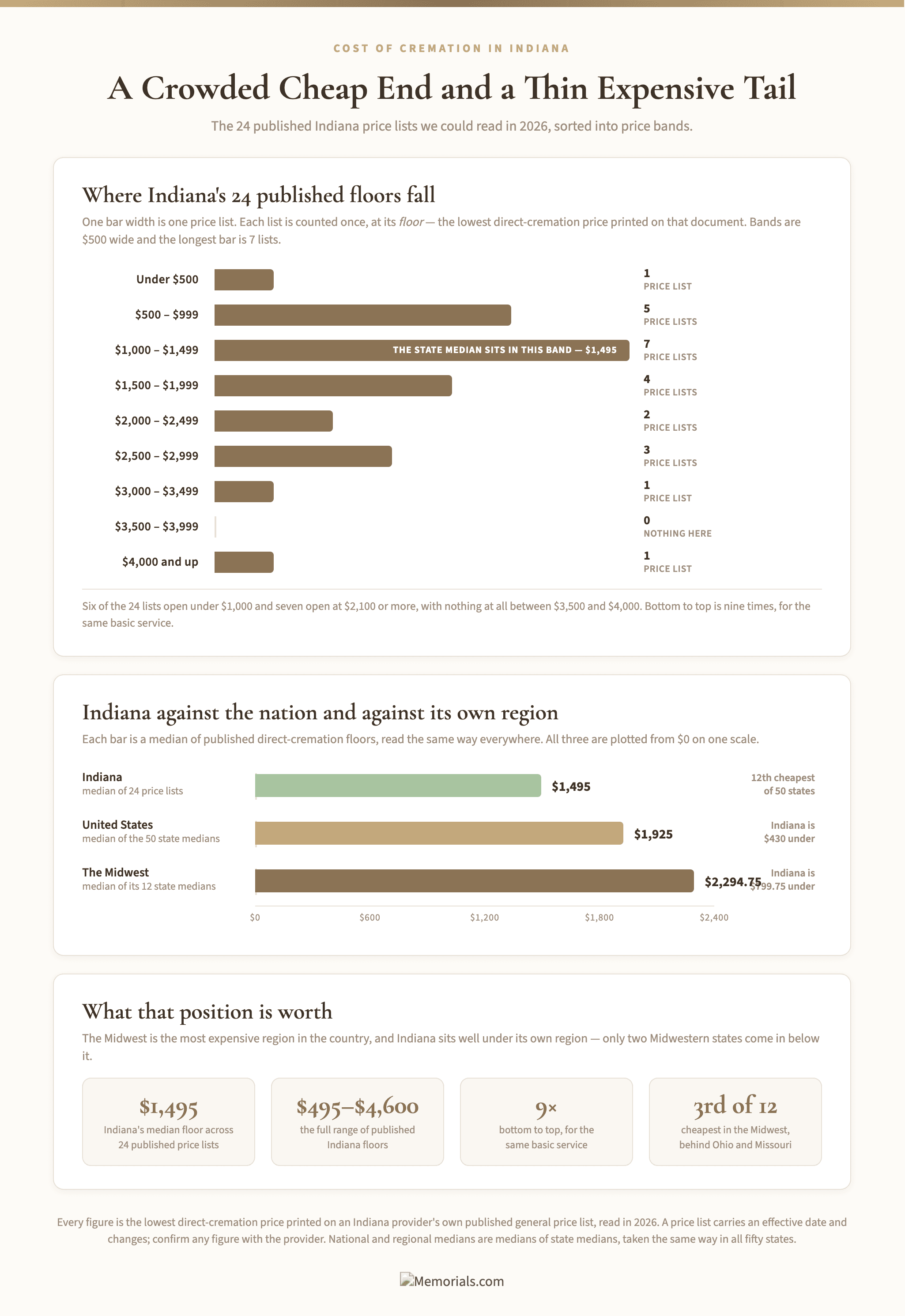
The average cost of cremation in Indiana is better answered with a median than with an average: $1,495, taken from 24 published Indiana price lists read in 2026, recording the lowest direct-cremation figure printed on each one. The floors run from $495 to $4,600.
That makes Indiana the 12th cheapest of the fifty states, $430 below the national median of $1,925, and the third cheapest of the twelve Midwestern states against a regional median of $2,294.75. The Midwest is the most expensive region in the country, and Indiana sits $799.75 under its own region; only Ohio at $1,195 and Missouri at $1,350 come in below it. Our guide sets all fifty side by side with the evidence behind each.
The nine-fold span matters more than the median does. Indiana's cheapest published floor and its highest sit about forty miles apart on the same road, so geography is not what separates them. The kind of business you call is. Cremation costs Indiana families see advertised are package prices, and the useful question is never "how much" on its own but "how much, covering what".
What Cremation Costs in Indiana
Across 24 published Indiana price lists, direct cremation starts between $495 and $4,600, with a median of $1,495.
Every figure on this page is a floor: the lowest direct-cremation price on that provider's own document. Eight of the 24 open under $1,200, nine sit between $1,200 and $2,000, and seven open at $2,100 or more — a crowded cheap end, a full middle and a thin expensive tail.
Federal law makes every Indiana funeral home hand you an itemized general price list and quote prices over the telephone, but nothing requires them to publish one on the web. A firm absent from this page is one whose figure we could not read, which is a fact about our lookup rather than about the business.
Coverage is thinnest outside the largest metro areas. For much of the state we could read only one or two published price lists, so call the providers near you before you treat this page as your whole market.
Indiana's 24 published price lists, counted by price band. Six open under $1,000 and seven at $2,100 or more, and the median of $1,495 sits $430 under the national median and $799.75 under the Midwest's — the most expensive region in the country.
Companion and Art Urns, Chosen at Home
Only three of Indiana's 25 price lists include even a temporary urn
Two kinds of business account for most of the gap, and working out which one you are calling is worth more than any price comparison.
A cremation-only provider sells one thing. It owns or contracts a retort, takes arrangements by telephone or online, and keeps no chapel and no viewing rooms — often an office suite rather than a building a family would ever visit. These firms set the Indiana floor and hold almost the whole cheap end of the range.
A full funeral home carries a building. A chapel, viewing rooms, refrigeration, staffed hours, a fleet and a director on call, all paid for whether or not your family uses them — and direct cremation is one line on a long price list, sitting beside the visitations, services and burials the building exists for. The seven highest floors in the state all belong to full-service funeral homes, and they open at $2,100 or more.
The cheaper firm is not undercutting anyone; it is selling you less. A funeral home spreads those real overheads across everything it sells, direct cremation included. A cremation-only provider has almost none of them to spread, so its floor is lower for a structural reason rather than a promotional one, and a low price here is not evidence of a corner cut.
What the cheap option cannot do is the part that decides it. A cremation-only provider generally cannot host a viewing, cannot hold a service with your loved one present, and cannot become a burial if the family changes its mind. So decide first whether the family will want time with your loved one beforehand. That one answer settles which half of the price range you are shopping in. A middle does exist: some cremation-only providers sell a short private gathering as an add-on — an hour, a small group, a better container — for a modest step up from their direct-cremation price.
We found no separate Indiana license category for a cremation-only provider, so the label on the door tells you nothing. Ask instead whether they own the crematory, and whether they have a building where your family could gather. One caveat at the bottom of the range: Indiana's cheapest published line carries no effective date and no statement of what it covers, so read it as a headline rather than a confirmed itemized figure. Whatever explains the price of a cremation in Indiana, it is not where in Indiana you die.
And the printed ceiling is a box, not a service
Some Indiana lists print a high at more than twice their low, and that span says nothing about service quality. The federal Funeral Rule makes a provider's direct-cremation entry cover every container they stock, from a cardboard alternative to a casket, so the top of a printed range is a casket price with a cremation attached. Only the box changes as the number climbs — which is why this page publishes the range of floors and never the span up to the most expensive ceiling.
What Is Included, and What Is Not
Indiana's price lists describe their own coverage in wholly different ways, which is why comparing two headline figures without the itemized list tells you very little. So ask any Indiana provider the same six things, and ask which of them are already inside the figure they just quoted: the cremation fee, the container, refrigeration during the 48-hour wait, the transfer and its mileage radius, county paperwork and certified death certificates, and a temporary urn. The best documents in the state answer all six on the page.
Refrigeration is the Indiana line to ask about, because state law creates it. Indiana requires a 48-hour wait before any cremation, so your loved one is cared for somewhere for two days and somebody bills for it. Where it is charged separately, Indiana lists put it in the region of $60 to $150 a day, and they do not all start the clock in the same place — some from the first hour, some only after 24 or 72 hours.
The container is the other one. Indiana requires a container and forbids requiring a casket, so the cardboard box is unavoidable and the casket is not; where it is billed on top it runs around $100 to $175. Many of the cheapest floors assume the family supplies one.
Other charges sit outside an Indiana headline price: mileage past a transfer radius, roughly $3.00 to $3.50 a mile; a higher fee for a removal from a home rather than a hospital; an insurance processing percentage; witnessing the cremation; shipping ashes; and on some lists a weekend, holiday or short-notice surcharge. Certified death certificates are extra almost everywhere; read how many death certificates you need before ordering a stack.
The crematory fee that can sit outside the price
This is the single most useful thing to check on an Indiana price list, because the same three words describe two different products. Some documents exclude the crematory charge from the direct-cremation figure and itemize it further down, so a family pays it on top of the headline. Others never say either way. Where it is priced separately in Indiana it ran from about $200 to $495 — enough to reorder the cheap end of the range, and worth one telephone call to settle.
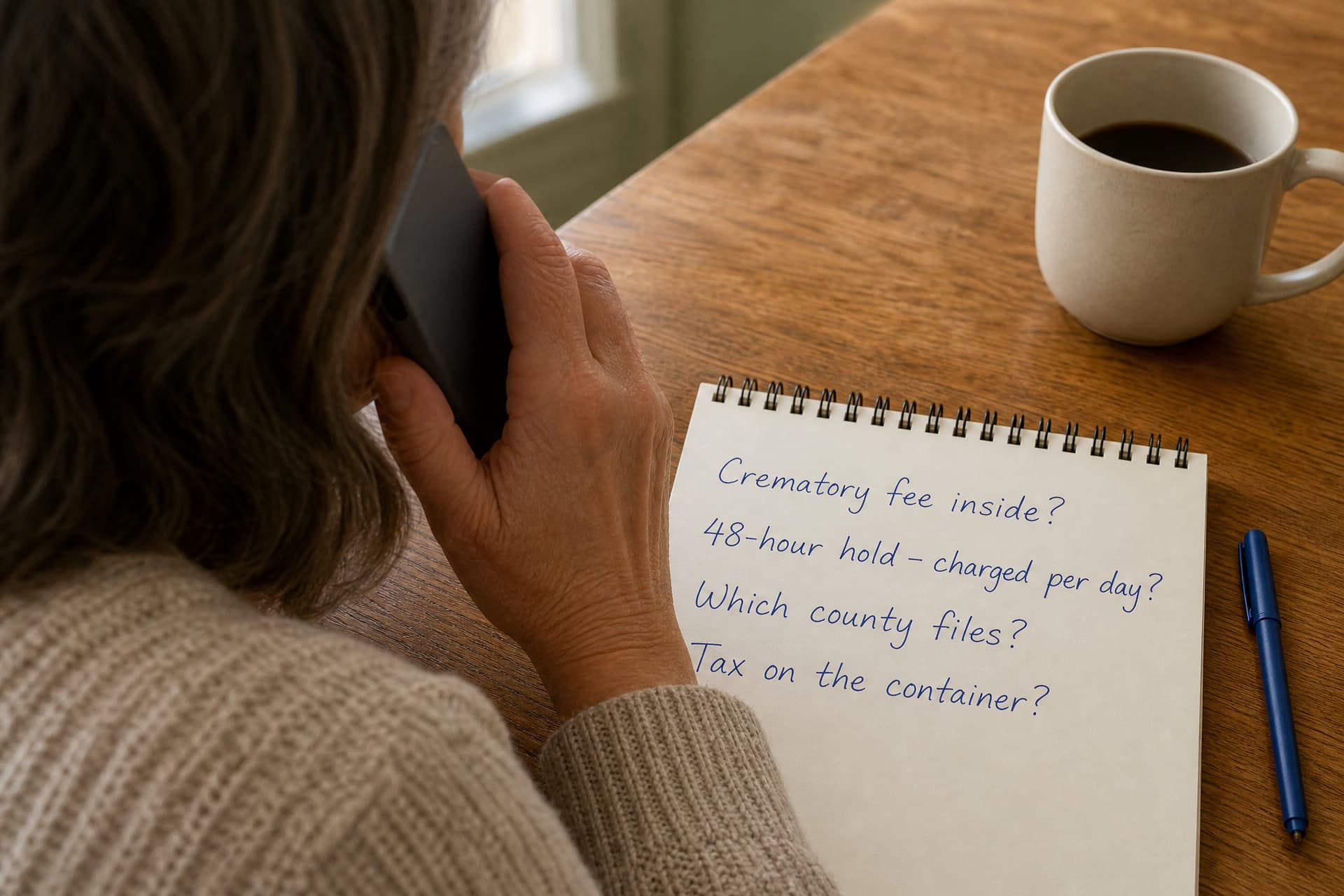
Four questions Indiana's price lists make necessary, and all four are answered on the first call. Some documents say plainly that the cremation fee is inside the price and some never mention it; refrigeration during the 48-hour statutory wait may be billed by the day; paperwork charges change with which county files; and some lists tax the container while leaving the services beside it untaxed.
What the state and the county charge on top
We could not find an Indiana statute setting a statewide coroner or cremation permit fee, and we will not print one. Indiana law routes the burial transit permit through the funeral director and leaves the money to county practice, which is why paperwork charges show up on price lists rather than in statute — and why some Indiana lists charge more when the filing crosses a county line. Ask what your county's paperwork costs and whether it is inside the quote. The question is real; the number is not ours to give.
One more small Indiana charge no other state page in this guide carries: sales tax. Some documents treat the container as taxable merchandise while the services beside it are not. It is a few dollars on a cardboard box and real money on a casket or an urn bought from the funeral home.
Indiana Cremation Laws That Affect Cost
The 48-hour wait, and what it costs
Indiana is one of the few states with a statutory waiting period, and it is a cost line as much as a delay. Under IC 23-14-31-36(a), remains "shall not be cremated less than forty-eight (48) hours after the time of death as indicated on the medical certificate of death or the coroner's certificate," unless waived in writing by the city or county health officer where the death occurred.
Some Indiana funeral homes build that mandated hold into their direct-cremation price and say so on the page; where a list leaves refrigeration out, two days of it are billed on top. Ask which of the two you are being quoted. Our guide to how long the cremation process takes covers the rest of the timeline.
A container is required; a casket never is
IC 23-14-31-35 says a crematory authority "shall not require that human remains be placed in a casket before cremation or that human remains be cremated in a casket," and in the same section that it may not accept remains unless they arrive "in a casket or an alternative container." It may not refuse unembalmed remains either. A required casket is not the rule in Indiana, and the federal Funeral Rule makes saying otherwise a deceptive act.
Who signs, and who is liable
IC 23-14-31-26 sets a priority ladder of authorizing agents: a person named in a funeral planning declaration or on a servicemember's DD Form 93, then an agent under a power of attorney or a health care representative, then the surviving spouse, then the further relatives the section lists.
The part worth reading twice is IC 23-14-31-29: the agent who signs "is personally liable for damages resulting from authorizing the cremation" and "is responsible for the final disposition." No director proceeds without that signature, and a delay in finding the right person is the most reliable way to add days of storage to a bill. Settle who will sign before you need to, if you can.
Permits, and why they travel with the funeral director
Under IC 23-14-31-27(a) a crematory may not begin until it holds the signed cremation authorization, a burial transit permit issued by the local health officer to the funeral director, and either a completed death certificate or a coroner's release. Because the permit goes to the director, Indiana families almost always go through one, and county paperwork charges arrive on the funeral home's bill.
We could not establish whether Indiana law requires a licensed funeral director at all — the statutes imply one is in the chain, but no section we found says so — so treat any home-funeral claim about Indiana as unverified until your county registrar confirms it.
Scattering, and the 30- and 60-day clocks
IC 23-14-31-44(a) is unusually permissive. Ashes may be kept, placed in a grave, niche or crypt, scattered in a scattering area, or "disposed of in any manner" provided they are reduced to one-eighth-inch particles and the disposal happens on a consenting owner's property, on uninhabited public land, or on a waterway. The particle size is the crematory's job; the condition you have to satisfy is permission. Our guide to scattering ashes laws and etiquette covers the manners of it.
There are two clocks on the other end: under IC 23-14-31-45 a crematory returns unclaimed ashes to the funeral director within 30 days, and the director may hold them for 60 days from the cremation before disposing of them lawfully after notice by certified mail.
How to Lower the Cost in Indiana
Ask for the all-in number, and ask specifically whether the crematory fee is in it. On this state's evidence a headline can exclude both the crematory charge and the vehicle that carries your loved one to it, with each itemized further down the same page.
Ask what a price does not say. Indiana's cheapest published line states no inclusions at all. A list with a full page of exclusions tells you more than a lower number with a silent one.
Say where the death will happen. Removal from a home costs more than removal from a hospital on many Indiana lists, transfer is priced within a mileage radius with a per-mile charge beyond it, and paperwork can cost more across a county line. On home hospice this is not hypothetical.
Ask what the same services would cost unbundled at that firm. Bought separately they come to considerably more than the package. The package discount is the product.
Check the date, and check the firm's other pages. More than one Indiana provider publishes two different direct-cremation prices on its own website. Print the page your quote came from.
Distrust directories, including the ones outranking this page. A funeral directory is a comparison site that publishes prices for funeral homes it does not run. Every Indiana provider we checked in September 2026 was listed wrong, by hundreds of dollars in both directions. Those listings are also where the city-level headline prices come from — the ones that greet anyone looking up the cost of cremation Indiana providers actually charge. Work from the provider's own price list instead.
And ask about township assistance, which is an Indiana answer. At least one Indiana price list names the township trustee, beside Medicaid, as a route that may cover a direct-cremation package for a family that qualifies. Townships set their own amounts and we verified none of them, but the trustee's office is a local telephone call worth making.
Indiana's townships still administer their own assistance, and at least one price list in the state names the township trustee beside Medicaid as a route that may cover a direct-cremation package. The amounts are set township by township; we verified none of them, and the office is a local call.
And plan ahead if you can. Arranging in advance means comparing Indiana providers calmly, with nobody grieving in the room. Cost of cremation vs burial sets the two side by side, how much a funeral costs covers the full-service figure, and direct cremation explains what happens and in what order.
Choosing an Urn
A temporary urn is sometimes inside the Indiana price and sometimes not, so ask — the answer decides how your loved one comes home. The permanent urn is a separate decision either way: made later, at home, with no funeral director in the room and no obligation to buy it from the firm that did the cremation. It is the one part of this whole process where you have time.
How much does cremation cost in Indiana? Direct cremation starts between $495 and $4,600, median $1,495, across the 24 Indiana price lists we read in 2026 — the 12th cheapest state of fifty.
What is the average cost of cremation in Indiana? We publish the median rather than the mean, because a handful of $2,500-and-up funeral homes pull an average upward and describe nobody. Distrust any average that came from a directory rather than from published prices.
How much is cremation in Indiana if I want nothing else at all? That is what direct cremation is, and it is the figure on this page. Add a viewing or a service and you are buying from a different kind of business.
What is the real cost of cremation in Indiana once everything is added? Add whatever sits outside the quote: the container, refrigeration for the 48-hour wait where it is billed by the day, county paperwork, certified death certificates, sales tax on merchandise, and mileage past the transfer radius. Where the crematory fee sits outside the headline, that line alone ran from $200 to $495 in Indiana.
Is there a waiting period before cremation in Indiana? Yes. IC 23-14-31-36(a) forbids cremation less than 48 hours after the time of death, unless the city or county health officer where the death occurred waives it in writing. It is why refrigeration matters here.
Does Indiana require a casket for cremation? No. IC 23-14-31-35 forbids a crematory from requiring one. Remains must arrive in a casket or an alternative container, so a container of some kind is unavoidable — usually cardboard, around $100 to $175 where it is itemized.
What is the Indiana cremation permit fee? We could not find a statewide figure in statute and will not invent one. Indiana routes the burial transit permit through the funeral director and leaves the charging to county practice. Ask your provider what your county costs and whether it is in the quote.
Can I scatter ashes in Indiana? IC 23-14-31-44(a) allows disposal "in any manner" where the ashes are reduced to one-eighth-inch particles and the scattering happens on a consenting owner's property, on uninhabited public land, or on a waterway. What you need in practice is permission from whoever owns the ground or the water.
In Short
Indiana is cheap for its region — $1,495 against a Midwestern median of $2,294.75, cheaper than Michigan at $1,635, Illinois at $1,702.50 and Kentucky at $1,540, and a long way under Wisconsin at $3,162.50. The risk here is not the price level; it is knowing what you are buying, in a state where the span runs nine times over between two towns forty miles apart and no two documents describe their coverage the same way.
So do four things. Decide first whether the family will want time with your loved one beforehand, because that settles whether you want a cremation-only provider or a funeral home that can hold a service. Then ask whether the crematory fee is inside the quote, ask what a 48-hour hold costs on that list, and print the page your price came from. Then compare: Tennessee, cheapest of the fifty at $1,170, shows how far a competitive cremation market can push the number.