🏬Supersize Online Funeral Retailer🪦1000's of Headstones⚱️Over 10,000 Cremation Urns⚰️Caskets Overnight Delivery🛒Funeral & Memorial Superstore🚚FREE Shipping on ALL Orders👨👩👧👦Helping Families for over 20 Years💰Lowest Price Guarantee🏬Supersize Online Funeral Retailer🪦1000's of Headstones⚱️Over 10,000 Cremation Urns⚰️Caskets Overnight Delivery🛒Funeral & Memorial Superstore🚚FREE Shipping on ALL Orders👨👩👧👦Helping Families for over 20 Years💰Lowest Price Guarantee
🏬Supersize Online Funeral Retailer🪦1000's of Headstones⚱️Over 10,000 Cremation Urns⚰️Caskets Overnight Delivery🛒Funeral & Memorial Superstore🚚FREE Shipping on ALL Orders👨👩👧👦Helping Families for over 20 Years💰Lowest Price Guarantee🏬Supersize Online Funeral Retailer🪦1000's of Headstones⚱️Over 10,000 Cremation Urns⚰️Caskets Overnight Delivery🛒Funeral & Memorial Superstore🚚FREE Shipping on ALL Orders👨👩👧👦Helping Families for over 20 Years💰Lowest Price Guarantee
Dealing with an Amazon deceased customer account is two jobs that people routinely mistake for one: canceling the subscription, which stops the money, and closing the account, which ends everything else. Doing the first and assuming it did the second is the common outcome, and it leaves an account live for years.
There is also a third thing families want and cannot have, which is worth knowing before you start: the account itself does not transfer to anybody.
Amazon Prime after death keeps renewing, because a subscription does not know anything has changed. It is an annual charge against a card that is probably about to be closed, at which point it fails and starts generating notices.
If you can log in, cancel Prime from the account's own membership settings. It takes a minute and it is the single most useful thing to do first.
A partial refund is often due. Where the membership was paid annually and barely used since renewal, Amazon will usually refund a prorated amount to the estate on request. Nobody offers this — ask.
If you cannot log in, the request to cancel Amazon Prime for deceased person accounts goes through customer service, and this is where the certified death certificate comes in. Whether you can log in at all usually turns on the handset, because the verification code goes there — what happens to someone's phone when they die decides how much of the rest of this you can do from a settings page instead of a queue.
Check for the other subscriptions underneath it. An Amazon account commonly carries several separate recurring charges that survive Prime being canceled: Audible, Kindle Unlimited, Music Unlimited, channel subscriptions bought through Prime Video, and Subscribe & Save deliveries. Each is its own line and each keeps billing. The Subscribe & Save ones are the surprise — households have continued receiving quarterly deliveries of coffee and cat litter to an empty house for a year.
Subscribe & Save keeps delivering. Families find quarterly boxes arriving at an empty house a year later.
Closing the Account
How to close an Amazon account when someone dies is a customer service process rather than a setting, and the request is straightforward once you reach the right team.
What you need. A certified copy of the death certificate, your own photo ID, and evidence of your authority — letters testamentary, a small estate affidavit, or proof you are the next of kin. This is one of the copies from the stack in how many death certificates you need.
How to reach them. There is no published direct number, and searches for an Amazon bereavement team contact number will not produce one that survives long. Amazon routes this through general customer service, so open a chat or a callback from the help pages and ask specifically for the account specialist team that handles a deceased customer. Say the words; the first-line agent cannot do it and will transfer you. Banks are better organized about this than Amazon is — Bank of America estate services is a named department with a published number and a document checklist, and most large institutions have an equivalent.
Expect to be asked twice. These requests move between teams and documentation sometimes has to be resubmitted. Keep a note of case numbers.
Closure is permanent and total. Order history, reviews, wish lists, photos in Amazon Photos, and any digital content all go. Which is why the next section matters more than this one.
How to close an Amazon account for a deceased person is the same request whether you say it that way or ask how to cancel an Amazon account for a deceased person — one process, and the distinction that matters is only ever subscription versus account.
What Happens to the Kindle Books and the Films
The part families find hardest to accept, and it is worth being plain about.
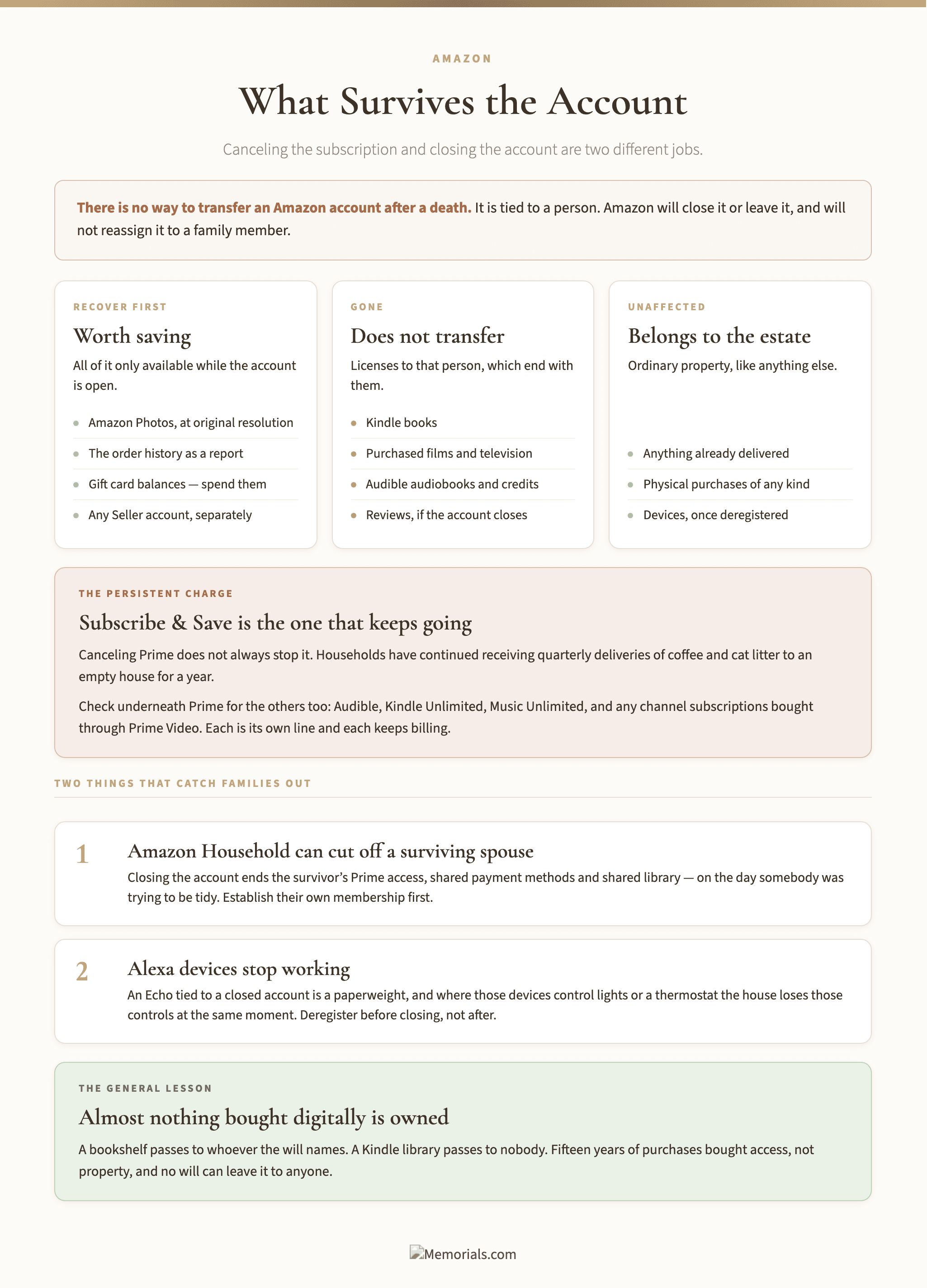
Digital purchases do not transfer. Kindle books, purchased films and television, and Audible audiobooks are licenses to that person. They end with them. A library of six hundred books represents real money and it cannot be passed to a spouse or a child by any mechanism Amazon offers.
There is no transfer Amazon account after death process. People search for one constantly. It does not exist — Amazon will close an account or leave it, and will not reassign it to a family member. The account is tied to an identity.
Which leaves one practical option, and it is a gray one. Families frequently keep the account open, keep a valid card on it, and carry on using the library. It works, it is what a great many people do, and it is not what the terms of service permit. It is not our place to tell you otherwise; it is our place to say that it is a choice with a known character, and that it ends whenever Amazon notices or the card expires.
Photos are the exception worth acting on. Amazon Photos holds original-resolution images and it is included with Prime. If the person used it, download everything before the account closes — this is genuinely irreplaceable and it is the one thing on the account that is.
Physical purchases are unaffected. Anything already delivered belongs to the estate like any other possession.
Before You Close Anything
Four things to retrieve, in this order.
Amazon Photos, in full and at original resolution. Use the desktop downloader rather than saving images one at a time from a browser.
The order history. This sounds odd and it is one of the most useful documents an executor gets: a searchable record of purchases going back years, which surfaces subscriptions, warranties, business expenses, and occasionally an expensive item nobody knew existed. Download it as a report before the account goes. It is the same kind of search as looking for unclaimed money from deceased relatives: the value is rarely in what you expected to find, it is in the account nobody mentioned.
Gift card balances. These belong to the estate. Amazon will not usually refund them to cash but they can be spent, and closing the account without spending them forfeits the money.
Any business account. Where the person sold anything, an Amazon Seller account is a separate entity with its own balance, tax obligations and closure process. Do not treat it as part of the personal account — a seller balance is an estate asset, unsold inventory held in a fulfillment warehouse is estate property that continues to accrue storage fees, and there may be a final tax filing attached to it. This is the one part of an Amazon estate that occasionally needs an accountant rather than a phone call.
Six hundred Kindle books represent real money and transfer to nobody. The photographs are the part worth saving.
The photographs are recoverable. The library is not, and there is no mechanism that changes that.
The Household Question
Amazon Household lets two adults share Prime benefits and payment methods, and it is the reason a family sometimes loses more than they expected.
Closing the account can cut off a surviving spouse. Where the person who died was the primary account holder, the survivor's Prime access, shared payment methods and shared content library go with it. The delivery of a household's groceries can stop on the day somebody was trying to be tidy.
Deal with the Household before the account. The surviving adult should establish their own Prime membership first, and only then should the deceased person's account be closed.
Shared content does not survive the split regardless. Family Library sharing of books and apps ends with the account, which is another version of the licensing problem above.
Check for a shared Alexa household too, where smart home devices, routines and shopping lists may be tied to the account that is about to close. This is a growing problem and it can leave a house whose lights and thermostat answer to nobody.
Cancel the subscriptions underneath Prime separately. Subscribe & Save is the one that keeps going.
Alexa, and the Devices Around the House
Increasingly the account is not just a shopping account — it is the thing the house answers to, and closing it has physical consequences.
Smart speakers stop working. An Echo tied to a closed account becomes a paperweight until somebody re-registers it. Where those devices control lights, plugs or a thermostat, the house loses those controls at the same moment.
Reset the devices before closing the account, not after. Deregistering while the account is live is straightforward; doing it afterward means a factory reset and sometimes proof of purchase.
Voice recordings. Amazon retains voice history, and some families want it and some very much do not. It can be deleted from the account's privacy settings while the account is open, and it goes automatically on closure. If there is any chance a family member would want a recording of the person's voice, that is a decision to make deliberately rather than by default.
Ring doorbells and cameras are tied to the same account and follow the same pattern. Footage does not survive closure, and where a camera is still recording an empty house that is worth someone's attention.
Shopping lists and routines vanish. Trivial in itself, and occasionally the small thing that lands hardest — a grocery list in progress, a reminder set for a birthday that has passed.
Frequently Asked Questions
Can I just keep using their account? Practically yes, and many families do. It is against the terms of service, and it ends when the card expires or Amazon notices. Save the photographs regardless, because that is the part you cannot recover afterward.
Will Amazon tell me what they ordered recently? Only through the account itself. Download the order history while you can — customer service will not reconstruct it for you afterward. Then keep it with the estate's records on the same clock as how long to keep utility bills after death, which is three years past the final estate tax return.
There is a balance on their gift card. It belongs to the estate. Spend it before closure; it is not usually refundable in cash.
They had an Audible library. Same licensing rules as Kindle. It does not transfer. Any credits on the account are lost at closure, so spend them first if there is anything worth having.
Something is still being delivered. A Subscribe & Save schedule. Cancel it specifically — canceling Prime does not always stop it, and it is the single most persistent charge on an Amazon account.
Their reviews are still up under their name. Reviews stay unless the account is closed, and closure removes them. Some families find the reviews a small unexpected record of the person and keep the account dormant for that reason alone — it is as good a reason as any.
Can Amazon tell me if there are open orders? Only from inside the account. Anything already dispatched will arrive; anything not yet shipped can be canceled from the order page. Check before closing, because an in-flight order to an empty house is a nuisance nobody needs. Mail forwarding does not catch these: how to forward mail for a deceased person covers what the Postal Service carries, and a courier delivering for Amazon is not that.
I only want the deliveries to stop, not the account closed. Then cancel Prime and every subscription underneath it and leave the account dormant. There is no obligation to close anything, and a dormant account with no card attached costs nobody anything.
Physical purchases belong to the estate like any other possession. Only the digital ones evaporate.
What This Says About the Rest of It
Amazon is a small account in most estates and it teaches the general lesson better than the large ones do.
Almost nothing bought digitally is owned. Books, films, music, games, software — nearly all of it is a license that ends with the person, at Amazon and everywhere else. A family that has spent thousands over fifteen years has bought access, not property, and no will can leave it to anybody.
The exceptions are worth knowing. Files downloaded and stored somewhere the family can reach — a hard drive, a computer, a home server — are theirs. Content that stayed in a company's account is not.
Which is an argument, quietly, for the physical copy. A bookshelf passes to whoever the will says. A Kindle library does not pass to anybody. Neither does a photo library that only ever existed in a cloud account, which is why the Apple legacy contact page makes the same point about photographs.
And an argument for doing it now rather than later. Every one of these accounts has a setting, a download tool or a nominated-contact feature that works far better before it is needed than after. An hour spent on your own accounts is worth more than any amount of effort spent on somebody else's afterward. And where no setting exists, a procedure sometimes does — there is no memorial state for a shopping account, while how to memorialize an Instagram account is a documented request with a documented outcome.
In Closing
Cancel the subscriptions today, download the photographs and the order history this week, and close the account whenever you are ready — or leave it dormant, which is a perfectly good answer.
The books are gone either way, and there is no version of this where they are not. Better to know that now than to discover it after the account has already closed.