🏬Supersize Online Funeral Retailer🪦1000's of Headstones⚱️Over 10,000 Cremation Urns⚰️Caskets Overnight Delivery🛒Funeral & Memorial Superstore🚚FREE Shipping on ALL Orders👨👩👧👦Helping Families for over 20 Years💰Lowest Price Guarantee🏬Supersize Online Funeral Retailer🪦1000's of Headstones⚱️Over 10,000 Cremation Urns⚰️Caskets Overnight Delivery🛒Funeral & Memorial Superstore🚚FREE Shipping on ALL Orders👨👩👧👦Helping Families for over 20 Years💰Lowest Price Guarantee
🏬Supersize Online Funeral Retailer🪦1000's of Headstones⚱️Over 10,000 Cremation Urns⚰️Caskets Overnight Delivery🛒Funeral & Memorial Superstore🚚FREE Shipping on ALL Orders👨👩👧👦Helping Families for over 20 Years💰Lowest Price Guarantee🏬Supersize Online Funeral Retailer🪦1000's of Headstones⚱️Over 10,000 Cremation Urns⚰️Caskets Overnight Delivery🛒Funeral & Memorial Superstore🚚FREE Shipping on ALL Orders👨👩👧👦Helping Families for over 20 Years💰Lowest Price Guarantee
In the Pennsylvania Dutch country of southeastern Pennsylvania there was once a sideways way of saying that someone in the house was not going to recover. The line most often quoted is "there will be raisin pie soon". Funeral pie is a raisin pie, and it was so reliably present at the meal that followed an Amish or Old Order Mennonite funeral that its name became a euphemism for the death itself. That is a remarkable thing for a dessert to have done, and it is the reason the dish is still looked up by people who have never been anywhere near a plain-dress community.
The pie is not complicated and it was never meant to be. Dried raisins, sugar, flour, a little cinnamon, lemon, a double crust. What makes it worth a page is not the filling but the logic behind it, which is the logic of a community that has to feed several hundred people on two days' notice and does not consider that an imposition. Everything about funeral pie — the fruit, the timing, the fact that nobody signs it — follows from that.
Practice varies by settlement and by church district, and anyone who tells you the Amish do one thing is flattening several hundred separate communities into one sentence. What follows is what is commonly recorded rather than a universal rule: what the pie is, why raisins in particular, what else is on the table beside it, and what to do if you are the outsider who has been invited. It sits inside a much wider habit of feeding the bereaved, which our funeral traditions guide covers across a range of faiths and regions.
What Funeral Pie Is
Funeral pie is a double-crust raisin pie, sweet and dense, traditionally served at the community meal that follows a funeral in Old Order Amish and Old Order Mennonite settlements. It goes by other names in the same kitchens. Rosina pie and rosine pie both appear in old recipe collections, from Rosine, the German word for raisin — Pennsylvania Dutch is a German dialect, not Dutch at all, and a surprising amount of the vocabulary around this dish is really German with the corners worn off.
Amish funeral pie is the name that has traveled furthest, and it is the one most people arrive with. Within the communities themselves the dish is likelier to be called raisin pie, plainly, because naming it after funerals would be a kind of ceremony the food is deliberately avoiding.
The pie belongs to a specific moment: not the viewing, and not the service, but the meal afterward. In most American funeral customs that gap between the burial and going home is where the food lands, and it is worth being clear about the sequence — what happens at a wake and what happens at the meal after the burial are two different gatherings that outsiders often merge into one. In a plain community the meal after the service is the larger of the two by far, because the whole church district is there.
You will see the dish written both ways, funeral pie and funeral pies, and the plural is the more honest form. A meal for a whole district was never going to be one pie.
Why Raisins?
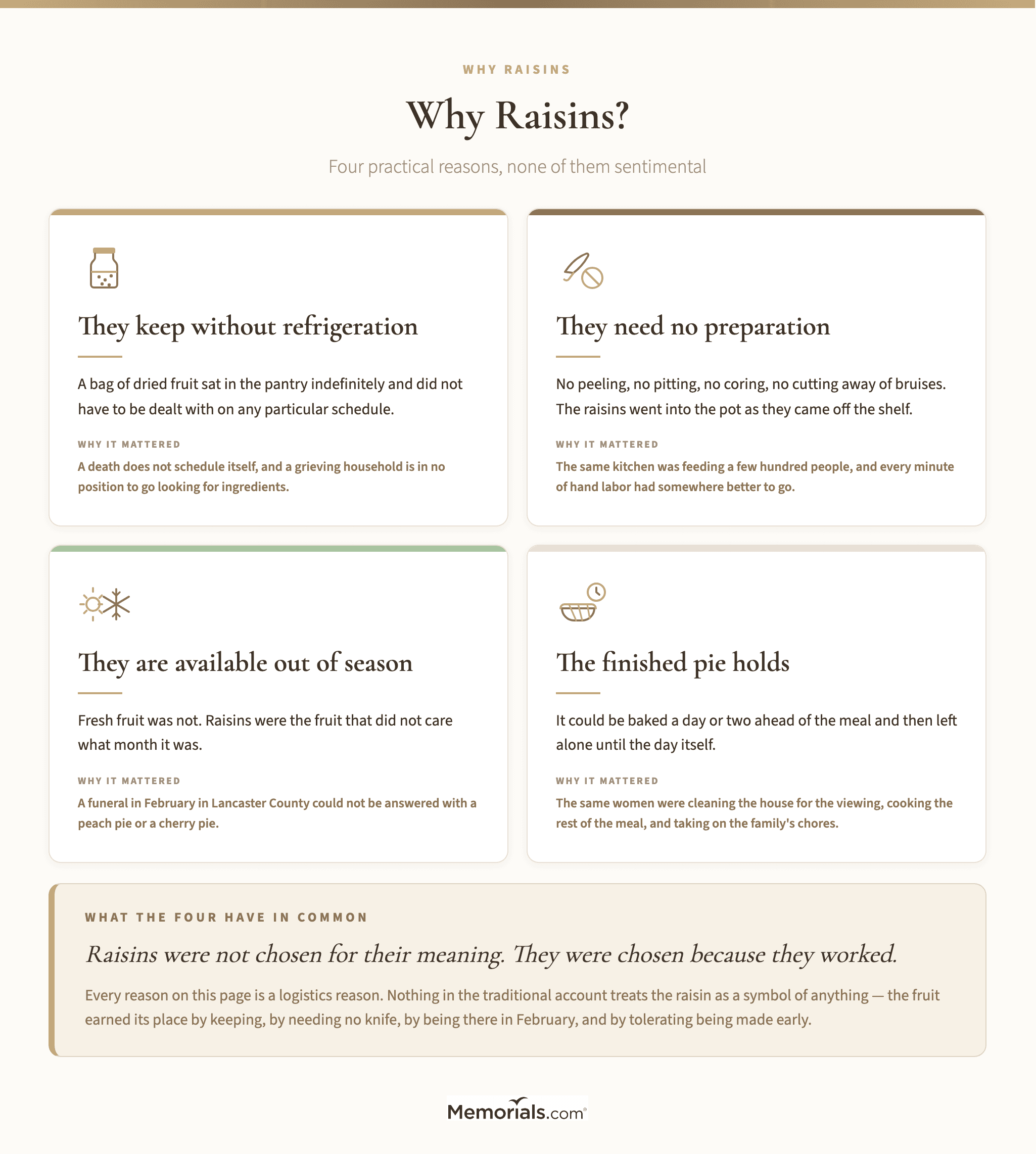
Raisins are the part everyone remembers and the part the ranking pages explain least specifically, so here is the practical case for them, which is the only case anyone was making at the time.
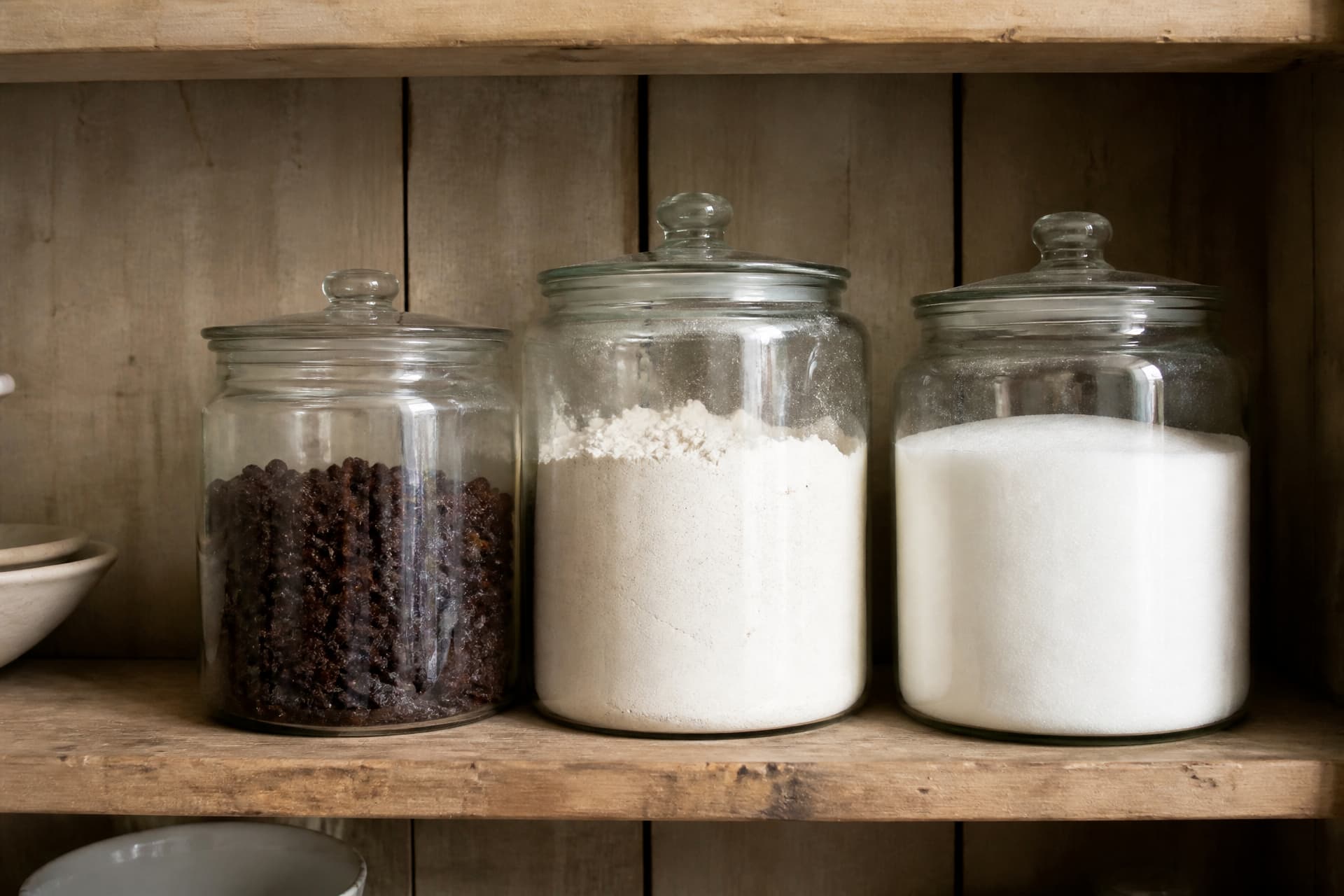
Raisins keep. Before household refrigeration, a bag of dried fruit sat in the pantry indefinitely and did not have to be dealt with on any particular schedule. A death does not schedule itself either, and a household that has just lost someone is not in a position to go looking for ingredients. The pie could be assembled from what was already on the shelf.
Raisins are also in season all year, which fresh fruit emphatically is not. A funeral in February in Lancaster County could not be answered with a peach pie or a cherry pie. Raisins were the fruit that did not care what month it was.
They need no preparation. No peeling, no pitting, no coring, no cutting away of bruises — a real consideration when the same kitchen is producing food for a couple of hundred people and every minute of hand labor has somewhere better to go.
And the finished pie holds. It could be baked a day or two ahead of the meal, which is the quiet detail that explains the whole custom. The women baking were also cleaning the house for the viewing, cooking the rest of the meal, and taking on the chores of a family that had stopped functioning. A dessert that could be made in advance and then left alone was worth more than a better dessert that could not.
Everything funeral pie needs was already on the shelf. That is the whole design — a dessert a grieving household could produce without sending anyone to town.
Four practical reasons, none of them sentimental. Raisins were not chosen for meaning; they were chosen because they were shelf-stable, ready to use, available in February, and forgiving of being made early.
What the Pie Is Made Of
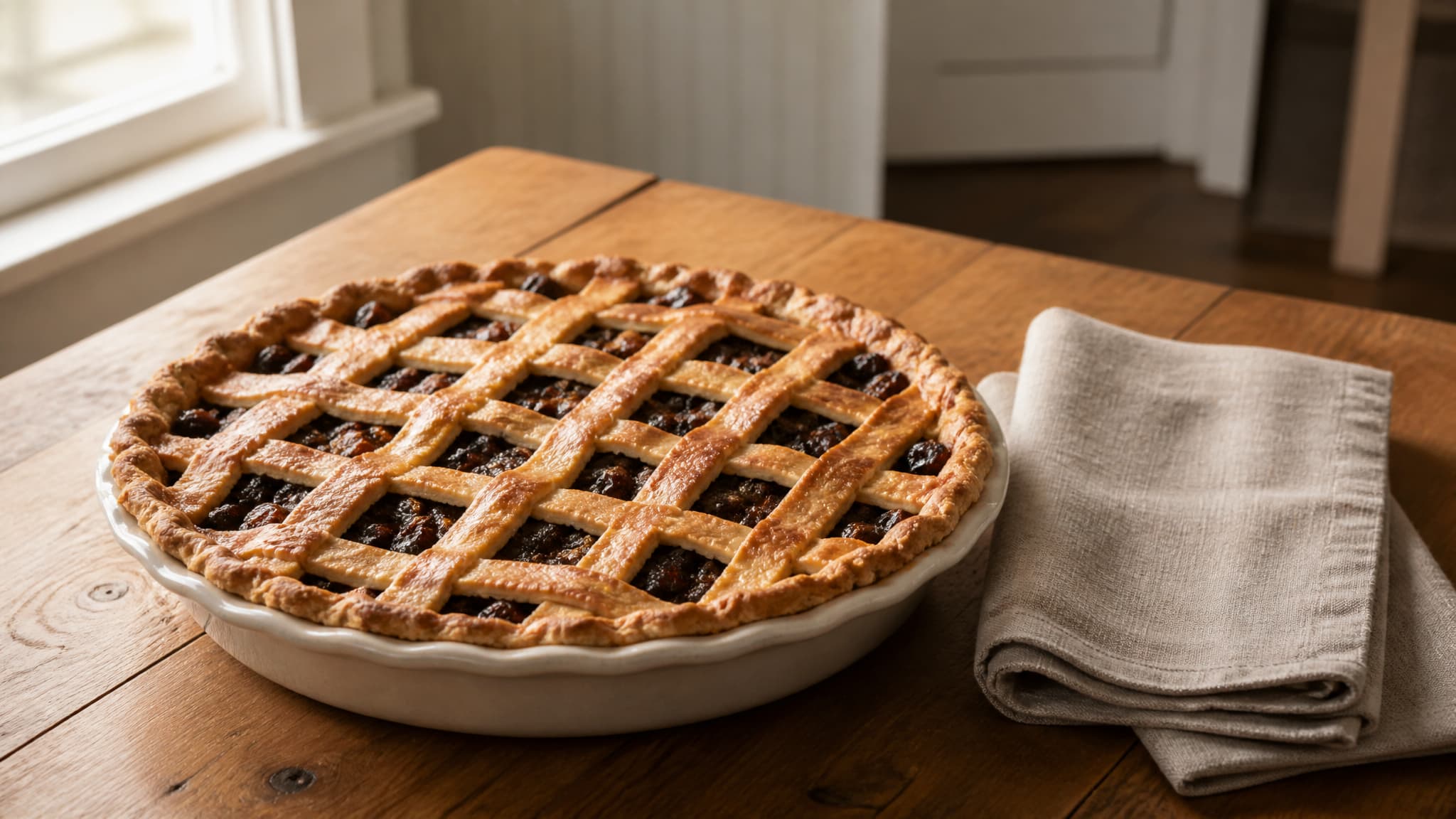
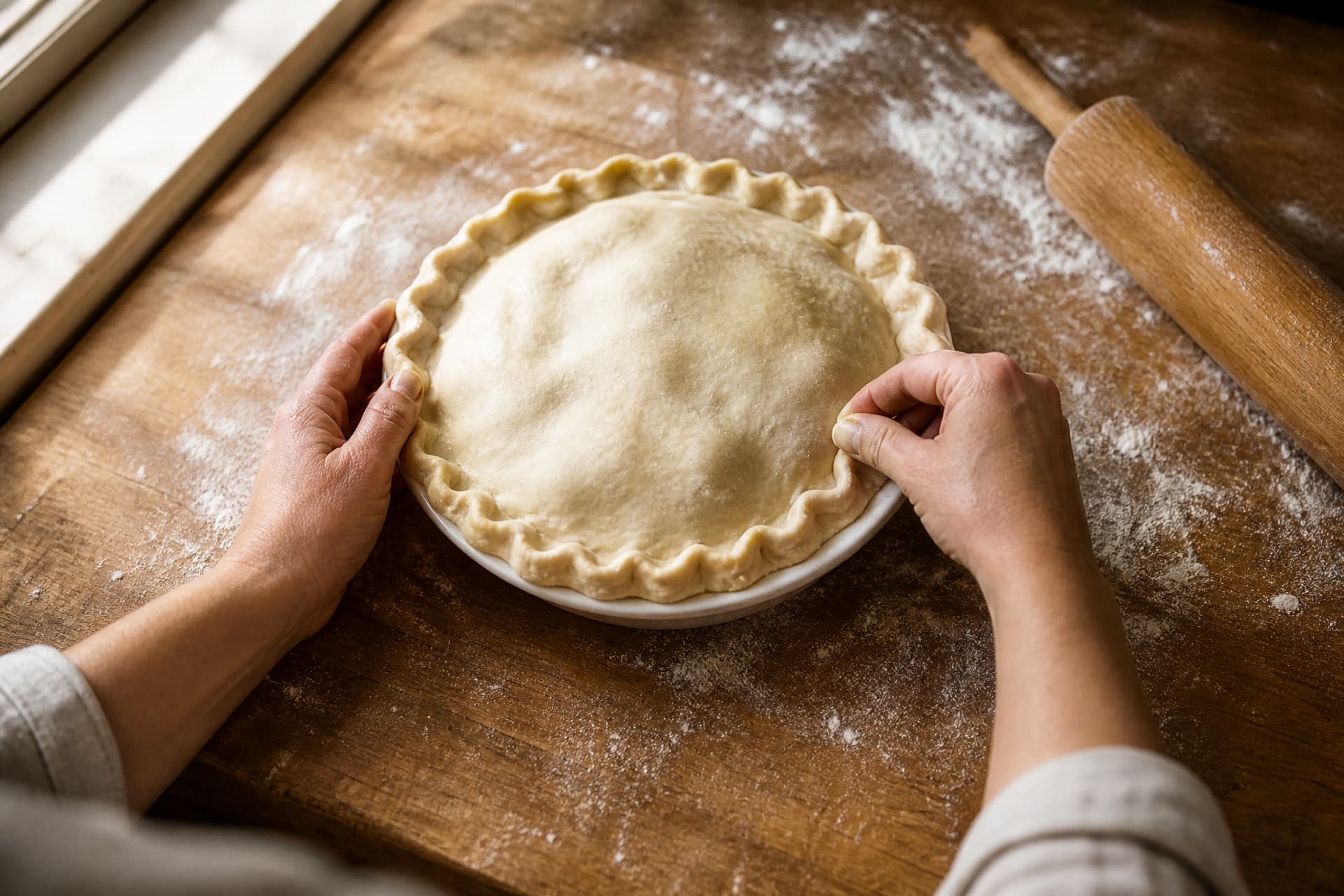
The traditional filling is raisins cooked down with sugar and thickened with flour, seasoned with cinnamon and a pinch of salt, and brightened with lemon juice and grated lemon rind. Some households add chopped walnuts. Butter goes in at the end. It bakes in a double crust, and the top crust is often cut into a lattice — partly to let steam out of a wet filling, partly because a lattice is the one decorative gesture a plain kitchen allows itself.
Variations are real and they are not corruptions. Some versions bind the filling with eggs into something closer to a custard, so that a slice sets up firm rather than running. Others push toward mincemeat, spicier and darker, with the raisins less distinct in the finished pie. Which one a family makes is usually a matter of whose recipe card it is rather than of any regional rule.
We are describing the dish, not publishing a recipe. There is no single authoritative version, quantities differ between settlements and between grandmothers, and a measured recipe presented as the traditional one would be a claim nobody can stand behind. Cooks who want to make it will find several tested versions from people who have actually baked them.
What the pie tastes like, since that is the next question everyone asks: sweet, quite sweet, with the raisins gone soft and jammy and the lemon keeping the whole thing from being cloying. The cinnamon is present but not dominant. It is closer to a mincemeat or a shoofly pie in register than to a fruit pie made with fresh fruit.
A double crust, often latticed. The lattice is functional as well as pretty — a wet raisin filling needs somewhere for the steam to go.
The Funeral Meal It Belongs To
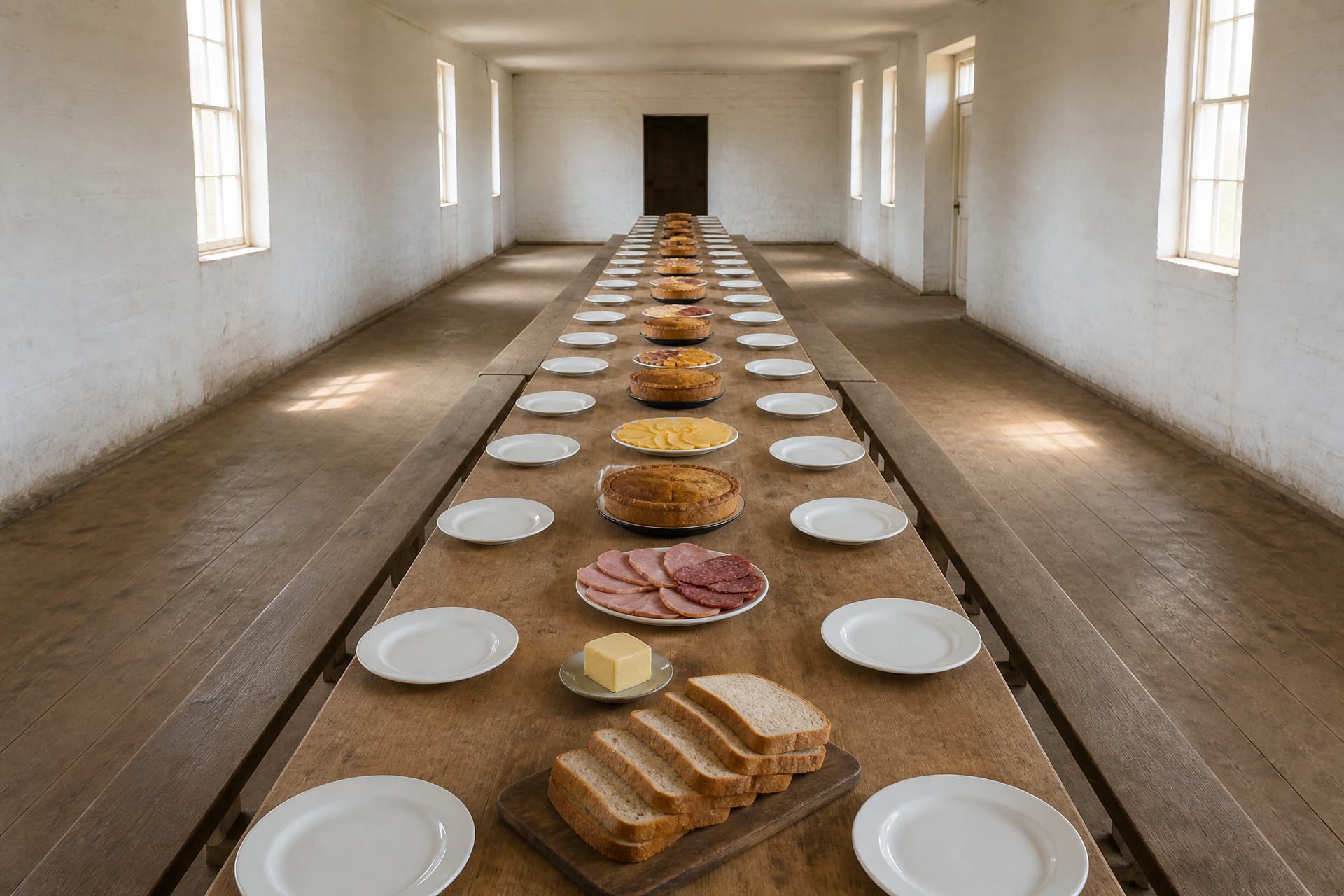
The pie is dessert at a meal, and the meal is the point. After the burial, the community eats together, usually at the home of the family or at whichever farm has the room, on long tables with benches down both sides. It is served in sittings, because everyone will not fit at once, and the people who cook and serve are neighbors rather than the bereaved family — who, in most districts, are seated and fed first and are not permitted to do any of the work.
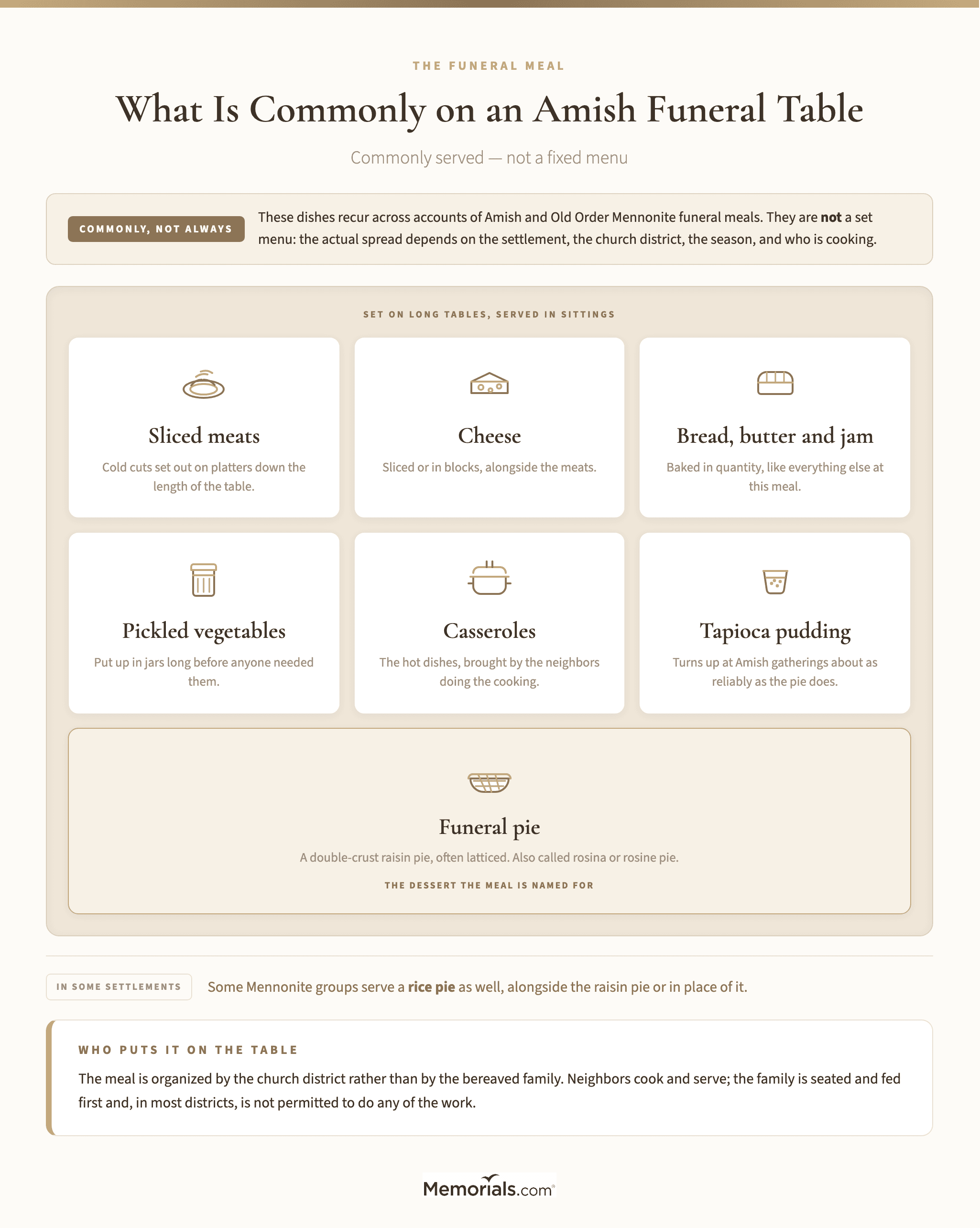
What is commonly on the table beside the pie is plain and substantial: sliced meats, cheese, bread, butter and jam, pickled vegetables, casseroles, and tapioca pudding, which shows up at Amish gatherings with the same reliability as the pie. Some Mennonite groups serve a rice pie alongside or instead. None of this is a fixed menu — say "commonly" and mean it, because the actual spread depends on the settlement, the season and who is cooking.
The custom is not unique to plain communities so much as unusually intact within them. Most American funerals are still followed by food of some kind, and our guide to funeral food traditions covers what people bring and serve across Southern, Jewish, Irish, Hispanic and other American traditions. What distinguishes the Amish version is that the meal is organized by the church district rather than improvised by individuals, so nobody has to decide whether to bring something. The system already decided.
Long tables, benches, sittings in shifts. The bereaved family is seated and served; the cooking and clearing belong to everyone else.
What is commonly on the table, not a set menu. Sliced meats, cheese, bread, casseroles and tapioca pudding recur across accounts of Amish funeral meals, with raisin pie as the dessert the meal is named for.
Communities That Feed the Bereaved
Feeding people after a death is close to universal, and the reasons given for it are strikingly consistent across communities that have nothing else in common: the family cannot cook, the food has to come from somewhere, and handing someone a dish is a way of saying something that would be awkward to say out loud.
New Orleans answers the same problem with a procession and then a table. The second line funeral turns the walk from the church into music and dancing, and the repast that follows it is a full meal put on by the neighborhood. The register could not be less like a plain Amish meal — one is loud and one is nearly silent — but the underlying arrangement is identical. The community feeds the family, and does not ask first.
Irish practice puts the food earlier in the sequence, at the wake itself rather than after the burial, with the house open and sandwiches, cake and tea going round for as long as people keep arriving. Irish wake traditions treat the days before the funeral as the part that needs staffing, which is a different bet about when a grieving household is least able to look after itself.
In Mexican households the food goes to the dead as well as to the living. Bread is baked for the ofrenda and set out with candles and photographs, and the dia de los muertos altar is built on the understanding that the person is coming to eat. Nobody expects the bread to be consumed. It is there because a place at the table is what belonging looks like.
Japanese Buddhist families make the same gesture daily and in miniature. A butsudan, the household altar, receives small offerings of rice and water each morning for years after a death. It is the most sustained version of this idea anywhere — not a meal on one afternoon but a cup of water every day, indefinitely.
And in Madagascar the meal is the observance outright. Famadihana, the turning of the bones, is a periodic family gathering at which the dead are brought out, rewrapped, and celebrated with a feast that the family saves for over years. Set beside it, a raisin pie is a small thing. The instinct behind both is the same one.
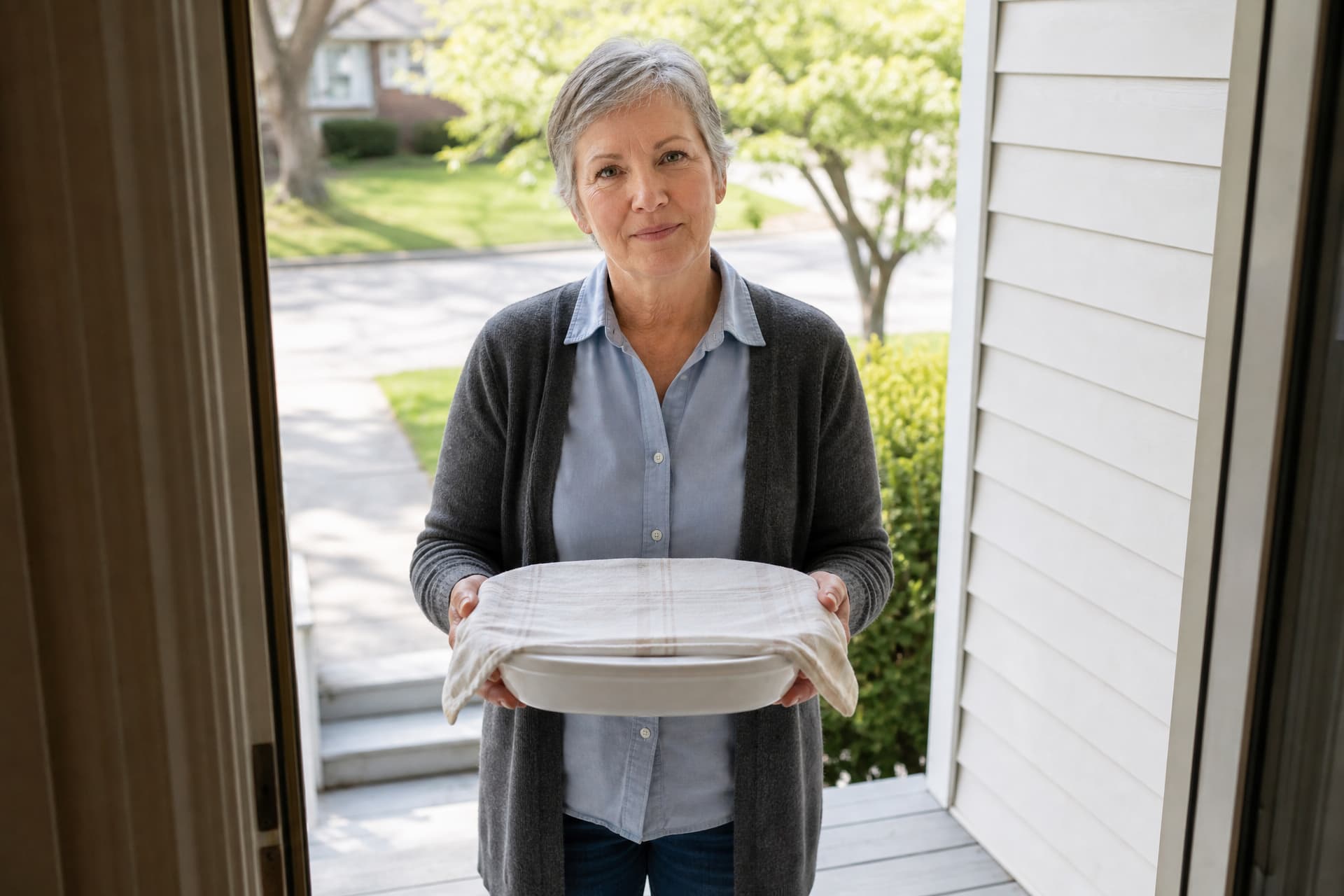
The gesture that crosses every tradition on this page: food arriving at a door without having been asked for.
If You Are Invited to an Amish Funeral Meal
This is the situation almost nobody writes about with any specificity — a neighbor, a coworker, an in-law or a business contact invited to the meal after an Amish or Mennonite funeral, who does not want to get it wrong.
Go, if you were invited. An invitation is not a formality and the meal is not a private family occasion; it is a community one, and outsiders who did business with the person or lived down the road are commonly included.
Dress plainly and dress down. Dark, modest, unremarkable. There is no requirement that a guest dress as a member of the community, and doing so would be a costume rather than a courtesy. The standard is simply that nothing you are wearing draws attention.
Do not take photographs, of anyone, at any point. Many Amish communities object to being photographed on religious grounds — a photograph is understood as a graven image and as an invitation to pride — and a camera at a funeral is the single most reliable way to cause offense. This is a requirement, not a custom. Put the phone away and leave it away.
You do not need to bring anything, and in most cases you should not. The meal is organized by the church district and the food is already accounted for; arriving with a dish is more likely to create a logistics problem than to help. If you want to do something, ask whoever invited you what would actually be useful. That is an ordinary question, it will not offend anyone, and the answer is usually more practical than anything you would have guessed.
For a non-Amish family — a coworker's household, a neighbor of your own — the equivalent gesture is the one everyone knows and few people execute well. Grief groceries covers what is genuinely useful to a household that has stopped cooking, which is rarely another casserole and often milk, bread, coffee and paper plates. If you are weighing whether to send something rather than bring it, sympathy gift etiquette works through the timing and the message.
At the meal itself, follow the room. Wait to be seated, expect a silent grace before and after eating, keep your voice down, and do not treat the occasion as an opportunity to learn about Amish life. You are there because someone died, the same as everyone else.
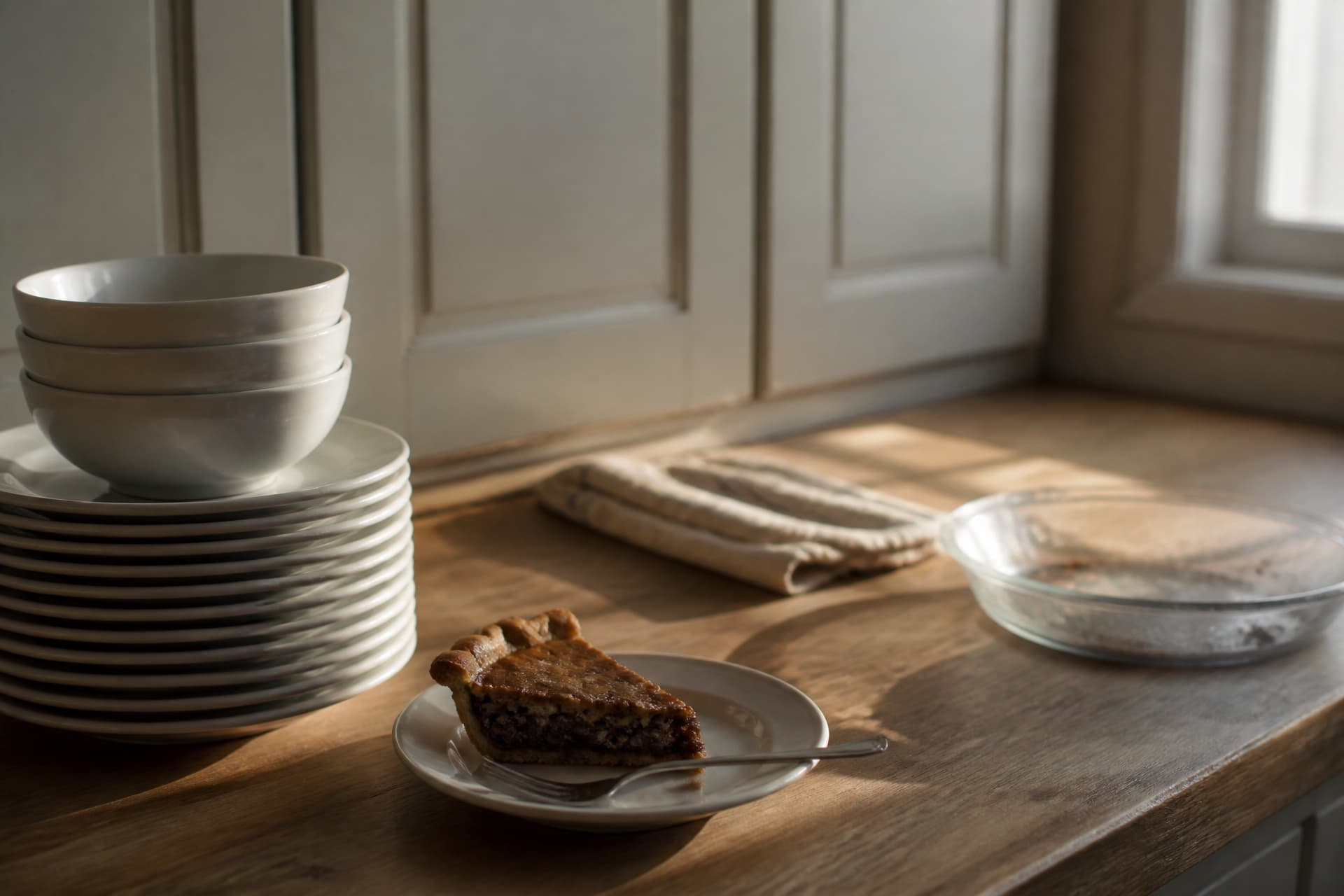
The end of a sitting. The clearing is done by the same neighbors who cooked, and the family is not expected to lift a plate.
Is Funeral Pie Still Made Today?
Yes, and unevenly, and anyone claiming a precise present-day answer is guessing. There is no survey of what Amish and Mennonite households bake, and practice differs from settlement to settlement in a way that resists summary.
What can be said honestly: the dish is still in circulation, it still turns up in Pennsylvania Dutch cookbooks and at markets in Lancaster County, and it is still associated with funerals in the settlements where the association started. It is also no longer confined to them — refrigeration removed the original reason for it, so where it survives now it survives as a tradition rather than as a solution to a problem.
In some Indiana Amish settlements the same pie appears at weddings rather than at funerals, which is a good illustration of how far a custom can drift once the practical logic underneath it has gone. A dish chosen because it kept without refrigeration outlived refrigeration, and became simply the pie you make when the whole district is coming.
The origin story is worth hedging too. Funeral pie is commonly dated to the eighteenth-century Amish and Mennonite settlers of Pennsylvania, and that date is repeated more or less everywhere. It is not, as far as we could establish, attached to a primary source. Treat it as the received account rather than as a documented fact.
Frequently Asked Questions
What is funeral pie?
Funeral pie is a double-crust raisin pie traditionally served at the community meal that follows a funeral in Old Order Amish and Old Order Mennonite settlements. It is also called rosina pie or rosine pie, from Rosine, the German word for raisin. The filling is raisins cooked with sugar, flour, cinnamon and lemon, sometimes with walnuts.
Why is raisin pie called funeral pie?
Because it was the dessert people expected to see at the meal after a funeral, reliably enough that the association ran in both directions. The line most often quoted about it — that there would be raisin pie soon — was reportedly used to say that someone in the house was dying, which is about as complete a merger of a dish and an occasion as American food has produced.
What else is served at an Amish funeral meal?
Commonly sliced meats, cheese, bread with butter and jam, pickled vegetables, casseroles and tapioca pudding, with raisin pie as dessert. Some Mennonite groups serve a rice pie as well. The meal is put on by the church district rather than by the bereaved family, and it is served in sittings because the whole community attends.
Do the Amish still serve funeral pie today?
In some settlements, yes; in others it has faded. There is no survey and practice varies by district, so a nationwide answer would be invented. The dish is still made in Pennsylvania Dutch country and still sold at markets there, and in parts of Indiana the same pie now shows up at weddings instead.
Should you bring food to an Amish funeral?
Usually no. The meal is organized by the church district and the food is already arranged, so an unexpected dish is more of a complication than a help. If you were invited and want to do something, ask the person who invited you what would be useful — asking is ordinary and welcome, and guessing is not.
What the Custom Actually Asks
Strip away the name and funeral pie is a set of instructions about how to help. Bring something that keeps. Make it ahead, so that the making does not become one more thing happening on the day. Do not require anything of the person you are helping — no dish to return by Tuesday, no note to write back, no decision to make. Do not sign it.
That last part is the one worth carrying out of a plain community and into an ordinary American week. The pie was never a gesture aimed at being noticed. It was food that appeared, was eaten, and did not ask the family to respond to it, at a moment when responding to things is the hardest thing there is. Whatever you would actually bring — a casserole, a bag of groceries, a full tank of gas in somebody's car — that is the standard the custom is setting.
The rest of the traditions in this guide are, at bottom, other answers to the same question. Every community that has thought about death for long enough arrives at some version of feeding the people it happened to.