🏬Supersize Online Funeral Retailer🪦1000's of Headstones⚱️Over 10,000 Cremation Urns⚰️Caskets Overnight Delivery🛒Funeral & Memorial Superstore🚚FREE Shipping on ALL Orders👨👩👧👦Helping Families for over 20 Years💰Lowest Price Guarantee🏬Supersize Online Funeral Retailer🪦1000's of Headstones⚱️Over 10,000 Cremation Urns⚰️Caskets Overnight Delivery🛒Funeral & Memorial Superstore🚚FREE Shipping on ALL Orders👨👩👧👦Helping Families for over 20 Years💰Lowest Price Guarantee
🏬Supersize Online Funeral Retailer🪦1000's of Headstones⚱️Over 10,000 Cremation Urns⚰️Caskets Overnight Delivery🛒Funeral & Memorial Superstore🚚FREE Shipping on ALL Orders👨👩👧👦Helping Families for over 20 Years💰Lowest Price Guarantee🏬Supersize Online Funeral Retailer🪦1000's of Headstones⚱️Over 10,000 Cremation Urns⚰️Caskets Overnight Delivery🛒Funeral & Memorial Superstore🚚FREE Shipping on ALL Orders👨👩👧👦Helping Families for over 20 Years💰Lowest Price Guarantee
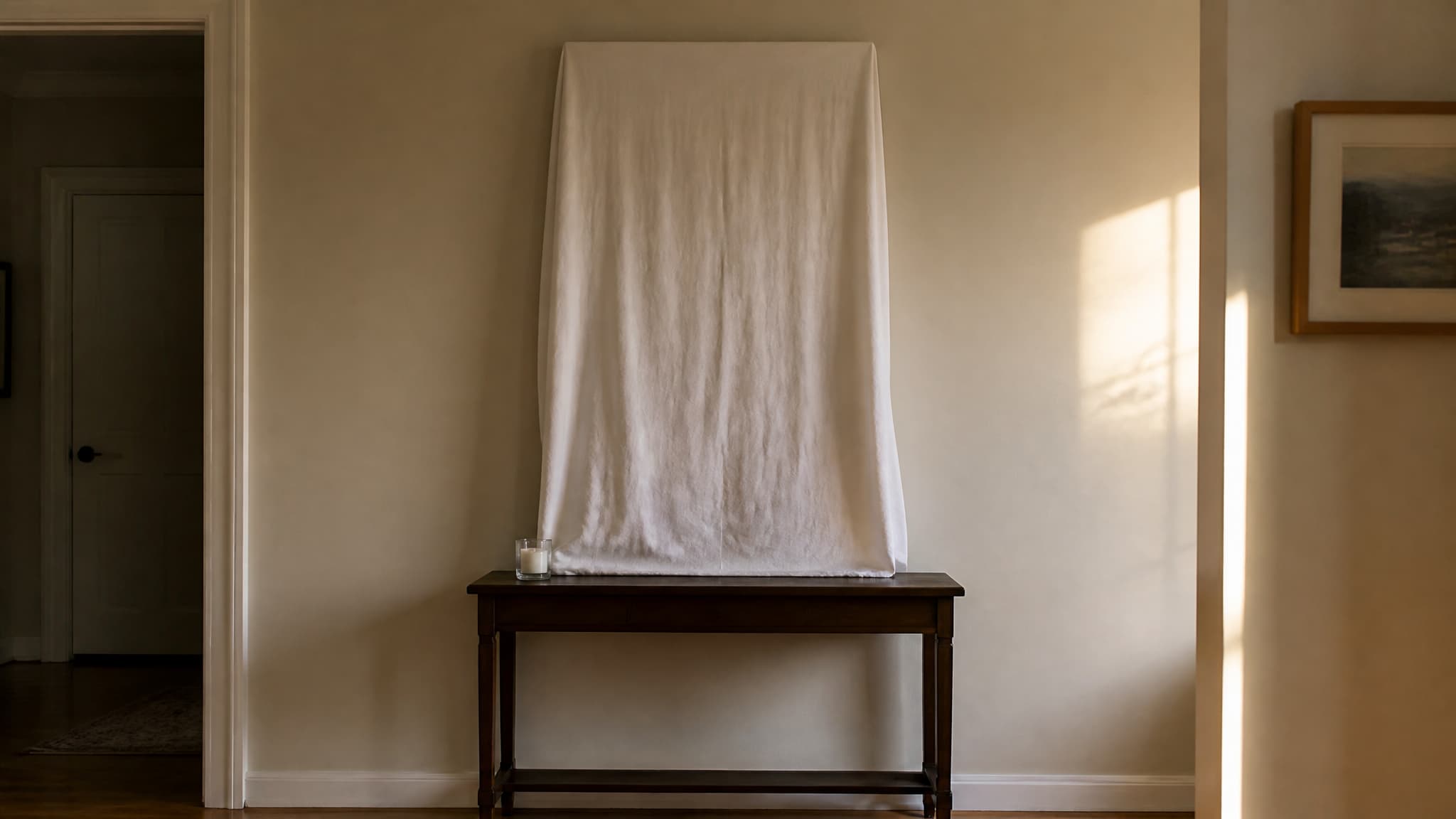
A sheet over the hall mirror is the first thing many people notice when they walk into a house where someone has just died, and it is the thing almost nobody wants to ask about. Why do people cover mirrors when someone dies? Several unrelated traditions do it, and the reasons they give sort into three groups: keeping the soul of the dead from being caught or delayed in the glass, taking vanity and self-regard out of a house in grief, and marking a room as no longer ordinary. No single origin accounts for all three, and the households that still do it are usually acting on a mixture.
This page covers who covers mirrors and why, what Jewish, Irish, Scottish, Victorian, Orthodox and Southern American families have meant by the practice, how long the coverings stay up, and what to do if you are the guest rather than the mourner. It sits inside our funeral traditions guide, alongside the other customs a family meets in the first week after a death. One thing is worth saying at the top, because a fair share of people arrive here quietly worried about it: nothing bad happens to a household that leaves its mirrors uncovered. This is a custom, not a rule with consequences attached.
The Three Reasons Families Cover Mirrors
Ask why are mirrors covered when someone dies and the answers fall into three families, which historians and clergy tend to keep separate even though households rarely do.
The first is the soul. In a large body of folk belief, a reflection was not simply an image — it was understood to hold something of the person, and glass was a place where a soul newly out of a body might be delayed, trapped, or drawn away. The danger in these accounts runs both ways: the departed might be caught in the mirror, or the living might be harmed by seeing themselves, or the dead, in it.
The second is appearance. A house in mourning is not a house that arranges its hair. Covering the glass removes the ordinary daily prompt to look at yourself, and several traditions state that reason plainly rather than as folklore — the point of covering mirrors when someone dies is to make self-regard briefly unavailable.
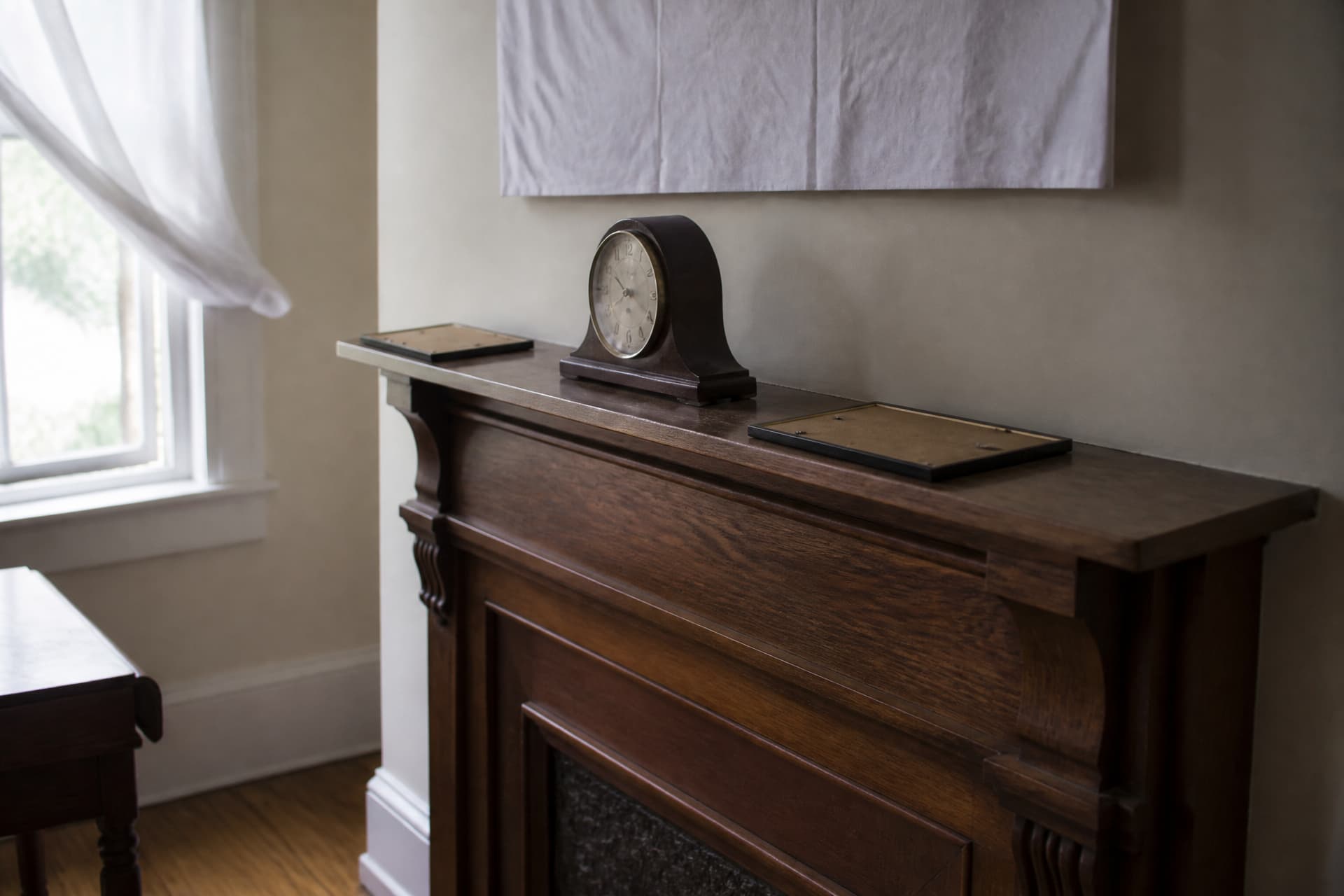
The third is the room itself. Draping the mirrors is one of a set of gestures that change a familiar space into a place where something significant has happened: the clock stopped, the blinds drawn, the front room cleared for a coffin. The covering is a signal, visible the moment anyone steps inside, that this is not a normal week.
The honest answer to why cover mirrors when someone dies is that the gesture has outlived most of its explanations. Many families who do it today learned it from a grandmother or a funeral director rather than from a doctrine, and the reason they give afterward is often the one that makes sense to them rather than the one the custom started with.
Covering Mirrors During Shiva: the Jewish Custom
The largest group of American households that still cover mirrors are Jewish families sitting shiva, the seven days of mourning that begin after burial. In a beit avel, a house of mourning, the mirrors are covered or turned to the wall, and in many homes other reflective surfaces are treated the same way. Depending on the community, the covering goes up at the moment of death or when the mourners return from the cemetery, and it stays up through the week.
Three reasons are commonly given, and they are not in competition. The first is the one most rabbis lead with: mourning is a turn away from appearance and toward the person who has died, and a mirror is an invitation to do the opposite. The second is practical and liturgical — a minyan often gathers to pray in the mourner's home, and Jewish practice objects to praying before an image or a reflection, so the glass is covered before the prayers begin. The third is Kabbalistic, and Chabad states it directly: reflective surfaces were understood as places where spirits might be seen, and the mourner's own difficult thoughts are described in the same language, so the glass is covered against both.
Two things are worth being precise about, because the pages that rank for the question typically are not. This is a minhag, a custom, and not halachah, law — a family that does not cover its mirrors has broken nothing. And the custom is comparatively recent in Jewish life. In a study published in the journal Ḥakirah (vol. 13), Rabbi Dr. Zvi Ron concludes that covering mirrors is a widespread practice among many peoples that Jews adopted from their neighbors, and that the religious explanations offered today are rabbinic interpretations supplied in the nineteenth and early twentieth centuries, long after the practice itself. He notes that Rabbi Moshe Tzuriel has argued the custom is an inappropriate one that should be discontinued. That is a live disagreement inside the tradition, not an outsider's criticism of it, and your family's rabbi is the authority on your own house.
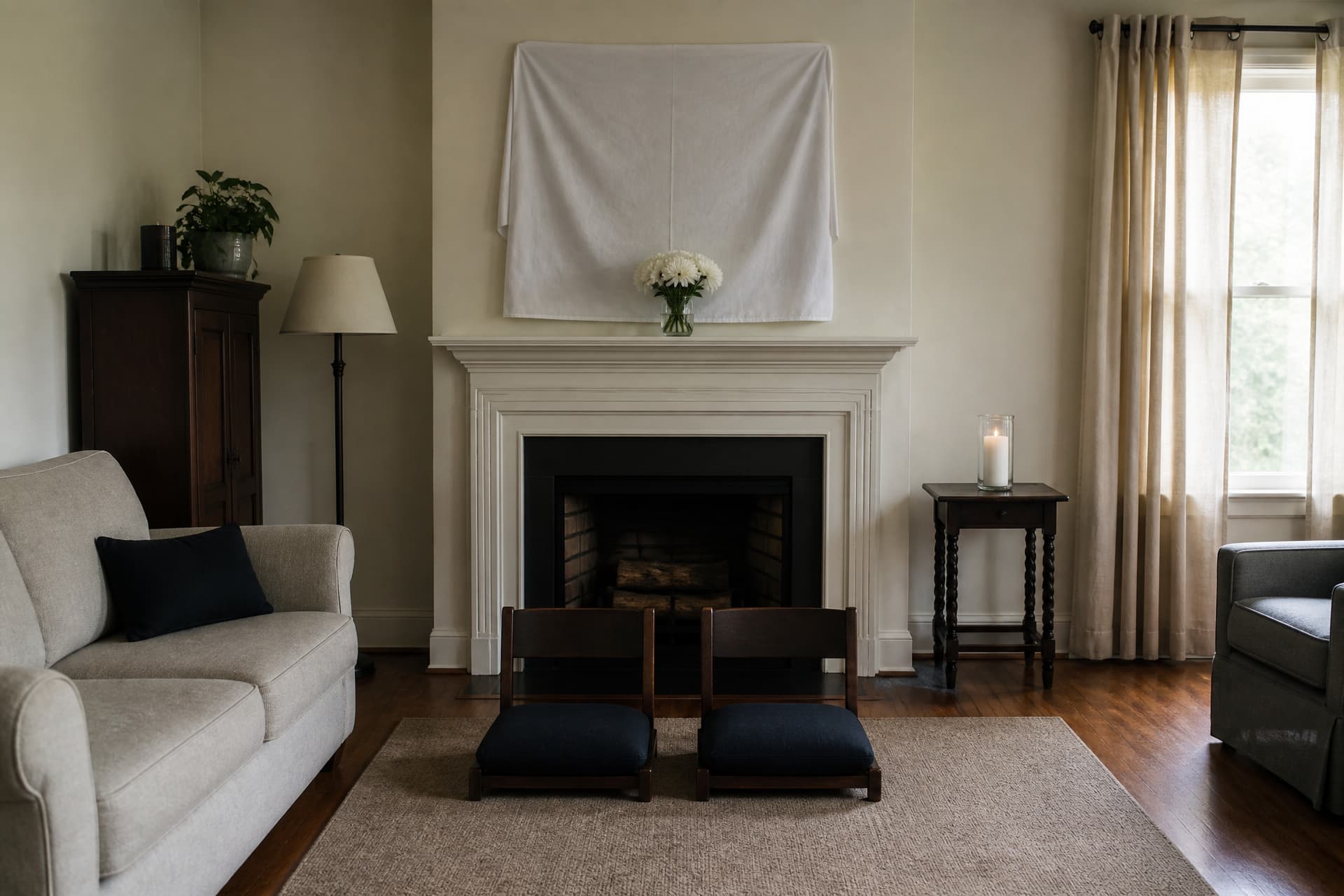
The mirrors are only one part of what a Jewish house does in that week. A memorial candle burns in the room while the coverings are up, low chairs replace the usual seating, and mirrors are covered in a home where the mourners are already wearing the torn garment of keriah. Before any of that, the body has been prepared by a burial society through tahara, the ritual washing, and buried as quickly as the family could arrange it. If you have typed why do jewish cover mirrors when someone dies into a search box while standing in someone's hallway, that is the shape of the week you have walked into.
Because burial is central to that week, families sometimes ask how the tradition regards other choices; Jewish views on cremation are a separate question with a settled answer in Orthodox and Conservative practice, and one this page deliberately does not fold into the mirror custom.
Low chairs, a candle, a covered mirror. The mirrors are one item in a set of changes that turn a living room into a house of mourning for a week.
The Older Belief: A Soul Caught in the Glass
The folk layer is older than the Jewish custom and much harder to pin down, which is exactly why it is worth handling carefully. The earliest firm record in the English-speaking world is Orkney in 1773, when the Rev. George Low described the islanders covering the mirrors in a house after a death — and reported that the people doing it could give no account of why. That is the pattern the custom keeps: it is observed first and explained afterward.
What the explanations say, where they were collected, is that a reflection could hold a soul. A newly dead person's spirit might see itself and stay; a living person who caught their own reflection in a death house might be the next to go. James Frazer gathered versions of the belief from England, Scotland, Madagascar and the Crimea, which is the strongest evidence that this is not one tradition traveling but a very common human idea about glass. In China, the practice was recorded by Reginald Fleming Johnston in 1910, where the reason usually given was that a mirror should not be allowed to reflect the coffin.
The same set of ideas runs through Scottish funeral customs and through the Irish wake, where covering the mirrors sat alongside stopping the clocks and opening a window while the body was still in the house. In practice the three gestures were done together and remembered together, which is why so many people can recall a grandmother doing all of them and none of the reasons.
People who ask why do they cover mirrors when someone dies are often really asking whether the belief was true, or whether something goes wrong if the custom is skipped. It is worth answering plainly. These are beliefs with a documented history, reported here as beliefs. Nothing in the record suggests a household that leaves the glass uncovered comes to harm, and the same reassurance applies to the related worry about whether it is bad luck to keep ashes in the house. The folk beliefs about the dead leaving something of themselves behind in an object are also why some families still hesitate over wearing a dead person's clothes — the mirror and the coat are the same idea in two materials.
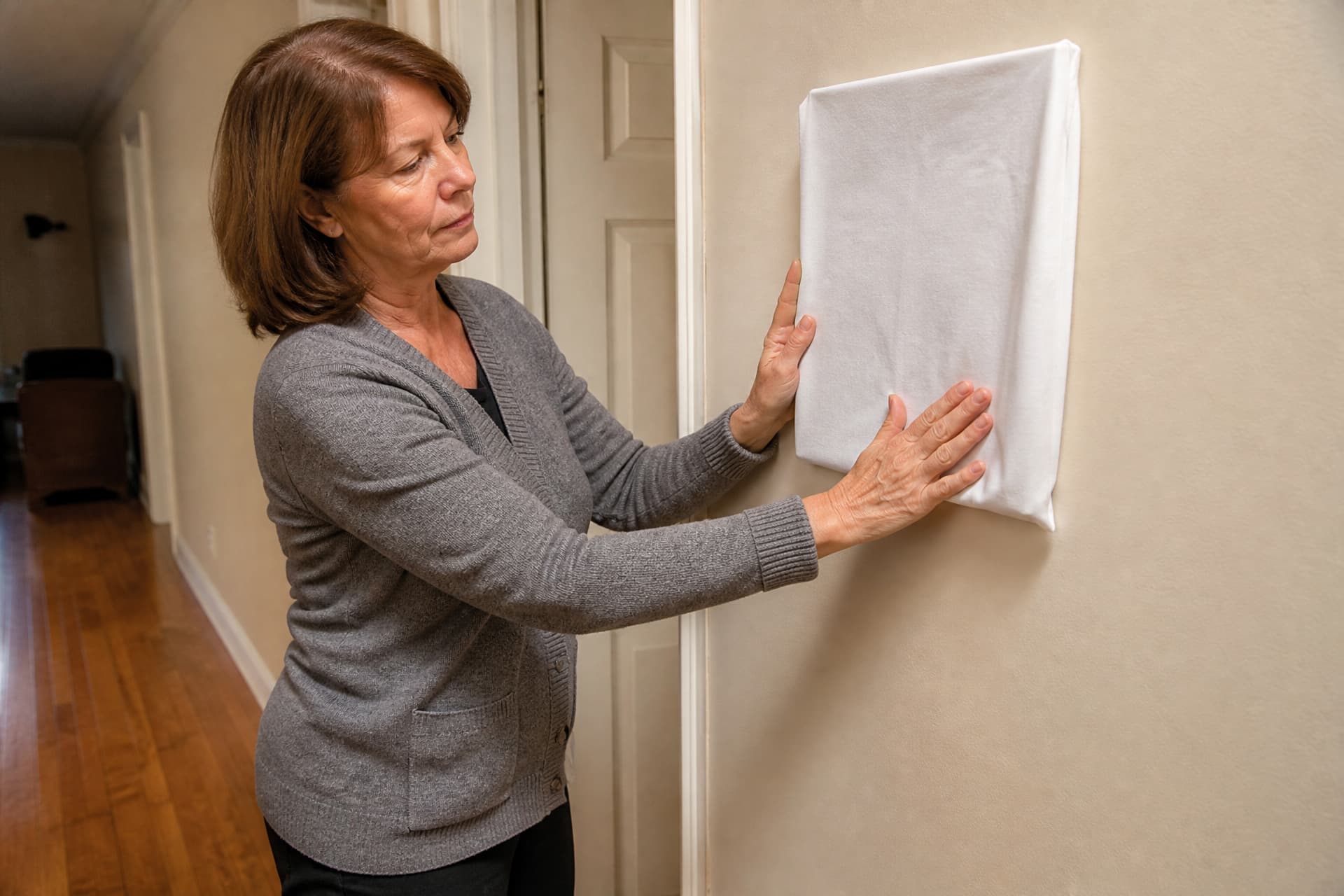
In most homes this is a two-minute job done by whoever is nearest the door. The plainer the cloth, the more traditional the covering.
Victorian Mourning and the Draped House
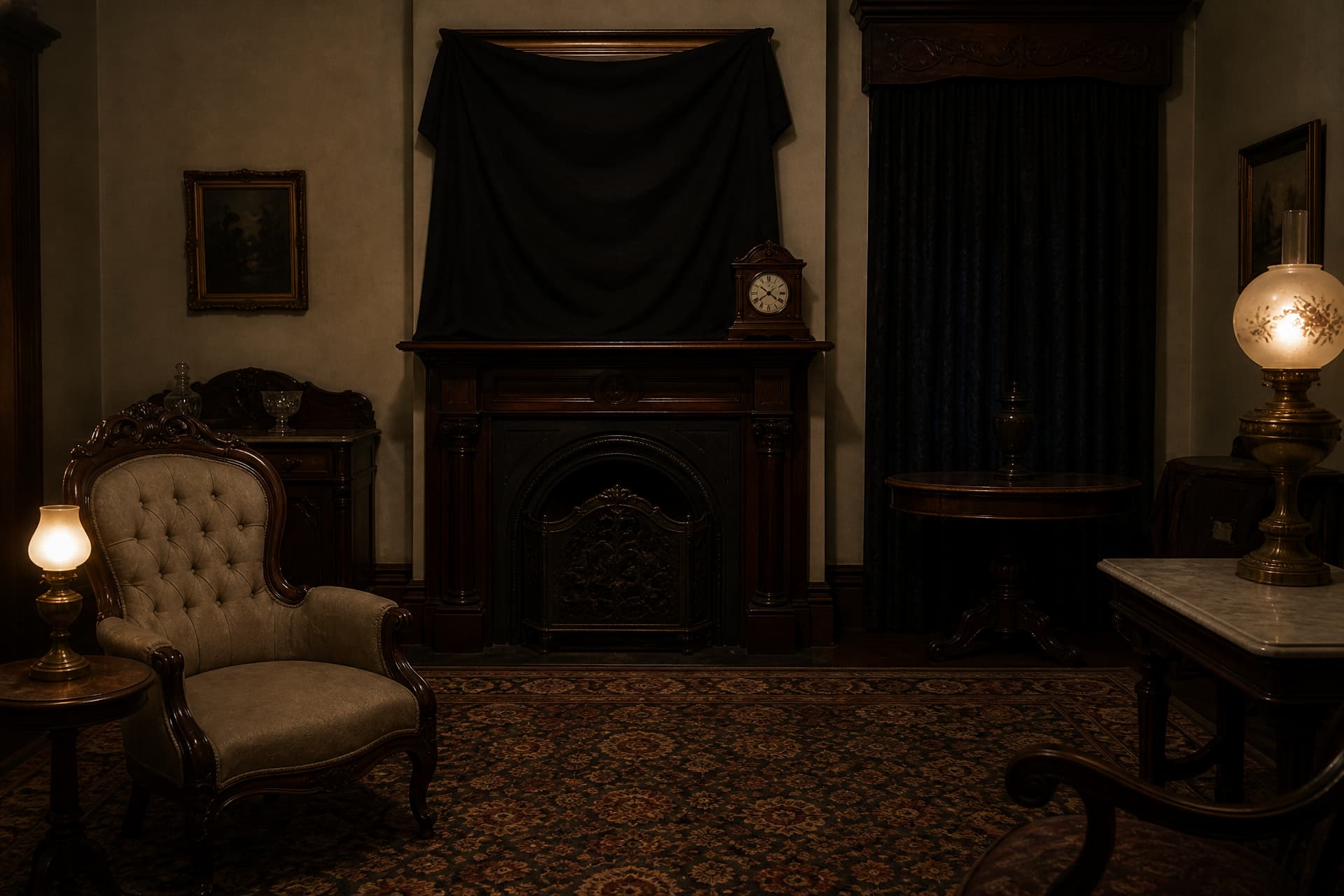
The nineteenth century is where the custom becomes visible in photographs, inventories and newspaper accounts, and it is the period most people are picturing when they ask why did they cover mirrors when someone died. In deep mourning, the mirrors of a well-off household were draped in black crape or barège along with the picture frames, the blinds were drawn, and the parlor was darkened for the viewing. When Abraham Lincoln lay in state in the East Room, the mirrors there were draped in black barège. When the railroad financier Charles Crocker died in San Francisco in 1888, the paintings in his house were turned to face the wall.
The practice was in America before the Victorians made it fashionable. Prudence Punderson's needlework of the early 1780s shows a draped mirror hanging above a coffin in a New England room — a domestic scene, stitched by a young woman who would herself die a few years later, and one of the clearest pieces of evidence that the custom crossed the Atlantic with ordinary families rather than arriving as a mourning fashion.
That timing matters for another reason. It is sometimes said that the custom belongs to the age of the modern mirror, since Justus von Liebig's silvered-glass process dates to 1835. Polished metal and glass mirrors are far older than that, and the Orkney record puts the custom in Britain more than sixty years before Liebig — so the covering is not a habit that grew up around a new invention. The nineteenth century did not create the practice; it dressed it in crape and wrote it down. The same period produced the mourning jewelry that survives in family boxes today, and the draped glass and the jet brooch belong to one material culture.
Black crape over the glass, curtains drawn, the clock stopped. The Victorians did not invent the custom, but they made it a formal, purchasable part of mourning.
Orthodox, Catholic and Southern American Practice
In Russian and Eastern Orthodox households the mirrors are covered for the forty days after a death, the period during which the soul is traditionally described as still making its way. Those forty days are punctuated by memorial services, and the panikhida is the one families gather for; the coverings often come down when the fortieth-day service is over. Polish and Irish Catholic homes have kept a shorter version of the same practice, usually lasting until the funeral, with a candle burning and a rosary said in the room where the mirrors are draped.
In the American South the custom arrived with Scottish, Irish and English families and stayed longer there than in most of the country, particularly in rural households where the body was laid out at home. Covering the mirrors and stopping the clocks were done together as a matter of course, and both are still remembered by people whose grandparents kept them. The tradition traveled as a package of house-keeping gestures rather than as a doctrine, which is why it survives among families who share no religion at all.
Five traditions, three reasons, and no shared origin. The Jewish and Orthodox customs run on a fixed calendar, while the wake and Southern versions end whenever the body leaves the house.
What Else the House Does: Stopped Clocks, Opened Windows, Covered Photographs
The covered mirror almost never travels alone. In the same households, someone stops the clocks at the hour of death, opens a window in the room so the soul can leave, turns the framed photographs face-down or drapes them, and lights a candle that is left to burn. Read as separate superstitions they sound arbitrary. Read together they are one gesture with several hands: the house is being told, and everyone entering it is being told, that ordinary time has been suspended.
That is also why the coverings are so often the first thing a visitor sees. The set is designed to be legible from the doorway.
Some of what the house does afterward belongs to a different impulse — airing the rooms, washing the bedding, and the various practices around cleansing a house where someone died are about making a home habitable again rather than about protecting anyone from the glass. The two sets overlap in time and in the same rooms, and families frequently do both without drawing a line between them.
The mirror is rarely the only thing changed. The stopped clock, the turned frames and the opened window are the rest of the same gesture.
How Long Do the Mirrors Stay Covered?
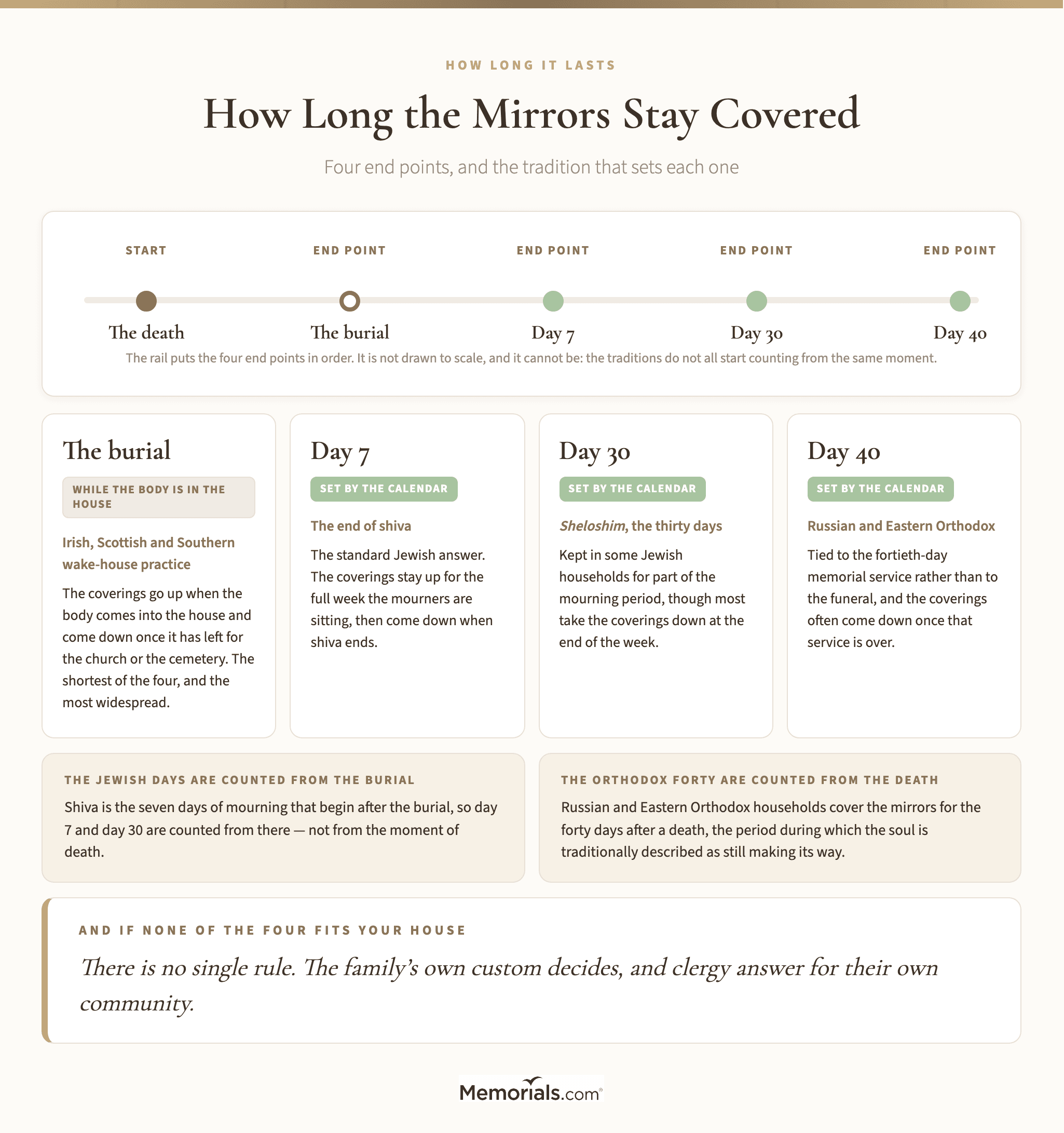
There are four common answers, and which one a family uses depends entirely on the tradition it is following.
Until the burial is the shortest and the most widespread. In wake-house practice, Irish, Scottish and Southern alike, the coverings go up when the body comes into the house and come down once it has left for the church or the cemetery.
Through the seven days of shiva is the standard Jewish answer. The coverings stay up for the full week the mourners are sitting, then come down when shiva ends.
Through sheloshim, the thirty days, is kept in some Jewish households for part of the mourning period, though most take the coverings down at the end of the week.
Forty days is the Russian and Eastern Orthodox reckoning, tied to the fortieth-day memorial service rather than to the funeral.
What no source will give you is a rule that settles it, and covering mirrors after death is exactly the kind of practice where the family's own custom outranks anything written down. The people who decide are the household itself and, where the family has one, its rabbi, priest or minister. If you are the one being handed the instruction with no explanation attached, asking the funeral director or the clergy member how long your community does it is a normal question and nobody will think it strange.
Four end points, not one. The wake-house custom ends when the body leaves; shiva ends on the seventh day; the Orthodox coverings stay up until the fortieth-day service.
What to Do If You Are Visiting a House of Mourning
If you have walked into a house with cloth over the glass and you are not sure of the etiquette, the rules are short. Do not comment on the coverings. Do not lift, move or straighten one, even to be helpful, and do not use a covered mirror or a dark screen to check your own appearance. Do not photograph the room. If you want to know why do you cover mirrors when someone dies, ask afterward, or read it up as you are doing now — a house of mourning is not the place to be curious out loud.
Beyond the mirrors, follow the household. Take your shoes off if others have. Sit where you are shown rather than in the low chairs, which are for the mourners. Let the family lead the conversation, and take your cue from them on how much is said about the person who died and how much is not.
Food is the standard thing to bring, and the one that reliably helps, because the household is feeding visitors all week and cooking for itself least of all. A handwritten note left with it does more than anything said at the door. If you are close enough to the family to be useful, offering one concrete job — a school run, an airport pickup, an hour answering the phone — is worth more than an open-ended offer to help with anything.
When the Mirrors Come Down
Uncovering is a real moment, and families who keep the custom tend to say so. The cloth comes off, the room goes back to being a hallway or a living room, and the household steps out of a week that had its own rules and into the much longer stretch that has none. People often describe the uncovering as harder than the covering, because the shape of the first week — the visitors, the food, the fixed things to do each day — is what had been holding the days together.
What frequently replaces the temporary covering is something permanent. A shelf, a wall, a corner of a room: a memorial space at home with a photograph, a candle and a few objects that belonged to the person is the natural forward step from a draped mirror, and unlike the covering, it is meant to stay.
Taking the cloth down is often the harder half. It is the moment the week with rules ends and the ordinary house comes back.
Frequently Asked Questions
How long do you keep the mirrors covered after a death?
Until the burial in wake-house practice, through the seven days of shiva in most Jewish homes, sometimes through the thirty days of sheloshim, and for forty days in Russian and Eastern Orthodox households. There is no single rule. The family's own tradition decides, and clergy answer for their own community.
Do you have to cover every mirror — what about a TV or a phone screen?
Practice varies, and this is a question worth asking the family's rabbi or clergy member rather than a website. Many households cover only wall and hall mirrors; others include a dark television screen, glass cabinet doors and framed photographs. Phones are handled inconsistently, and most families take the sensible view that a device in a pocket is not the same as a mirror on a wall.
What happens if you don't cover the mirrors?
Nothing. No tradition in this article attaches a penalty to leaving the glass uncovered, and in Jewish practice the covering is a custom rather than a law. Some families skip it because they find it unsettling, some because nobody in the house grew up with it, and some because the mourner would rather the room stayed normal.
Is covering mirrors a Jewish law or a custom?
A custom — minhag, not halachah. Rabbi Dr. Zvi Ron's study in Ḥakirah concludes it is a practice found among many peoples that Jewish communities adopted from their neighbors, with the religious explanations supplied later, and notes that Rabbi Moshe Tzuriel has argued it should be discontinued altogether.
Do Christians cover mirrors after a death?
Some do. Russian and Eastern Orthodox households commonly cover mirrors for forty days, and Polish, Irish and Southern American Catholic families have kept a shorter version until the funeral. There is no Christian doctrine requiring it anywhere; where it survives, it survives as a regional family custom.
The Short Answer, for Both Kinds of Reader
If you are the guest, the answer is that the cloth over the glass means the household is in mourning and has set the ordinary business of appearance aside for a while. It is not a warning and it is not aimed at you. Say nothing about it, leave it alone, bring food, and follow whatever the family is doing.
If you are the one who has been handed the instruction, by an older relative or a funeral director, with no explanation attached: this is a custom with a long, mixed and partly untraceable history, and it carries no obligation and no consequence. Do it if it helps. Skip it if it does not. Most families who keep it say afterward that the value was never in the folklore — it was in having one small, definite thing to do in a week that otherwise had no shape at all.