🏬Supersize Online Funeral Retailer🪦1000's of Headstones⚱️Over 10,000 Cremation Urns⚰️Caskets Overnight Delivery🛒Funeral & Memorial Superstore🚚FREE Shipping on ALL Orders👨👩👧👦Helping Families for over 20 Years💰Lowest Price Guarantee🏬Supersize Online Funeral Retailer🪦1000's of Headstones⚱️Over 10,000 Cremation Urns⚰️Caskets Overnight Delivery🛒Funeral & Memorial Superstore🚚FREE Shipping on ALL Orders👨👩👧👦Helping Families for over 20 Years💰Lowest Price Guarantee
🏬Supersize Online Funeral Retailer🪦1000's of Headstones⚱️Over 10,000 Cremation Urns⚰️Caskets Overnight Delivery🛒Funeral & Memorial Superstore🚚FREE Shipping on ALL Orders👨👩👧👦Helping Families for over 20 Years💰Lowest Price Guarantee🏬Supersize Online Funeral Retailer🪦1000's of Headstones⚱️Over 10,000 Cremation Urns⚰️Caskets Overnight Delivery🛒Funeral & Memorial Superstore🚚FREE Shipping on ALL Orders👨👩👧👦Helping Families for over 20 Years💰Lowest Price Guarantee
There is no RIP emoji. There is no sorry for your loss emoji either. That is the first thing to know, and it is why people end up here: the keyboard has a symbol for almost everything and nothing that plainly says I am sorry he died.
What people use instead, in rough order of how well it lands: 🤍 the white heart, 🕊️ the dove, 🕯️ the candle, 🙏 praying hands, and 🪦 the headstone. The white heart is the safest of them by a distance. The sympathy and condolence guide covers the words that go around it. The dove is the oldest of the five by a long way: what a dove represents runs from the olive branch in Genesis through Christian and classical art to the release at a graveside.
This is the actual question, asked more than any other, so it goes first.
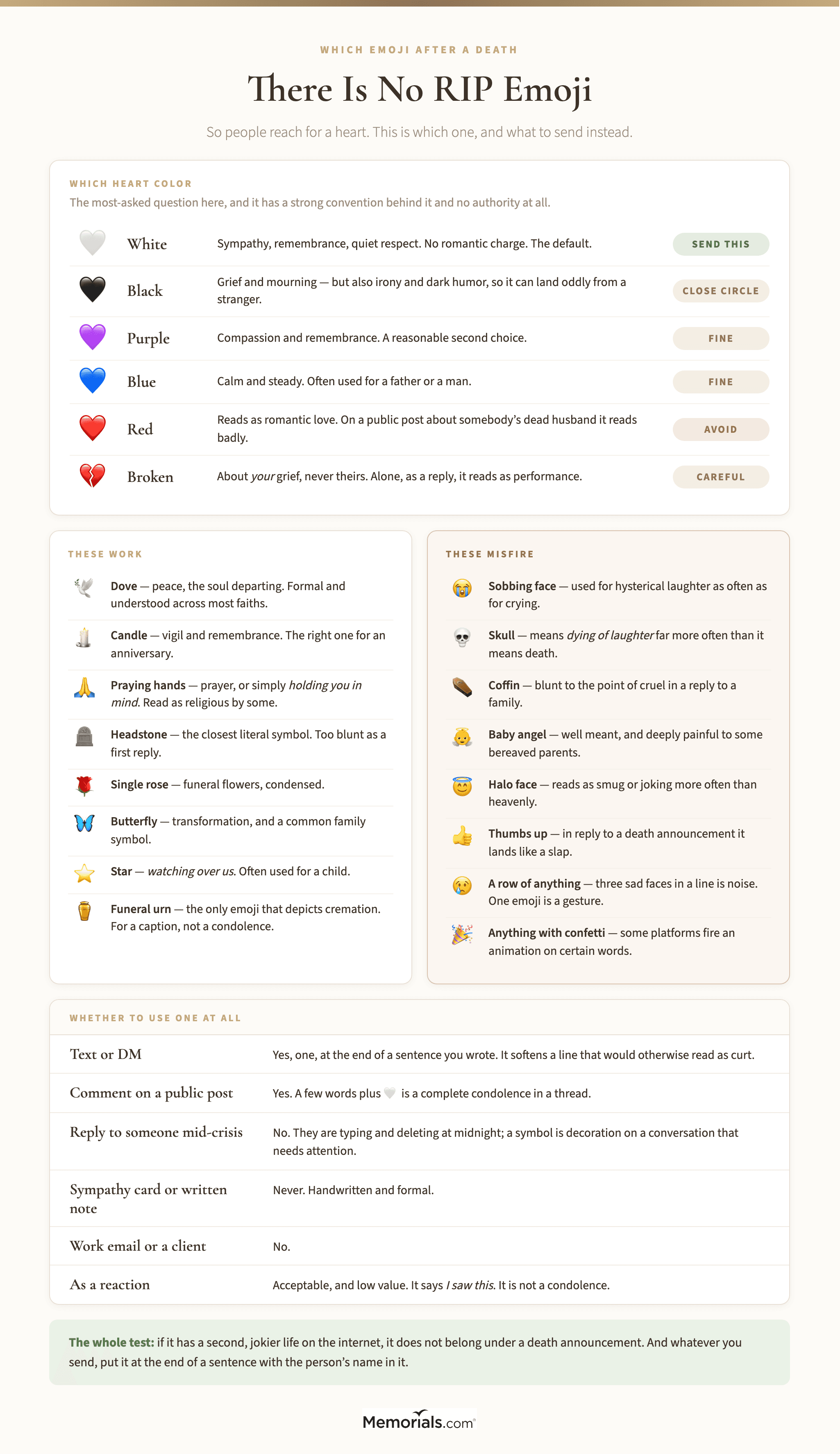
🤍 White. The one to use. It reads as sympathy, remembrance and quiet respect, and it carries no romantic charge at all. If you send one emoji after a death, send this. The little white heart has become the default condolence emoji online almost by consensus, without anyone announcing it.
🖤 Black. Grief and mourning, and it is genuinely used that way — but it is also used for irony, dark humor and metal bands, so it can land oddly from someone the family does not know well. Safe within a close circle, riskier in public.
💜 Purple. Widely read as compassion and remembrance, and the standard color for several specific causes. A reasonable second choice.
💙 Blue. Calm and steady, often used for a father or a man. Harmless.
❤️ Red. Avoid. It reads as romantic love, and on a public post about somebody's dead husband it reads badly.
💔 Broken heart. Use it about your own grief, never about theirs. 💔 I can't believe it is fine. Replying to their announcement with 💔 alone can read as performance.
And there is no official rule. What color heart emoji for death is a question with a strong convention and no authority behind it, which is exactly why so many people search it — as white emoji heart, as sympathy heart emoji, as heart emoji for sympathy, and a dozen other ways. White is the convention in all of them.
The white heart is the convention, arrived at by consensus and written down nowhere. That is why people search for it.
🤍 White heart — sympathy, remembrance, respect. The default.
🕊️ Dove — peace and the soul departing. Formal, gentle, and understood across most cultures and faiths.
🕯️ Candle — vigil and remembrance. The right emoji for an anniversary, a vigil post, or a name being read out.
🙏 Praying hands — prayer, gratitude, or simply I am holding you in mind. Read as religious by some and as thanks by others, so consider who is receiving it.
🪦 Headstone — literal, and the closest thing the keyboard has to a RIP symbol. Works in a caption about a grave visit; too blunt in a first reply to a death announcement.
🌹 Single rose — funeral flowers, condensed. Widely used on memorial posts.
🦋 Butterfly — transformation and remembrance, and a common family symbol.
⭐ Star — watching over us. Gentle, and often used for a child.
♾️ Infinity — forever, without a religious frame.
🌈 Rainbow — remembrance, and it carries specific meanings in some communities. Fine when you know the family.
Any of these works as a sympathy emoji, and the same handful comes back whatever you type into a search box — condolences emoji, emoji for condolences, emoji for death condolences, emoji for sympathy. The emojis to use when someone dies are fewer than a keyboard of three thousand symbols suggests. If you are choosing under pressure, the white heart and the dove are the two that are almost never wrong.
The Ones to Avoid
❤️ Red heart and 😍 anything with hearts for eyes. Romantic register.
😭 The sobbing face. It is used for hysterical laughter as often as for crying, and the ambiguity is fatal here.
💀 Skull and ☠️ crossbones. Used for dying of laughter far more than for death.
⚰️ Coffin. Blunt to the point of cruel in a reply to a family.
👼 Baby angel. Well meant, and deeply painful to some bereaved parents.
😇 Halo face. It reads as smug or joking more often than it reads as heavenly.
A row of anything. 😢😢😢 is noise; one emoji is a gesture.
A thumbs up 👍 in reply to a death announcement. It happens, and it lands like a slap.
Anything animated or with confetti. Some platforms fire an effect on certain words. Check before you send.
The general rule for any grief emoji: if it has a second, jokier life on the internet, it does not belong under a death announcement. That is the whole test, and it disqualifies every candidate above.
🕯️ is the one for anniversaries and vigils. It says remembrance without asking for a reply.
The Urn, and the Ones Most People Never Find
Three symbols sit in the keyboard that almost nobody thinks to look for.
⚱️ The funeral urn. It exists, it is accurate, and it is the only emoji that specifically depicts cremation. Used most naturally in a caption about scattering or interring ashes rather than in a first condolence.
🥀 The wilting rose. Loss rather than tribute. It reads as sadness about the death rather than respect for the person, which makes it right for your own post and wrong as a reply to the family.
🌙 The crescent moon and 🌌 the night sky, which several families adopt as a private shorthand for someone who died. Neither means anything on its own; both mean a great deal once a family has claimed one.
There is no dedicated grieving emoji, and none of these becomes one. What they offer is a way to say something specific when the white heart has already been said.
Whether to Use One at All
The honest answer is that it depends where you are writing.
In a text or a DM: yes, one. A short message with a white heart at the end is warm, and the emoji softens a line that would otherwise read as curt. Sending condolences by text covers the message itself.
In a comment on a public post: yes, and keep it to the emoji plus a few words.So sorry, Sam. 🤍 is a complete condolence in a comment thread, and better than a paragraph that makes the thread about you.
In a reply to someone mid-crisis: no. When they are typing and deleting at midnight, an emoji is a decoration on a conversation that needs your attention. Comforting someone over text covers that moment.
In a sympathy card or a written note: never. Handwritten and formal, no emoji.
The one place the rule is absolute. A card is handwritten, and a symbol on it reads as a shortcut.
As a reaction rather than a message: acceptable, and low value. A 🤍 reaction on a death announcement says I saw this. It is not nothing. It is also not a condolence, and it should not be the only thing you do.
The white heart and the dove are the two that are almost never wrong. Everything in the right-hand column has a second, jokier life online, which is what disqualifies it.
What the Emoji Cannot Do
An emoji is punctuation, not a message. It works as the last character of a sentence somebody wrote, and it fails as the whole reply.
Say the name.Thinking of you and of David 🤍 does more than any symbol on its own.
Send a second message later. The emoji marks the moment; the message two weeks afterward is the one that counts.
And if you receive one, you owe nothing back. How to respond to a death text covers the other direction, including the perfectly good option of a single heart in reply.
Anniversaries, Memorial Posts, and Profile Pictures
The emoji people want a year later are not the ones they wanted on the day.
On an anniversary, 🕯️ and 🤍 do the work. A candle posted on the date, with the person's name, is a small public act of remembrance and it is well understood.
On a memorial post of your own, one symbol and a photograph beats a row of them. 🌹, ⭐ and 🦋 are the ones families use most, and an emoji for someone who passed away years ago carries more weight when it is always the same one.
In a profile name or bio, a single 🤍 or ⭐ beside a name is a quiet, permanent marker. Some families adopt one symbol — a butterfly, a robin, a particular flower — and it becomes shorthand within the family.
On a birthday, say happy birthday. Happy birthday, Mom 🤍 is what people actually post, and it is right.
If you want something more lasting than a symbol on a screen, the keepsake gifts range holds the small physical version of the same gesture, and sympathy gift etiquette covers the timing.
When the News Breaks in a Group Chat
A particular situation nobody writes about, and almost everyone has been in.
Somebody posts the news to a group, and then twenty identical hearts arrive. That is not a failure of feeling — it is what a group chat does — but it leaves the person who posted it holding a wall of symbols and no conversation.
Be the one who writes a sentence.Oh no. I'm so sorry, Sam. Was it sudden? 🤍 Anything with a human clause in it stands out from a column of reactions.
Then take it out of the group. Send one private message. The group is where the news travels; the DM is where the condolence goes.
Do not react and leave. A heart in a group thread, from someone who never follows up, is the most common way people mean well and land as absent.
And if you posted the news: you do not owe the wall of hearts anything. Nobody expects a reply to a reaction, and reading them all is optional.
It Does Not Look the Same on Their Phone
Worth knowing before you send something you have not sent before.
The same emoji is drawn differently by every platform. Apple, Google, Samsung, WhatsApp and Facebook each draw their own set. 🤍 is close to universal, but some symbols shift in tone considerably between them.
Older devices show a box. Newer emoji — including some of the ones above — appear as an empty rectangle on a phone that has not been updated in years, which is exactly the phone an older relative is likely to be holding.
Skin tone and gender variants do not always carry. 🙏 with a modifier can arrive without it.
Some platforms react to keywords. A word in your message can trigger balloons or confetti on the recipient's screen. On a message about a death that is genuinely awful, and it has happened to people.
The safe set is small and old. 🤍 🕊️ 🕯️ 🙏 🌹 have existed for years and render sensibly everywhere. If it matters, stay inside it.
Frequently Asked Questions
Is there a RIP emoji? No. The keyboard has no dedicated one. 🪦 the headstone is the closest literal symbol, and 🤍 the white heart is what most people actually send.
What color heart do you use for condolences? White 🤍. Black 🖤 works within a close circle, purple 💜 is a reasonable alternative, and red ❤️ should be avoided because it reads as romantic.
Is it rude to reply to a death announcement with an emoji? Not in a comment thread, where a few words plus 🤍 is a normal and welcome condolence. In a private message, write a sentence and put the emoji at the end of it.
Which emoji means someone has died? None of them, precisely. 🕊️ 🕯️ and 🤍 are read as remembrance in context, and 👼 is best avoided because it is painful to many bereaved parents.
Can I use emoji in a sympathy card? No. Cards and written notes are handwritten and formal.
What about the crying face? 😭 is used for laughing as often as crying, and that ambiguity makes it the wrong choice here. 🤍 is safer.
In Closing
Send 🤍, put it at the end of a sentence you wrote yourself, and say the name of the person who died.
That is the whole answer, and it works in a text, a comment, and a message sent a year later.