🏬Supersize Online Funeral Retailer🪦1000's of Headstones⚱️Over 10,000 Cremation Urns⚰️Caskets Overnight Delivery🛒Funeral & Memorial Superstore🚚FREE Shipping on ALL Orders👨👩👧👦Helping Families for over 20 Years💰Lowest Price Guarantee🏬Supersize Online Funeral Retailer🪦1000's of Headstones⚱️Over 10,000 Cremation Urns⚰️Caskets Overnight Delivery🛒Funeral & Memorial Superstore🚚FREE Shipping on ALL Orders👨👩👧👦Helping Families for over 20 Years💰Lowest Price Guarantee
🏬Supersize Online Funeral Retailer🪦1000's of Headstones⚱️Over 10,000 Cremation Urns⚰️Caskets Overnight Delivery🛒Funeral & Memorial Superstore🚚FREE Shipping on ALL Orders👨👩👧👦Helping Families for over 20 Years💰Lowest Price Guarantee🏬Supersize Online Funeral Retailer🪦1000's of Headstones⚱️Over 10,000 Cremation Urns⚰️Caskets Overnight Delivery🛒Funeral & Memorial Superstore🚚FREE Shipping on ALL Orders👨👩👧👦Helping Families for over 20 Years💰Lowest Price Guarantee
Writing a condolence message for loss of a grandmother is harder than it sounds, because the grief is real and the world quietly treats it as minor. Grandparents are supposed to die. Everybody knows that, including the person you are writing to, and it does not help them at all.
The short version: say her name, say something specific about her, and do not mention her age. The sympathy and condolence guide is the wider starting point, and short condolence messages has sixty lines you can lift.
Two People Are Grieving, and the Messages Go to the Wrong One
This is the thing nobody says about a grandparent's death, and it changes who you should be writing to.
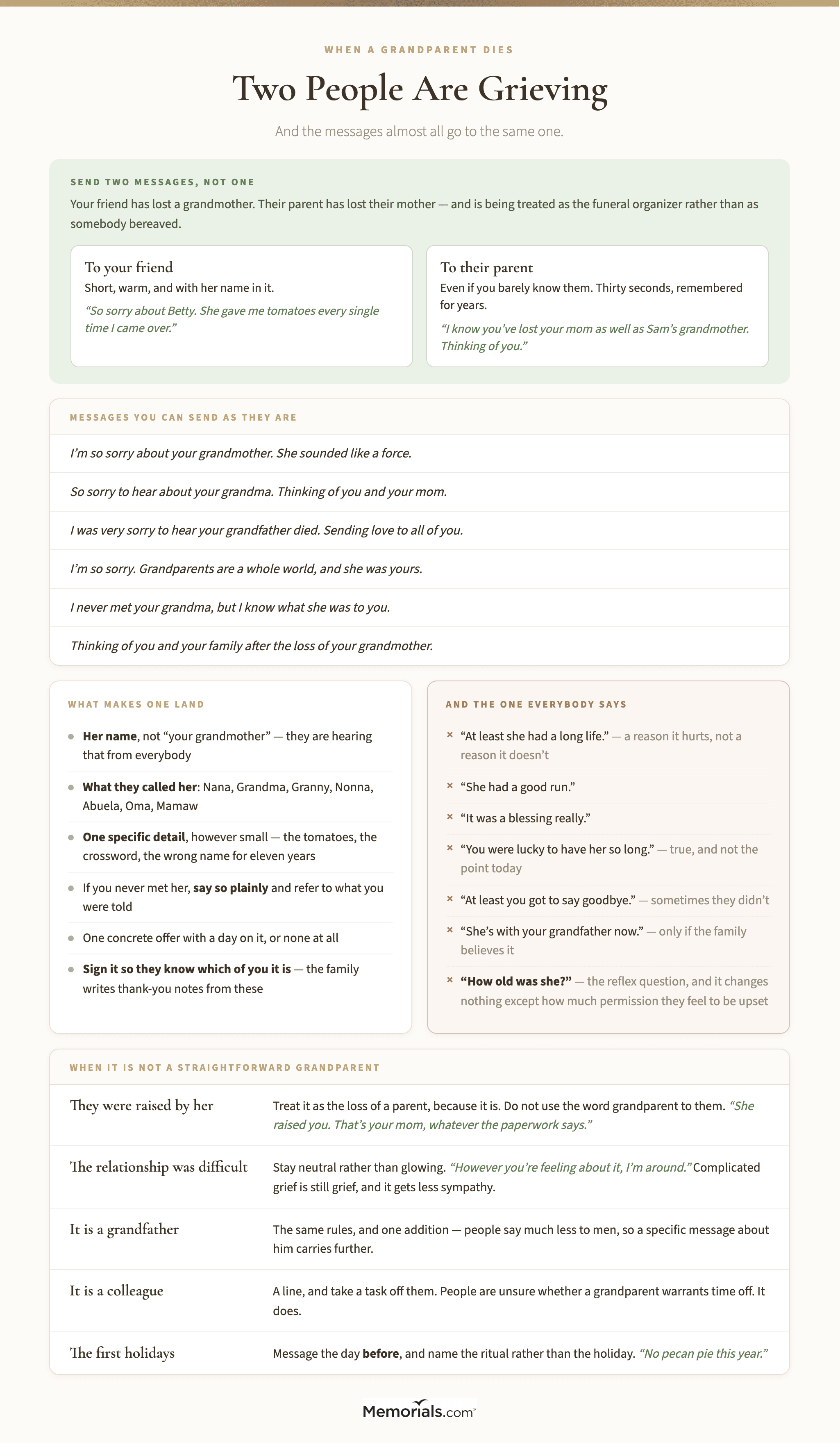
Your friend has lost a grandmother. Their parent has lost their mother. The messages overwhelmingly go to the grandchild — they are the one on social media, the one in your group chat — while the person who has lost a parent is treated as the organizer of the funeral rather than as somebody bereaved.
Send two messages. One to your friend, and one to their mother or father, even if you barely know them. I know you've lost your mom as well as Sam's grandmother. Thinking of you. It takes thirty seconds and it is remembered for years.
And if you are close to the family, name the chain.Three generations are missing her today. Grandparents hold families together and their death rearranges everyone at once.
And mind the group chat. A grandparent's death is often announced there first, and a row of reactions accumulates under it within the hour. The condolence emoji people reach for carry more than they intend — a few read as care and a few read as careless — and one line of your own is worth more than any of them.
Two people are grieving. The grandchild gets the messages; the parent, who has lost their own mother, is treated as the organizer.
Keepsakes for a Grandparent
Somewhere for the photographs, and something to wear
I'm so sorry about your grandmother. She sounded like a force.
So sorry to hear about your grandma. Thinking of you and your mom.
I was very sorry to hear your grandfather died. Sending love to all of you.
Thinking of you today. I know how much she meant to you.
I'm so sorry. Grandparents are a whole world, and she was yours.
So sorry about your grandpa. He was clearly the best of them.
Sorry to hear about your grandmother's passing. Condolences to your whole family.
Thinking of you and your family after the loss of your grandmother.
A shorter grandparent condolence message is fine. Four words that name her beat four sentences that do not. People search for these in a dozen shapes — condolence messages for loss of grandmother, condolences grandmother, loss of a grandparent message, passing grandmother condolences, grandmother death condolence message, sympathy for grandmother — and every one of them wants the same thing: a sentence with her name in it.
For a text, drop the formality entirely — So sorry about your grandma. Here if you want to talk.Sending condolences by text covers the medium.
For a card, add one specific thing and sign it properly. The card gets kept.
Say Something Specific About Her
The difference between a message that lands and one that does not is a detail, and it does not have to be a big one.
If you met her, say what you remember. She gave me a bag of tomatoes every single time I came over.She called me by your sister's name for eleven years. Specific beats reverent every time.
If you never met her, say what you know through your friend. You talked about her constantly — I feel like I knew her.The stories about her kitchen were the best stories you had.
If you know nothing at all, say that honestly. I never met your grandmother but I know what she was to you. That is a complete sympathy message for loss of a grandmother and nobody expects more.
Use her name, not her role.Betty rather than your grandmother, if you knew her at all. The family are already hearing "your grandmother" from everybody.
And use what they called her. Nana, Grandma, Granny, Nonna, Abuela, Oma, Mamaw. Getting that right shows you were listening.
Say her name, say one specific thing, and do not mention her age. Everything else is optional.
The Thing Not to Say
There is one wrong sentence here and almost everybody says it.
"At least she had a long life." This is the grandparent version of at least he didn't suffer, and it lands the same way. Ninety-four years is a reason it hurts, not a reason it does not. Somebody has lost the person who was there before they were born.
Nor any of its relatives:she had a good run, she'd been ready for a while, it was a blessing really, at least it wasn't sudden. Every one of them is a small argument that the grief is disproportionate.
"You were lucky to have her so long." True, and not the point today.
"At least you got to say goodbye." Sometimes they did not, and you rarely know.
"She's with your grandfather now." Lovely if the family believes it. A stranger's theology if they do not.
And do not ask how old she was. It is the reflex question and the answer changes nothing except how much permission the person feels to be upset. What to say instead of sorry for your loss covers the other worn-out phrases.
When They Were Raised By Their Grandparents
A significant number of people were brought up by a grandmother, and for them this is the loss of a parent in everything but the word.
Do not call it a grandparent's death to them. Say her name, or say the woman who raised you.
Expect the grief to look like parental grief, because it is. The same shape, the same length, the same hole. How long grief lasts is the honest version of the timeline.
And watch for the second wound, which is people around them not understanding why they are this upset. A message that treats the loss at full weight is worth a great deal. She raised you. That's your mom, whatever the paperwork says.
Grandparents hold the family archive. When one dies the photographs come out, and nobody knows who half the people in them are.
When the Relationship Was Distant or Difficult
Not every grandparent was beloved, and pretending otherwise puts the reader in an awkward position.
Keep it neutral rather than glowing.I'm sorry about your grandmother. However you're feeling about it, I'm around. That covers grief, relief, guilt and numbness without guessing which one it is.
Do not eulogize somebody you did not know. Calling her wonderful when she was not is jarring, and the family know exactly what she was.
Complicated grief is still grief. People often feel worse, not better, when the relationship was difficult, and they get less sympathy for it.
If they were estranged, say the true small thing: That's a complicated one. I'm sorry all the same.
A grandmother's death also rearranges the generation between you, and the person who has just lost a sibling of her own is the one nobody writes to at all. If that is who you are sending to, the loss of a sister is written for exactly that reader.
The First Holidays
Grandparents anchor the calendar, and the first year of holidays without one is its own event.
The empty chair is literal. Grandmothers in particular tend to host, cook, or sit in the same seat for forty years, and the first Christmas or Thanksgiving without her is not a metaphor to the people in that room.
The empty chair is literal. Grandmothers tend to sit in the same seat for forty years.
Say something before the day, not after.Thinking of you all this week — first one without her. A message the day before is worth five afterward.
Name the ritual, not the holiday.No pecan pie this year.Who's doing the stuffing? The specific thing she did is what everybody is thinking about and nobody is saying.
Expect the family to change how they do it, and do not comment on it either way. Some go somewhere else entirely for a year; some keep every tradition exactly.
And the grandchildren of the family often carry it forward. Somebody makes her recipe badly and everybody cries and it becomes the new tradition. That is how this works.
Writing to a Friend, a Colleague, or the Family
The register changes with the relationship, and the length changes with it.
To a close friend — short, warm and specific, and follow it with something practical. So sorry about your grandma. I'm bringing coffee Thursday, no need to reply.
To a colleague — a line, and take a task off them. Condolences for loss of a grandmother at work are often awkward because people are unsure whether it warrants time off; it does. Condolence messages for a coworker covers the register, and grief at work covers the return.
To your friend's parent — a proper card, and treat it as the loss of a mother or a father, which is what it is.
To an older relative who has lost a sibling — grandparents' funerals gather people whose own losses go unnoticed. A word to the great-aunt in the corner costs nothing.
Sympathy for loss of a grandfather follows all the same rules, with one addition: people say much less to men, so a specific message about him lands harder than usual.
And if it has to be an email — a colleague, a client, somebody whose address you do not have — the condolence email subject line is the part people agonize over and still get wrong. Four or five plain words, on a new thread, never a reply into an existing one.
Religious and Traditional Messages
Match what the family believes, not what you believe.
May her memory be a blessing.
She is at rest, and her family will carry her.
Praying for your family this week.
May God comfort you and your mother.
Rest in peace, Nonna. You were loved by everyone in that house.
Eternal rest grant unto her, O Lord.
If you do not know what they believe, do not guess.Thinking of you offends nobody.
And a grandmother passed away message in another language, if that was hers, is often the one the family remembers. Condolences in Spanish has the phrases that actually work rather than the literal translations.
A grandparent's death produces a specific kind of object problem: a house full of things, and everyone wanting one.
Something for the photographs. Grandparents hold the family archive, and after the funeral it comes out of boxes. Keepsake boxes give the photographs, letters and order of service somewhere to live that is not a kitchen drawer.
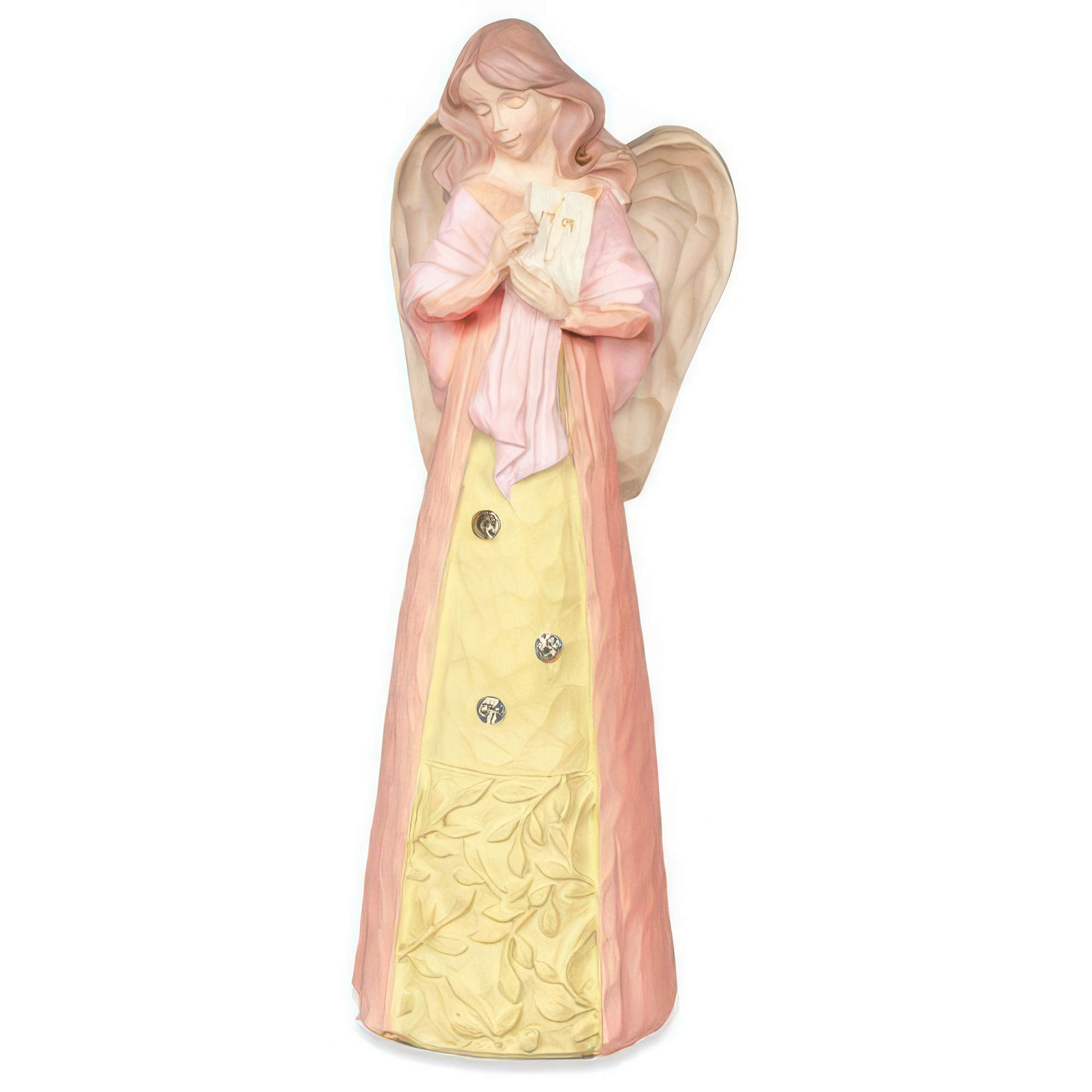
Something to wear to the funeral.Angel pins are a grandparent-generation gesture and people genuinely wear them, often the whole family in the same one.
Food, still. The family are hosting relatives they see once a decade. Sympathy gift etiquette covers timing and who sends what.
And later, ask about the stone. Grandparents often share a plot with a spouse who died years earlier, which makes the inscription a family decision rather than a form to fill in — headstone inscriptions for grandparents covers the wording.
What to Write in the Card
The card outlives the flowers and the family reads it twice — once now, once when writing the thank-you notes.
Open with her name.Dear Sam, I was so sorry to hear about Betty.
One specific memory, or one true thing about your friend. Two sentences at most.
No advice, no theology unless it is theirs, and no age.
One concrete offer with a day on it, or none at all.
Sign it so they know which of you it is.Ravi and Priya (from number 14) — forty cards arrive and first names alone are useless. They are also the list the family writes back from, and funeral thank-you messages covers that side.
Most of the answering happens on a phone long before any of that, and usually within a day. How to respond to a death text is written for whoever is on that end, including the four-word reply that closes an exchange without seeming curt.
Frequently Asked Questions
What do you write for the loss of a grandmother? Say her name, say one specific thing about her, and offer something concrete. So sorry about Betty. She gave me tomatoes every time I visited. I'm bringing dinner Thursday.
Is it appropriate to send condolences for a grandparent? Yes, and it is under-done. Grandparent grief is routinely treated as minor, so a message that takes it seriously stands out.
Should I mention how old she was? No. A long life is a reason it hurts, not a reason it does not.
What if I never met them? Say so plainly and refer to what your friend told you. I never met your grandma, but I know what she was to you.
Do I send something to the parent as well? Yes. They have lost their own mother or father and are usually treated as the funeral organizer instead of as someone bereaved.
What do I say if they were raised by their grandmother? Treat it as the loss of a parent, because that is what it is. Do not use the word grandparent to them.
What about a grandfather? The same rules, and one addition: people say much less to men, so a specific message about him carries further.
In Closing
Write two messages, not one — your friend, and the person who has lost their mother.
Say her name, say the tomatoes or the crossword or whatever the specific thing was, and leave her age out of it entirely.