🏬Supersize Online Funeral Retailer🪦1000's of Headstones⚱️Over 10,000 Cremation Urns⚰️Caskets Overnight Delivery🛒Funeral & Memorial Superstore🚚FREE Shipping on ALL Orders👨👩👧👦Helping Families for over 20 Years💰Lowest Price Guarantee🏬Supersize Online Funeral Retailer🪦1000's of Headstones⚱️Over 10,000 Cremation Urns⚰️Caskets Overnight Delivery🛒Funeral & Memorial Superstore🚚FREE Shipping on ALL Orders👨👩👧👦Helping Families for over 20 Years💰Lowest Price Guarantee
🏬Supersize Online Funeral Retailer🪦1000's of Headstones⚱️Over 10,000 Cremation Urns⚰️Caskets Overnight Delivery🛒Funeral & Memorial Superstore🚚FREE Shipping on ALL Orders👨👩👧👦Helping Families for over 20 Years💰Lowest Price Guarantee🏬Supersize Online Funeral Retailer🪦1000's of Headstones⚱️Over 10,000 Cremation Urns⚰️Caskets Overnight Delivery🛒Funeral & Memorial Superstore🚚FREE Shipping on ALL Orders👨👩👧👦Helping Families for over 20 Years💰Lowest Price Guarantee
Sending condolences for loss of husband or wife is not the same job as sending them to somebody who has lost a parent, and the difference is structural rather than a matter of degree. They are now alone in the house. Everything hard about the next two years follows from that one fact.
So the useful message is not a better sentence. It is a sentence that implies you will still be there in March, when the casseroles have stopped and the paperwork has run out and the quiet arrives properly.
Below are lines you can send today, the two dates nobody else marks, and the sentence that stings most — which is one almost everybody says. The sympathy and condolence guide is the wider starting point.
I heard about Anne. I'm so sorry. No need to reply to this.
There are no words for this one. I'm here.
I'm so sorry. I'll call Sunday — you don't have to pick up.
Sending love. I'm not going anywhere.
I'm so sorry about your husband. He was very good to me.
I keep thinking about your wife and about you.
A short condolence message for loss of husband or wife is enough: I'm so sorry. I'm here.
A loss of husband message does not need to be long, and neither does a loss of wife message. It needs to arrive, and it needs to sound like a person rather than a card.
The difference from losing a parent is structural. There is nobody else in the house.
This is the most valuable thing you can offer and the most commonly withheld, because people worry that mentioning the marriage will hurt. It does the opposite — the marriage is what they have lost, and being the only person not mentioning it is its own loneliness.
You two were the reason I believed in it, honestly.
I have never seen him look at anyone the way he looked at you.
Forty years. What a thing to have had.
I can still hear the pair of you arguing about the sat nav in the front of that car.
She talked about you constantly. Constantly.
Use the wedding anniversary too. Almost nobody does. More on that below.
Words of Comfort for Loss of Spouse — What Actually Lands
Effective words of comfort for loss of spouse come down to three things, in order of usefulness.
Say their name. Not your husband — Michael. Widowed people report that the thing they miss soonest is hearing the name said out loud by someone else.
Name something concrete you will do, with a day attached.I'm coming Tuesday and bringing dinner. You don't have to be dressed.
Say you will still be here later. This is the one that separates a good message from a form. I'll still be checking in when everyone else has stopped is an unusual promise, so only make it if it is true — and if you make it, put a reminder in your phone before you close the message.
What to write in sympathy card for loss of husband follows the same four moves as any sympathy card, with one addition: acknowledge the marriage, not just the death.
Dear Anne,
I was so sorry to hear about Michael. I have been thinking about the two of you all week — about him standing in your kitchen refusing to admit the oven was broken, and about how much noise that house had in it.
I'm coming over on Thursday with food. You don't need to talk to me and you don't need to tidy up.
If a card is the wrong channel — a client, a colleague, somebody whose home address you do not have — the condolence email subject line is where that version goes wrong first. Four or five plain words, on a new thread, and nothing about work underneath.
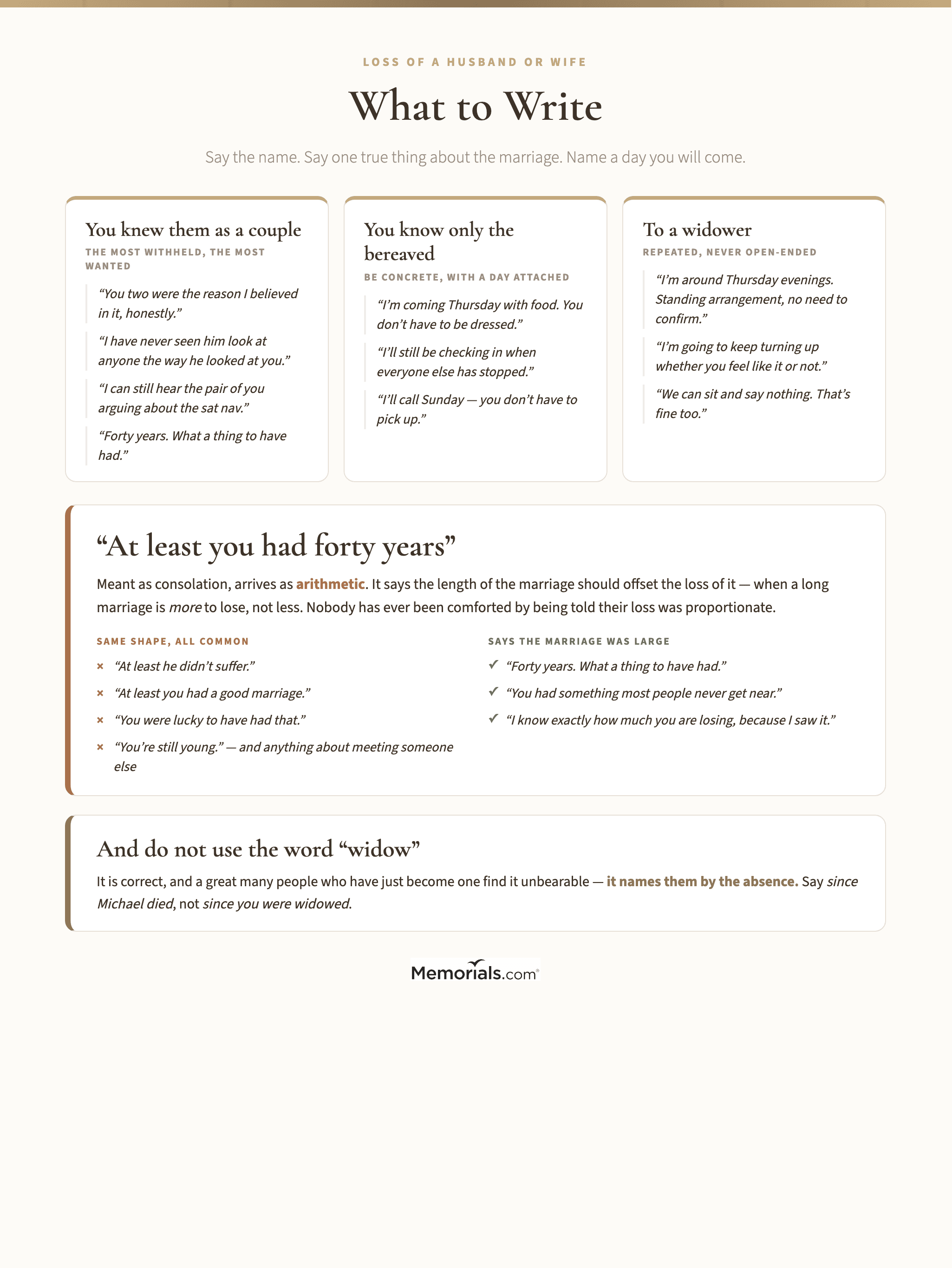
The highlighted panel is the one worth reading twice. "At least you had forty years" is said constantly and lands as arithmetic.
The Sentence That Stings Most
"At least you had forty years."
It is meant as consolation and it arrives as arithmetic. It tells someone that the length of the marriage should offset the loss of it, when in fact a long marriage is more to lose, not less — more shared vocabulary, more routine, more of a life that only worked with two people in it. Nobody has ever been comforted by being told their loss was proportionate.
The same shape, all common:
At least he didn't suffer.
At least you had a good marriage.
At least it was quick.
You were lucky to have had that.
What to say instead, when what you mean is what you had was remarkable:
Forty years. What a thing to have had.
You had something most people never get near.
I know exactly how much you are losing, because I saw it.
The difference is that these say the marriage was large. The at least version says the grief should be small. Our page on what to say instead of "sorry for your loss" covers the wider pattern.
And do not use the word "widow" to them. It is correct, and a great many people who have just become one find it unbearable — it names them by the absence. Say since Michael died, not since you were widowed.
When It Is a Man Who Has Lost His Wife
Worth its own section, because widowers get treated differently and usually worse.
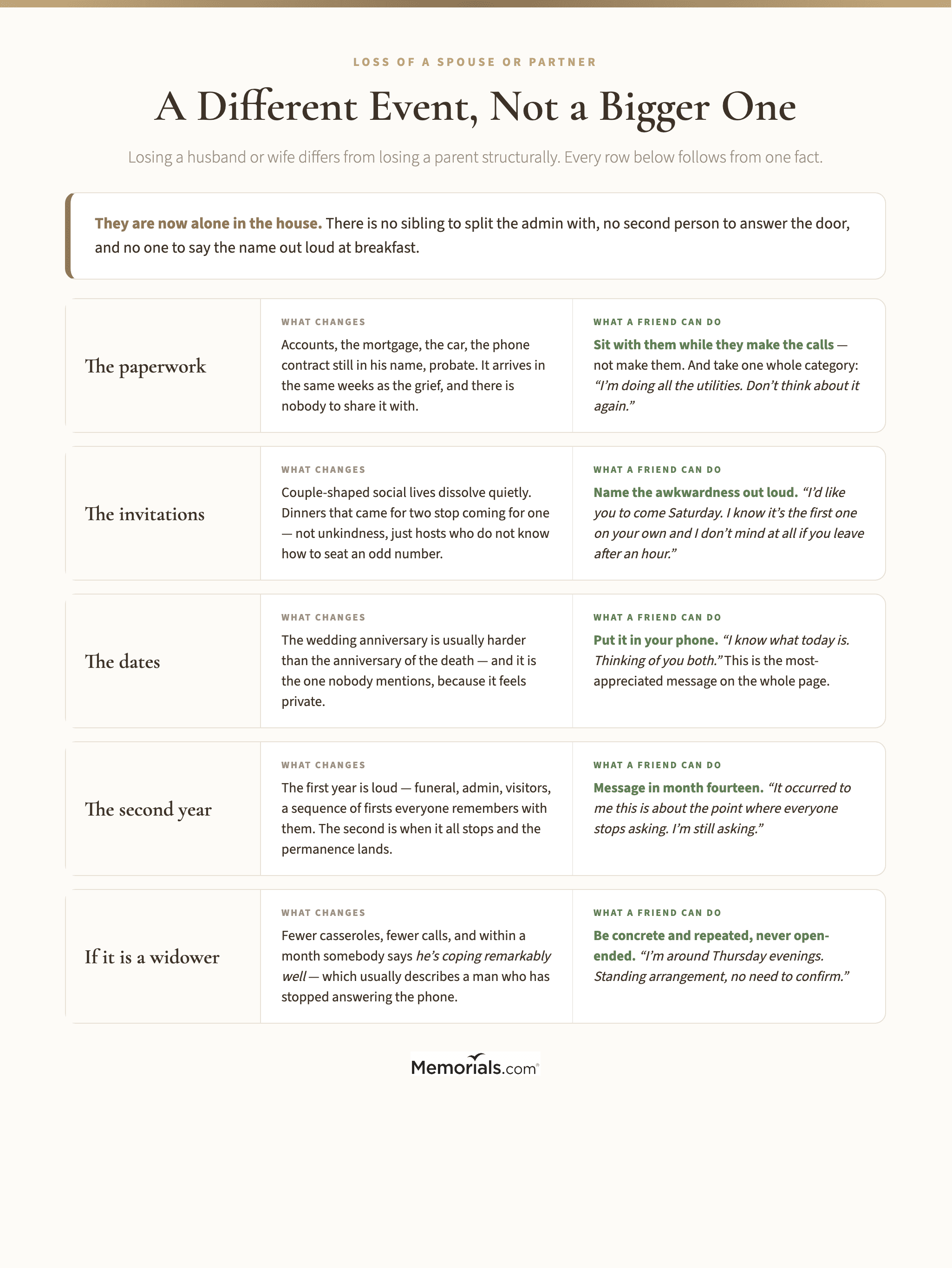
The casseroles arrive in smaller numbers. Fewer people call. And within about a month somebody will say he's coping remarkably well, which is almost always a description of a man who has stopped answering the phone rather than one who is fine. Men are asked how they are far less often than women in the same position, and asked to talk about it almost never.
Good condolences for loss of wife account for that by being concrete and repeated rather than open-ended.
I'm so sorry about Anne. I'll come Saturday. I'll bring lunch and I won't stay long.
Thinking of you. I'm going to keep turning up whether you feel like it or not.
I'm around Thursday evenings. Standing arrangement, no need to confirm.
No expectations from me. We can sit and watch the football and say nothing.
Two useful sympathy messages for loss of husband work as well for a wife, and one does not: let me know if you need anything is inert with anybody, and with a man who has been raised not to ask, it is a guaranteed dead end.
Some other lines that land — good words of sympathy for loss of wife tend to name her rather than the situation:
Anne was the funniest person in any room she walked into.
She kept that whole family upright and everybody knew it.
I'm so sorry about your wife. I don't know how you do this.
What not to say to a widower: anything about how well he is doing, anything about how he will need to learn to cook, and anything at all about meeting someone else. A sympathy message loss of wife should contain no forecast of his future.
The Two Dates Nobody Else Marks
Everyone remembers the funeral. Almost nobody remembers these.
The wedding anniversary. For most widowed people this is harder than the anniversary of the death, and it is the one nobody mentions because it feels like a private thing. Mentioning it is the single most-appreciated message in this whole article.
I know what today is. Thinking of you both.
Happy anniversary, in whatever way that works now. He was lucky.
The first of everything alone. The first Christmas, the first birthday, the first holiday they would have taken, the first time the car needs its MOT and there is nobody to argue with about it. How long grief lasts covers the shape of the first year.
If there is a family wedding coming, our guide to remembering a loved one at a wedding covers how families mark an absent spouse or parent on the day.
The most-felt and least-written part of losing a spouse.
Couple-shaped social lives dissolve quietly. Dinner invitations that came for two stop coming for one, not from unkindness but because hosts do not know how to seat an odd number and are afraid of an awkward evening. The result is that somebody who has just lost the person they lived with also loses most of their social calendar, in the same season, without anybody naming it.
You can fix this in one line.
I'd like you to come on Saturday. I know it's the first one on your own and I don't mind at all if you leave after an hour.
Same standing invitation as before, just for one now.
I'm going to keep asking. Say no as often as you like.
Naming the awkwardness out loud is what makes it survivable. Pretending nothing has changed is what makes people stop coming.
The invitations stop quietly, and nobody says why. One sentence fixes it.
When the Admin Lands on One Person
A practical difference from losing a parent: there is no sibling to split it with. Accounts, the mortgage, the car, the phone contract still in his name, the pension, the probate. It arrives in the same weeks as the grief and it is relentless.
Useful offers, in descending order of usefulness:
Sit with them while they make the calls. Not make them — sit there. The calls are unbearable alone and trivial with company.
Take one whole category.I'm doing all the utilities. Give me the account numbers and don't think about it again.
Drive them. To the registrar, the bank, the solicitor.
Bring food in week five, not week one. The fridge is full in week one.
If they are choosing a memorial, that is a decision that does not need making quickly — our guides to double headstones for couples and to urns designed for two cover the shared-memorial question that most couples never discussed while both were alive.
If They Are Young
Losing a husband or wife in your thirties or forties is a different experience from losing one at eighty, and the messages differ.
They are usually the only widowed person anyone they know has met, which is isolating in a specific way. There may be small children. And people will start asking about dating far earlier than is bearable.
I don't know anyone else who has been through this and I imagine you don't either. I'm here for however long this takes.
No advice from me, ever. Just company.
I'll take the kids Saturday morning. Sleep, or don't — either is fine.
Do not say you're still young, mention remarriage in any form, or tell them their spouse would want them to move on. Not in the first year, not from you.
And they are not the only bereaved person in that family. Someone who dies at forty usually leaves parents, and a parent burying a son or daughter at any age is in the territory a sympathy message loss of child has to cover. Their brothers and sisters are the ones nobody asks about at all — a condolence message for loss of brother is a separate letter, not a line added to the widow's card.
The second year is often harder than the first. That is when the paperwork ends and the house goes quiet.
The Second Year
Worth knowing because almost nobody expects it: for many widowed people the second year is harder than the first.
The first year is loud — the funeral, the admin, the visitors, the sequence of firsts that everyone else remembers with you. The second is when the paperwork ends, the visitors stop, and the permanence of it lands properly. Support falls away at exactly the point it becomes most needed.
A message in month fourteen is worth several in week two.
Still thinking of you, and of Michael. No reply needed.
It occurred to me this is about the point where everyone stops asking. I'm still asking.
A keepsake works differently here than for any other relationship, because it will be in a house that now has one person in it. Small, and not a display piece.
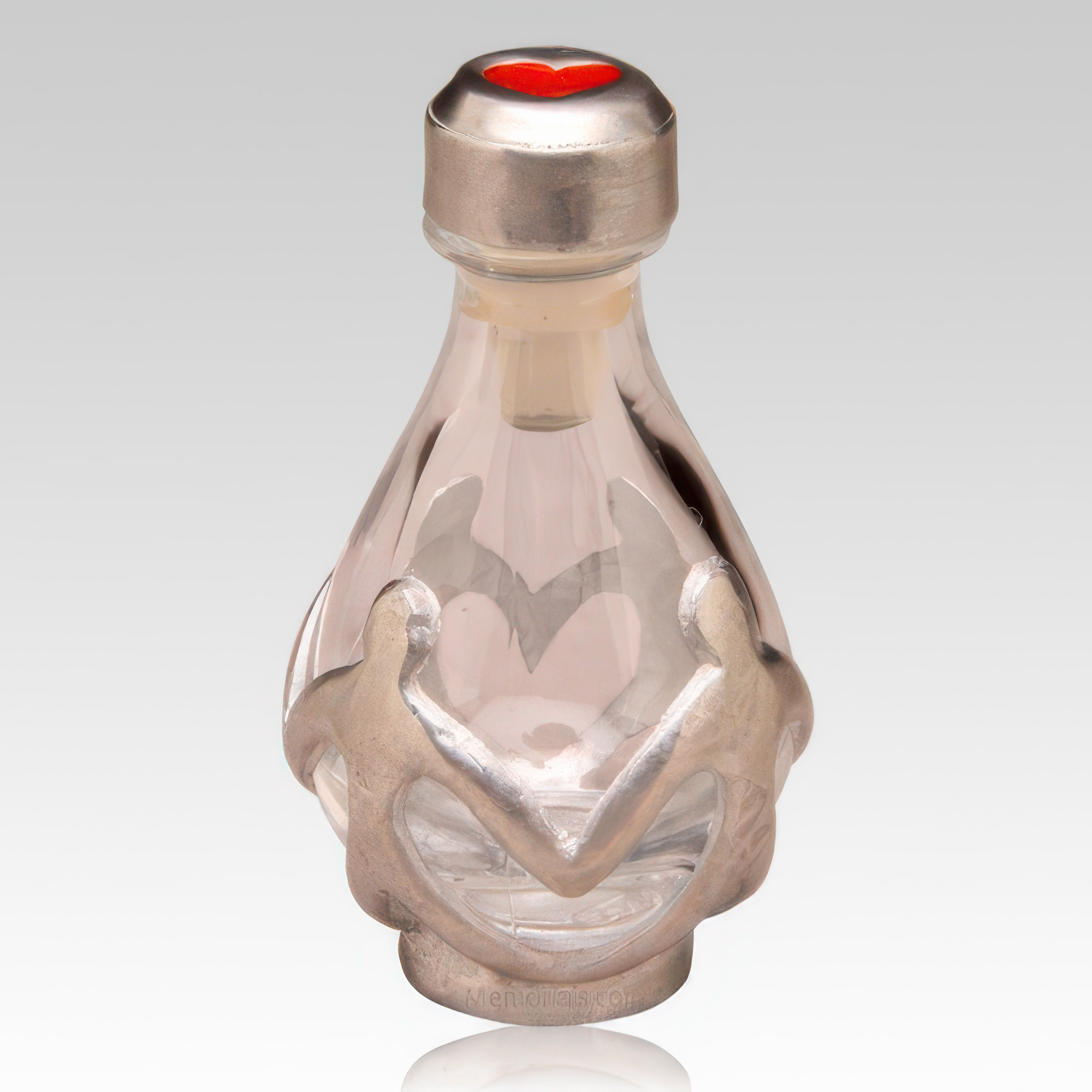
What people keep: a piece holding a little of the ashes, something with his handwriting or her signature, a framed photograph of the two of them that they have not seen before. Among bereavement gifts the pieces that suit are the quiet ones; the keepsake gifts range covers most of it.
Every one of these follows from a single fact: there is nobody else in the house.
Frequently Asked Questions
What do you say for the loss of a husband or wife? Say their name, say one true thing about the marriage, and name a concrete thing you will do on a named day. I'm so sorry about Michael. I'm coming Thursday with food.
What should I not say? Anything beginning at least — especially at least you had forty years, which lands as arithmetic. Also avoid the word widow, and any mention of dating or remarriage.
Is it all right to mention their marriage? Yes, and you should. The marriage is what they have lost, and being the only person not mentioning it is its own loneliness.
When is the hardest time? Often the second year, once the paperwork ends and the visitors stop. And the wedding anniversary, which is usually harder than the anniversary of the death.
What if I don't know them well? Two lines is plenty. I was so sorry to hear about your wife. Thinking of you. Silence from an acquaintance is noticed more than a short message ever is.
What is the most useful practical help? Sitting with them while they make the admin calls, and taking one whole category off them — I'm doing all the utilities, don't think about it again.
In Closing
Say his name or her name. Say one true thing about the marriage. Then put two dates in your phone before you close this page — the wedding anniversary, and a day in month fourteen.
Almost nobody does the second one, which is exactly why it will be the message that gets kept.