🏬Supersize Online Funeral Retailer🪦1000's of Headstones⚱️Over 10,000 Cremation Urns⚰️Caskets Overnight Delivery🛒Funeral & Memorial Superstore🚚FREE Shipping on ALL Orders👨👩👧👦Helping Families for over 20 Years💰Lowest Price Guarantee🏬Supersize Online Funeral Retailer🪦1000's of Headstones⚱️Over 10,000 Cremation Urns⚰️Caskets Overnight Delivery🛒Funeral & Memorial Superstore🚚FREE Shipping on ALL Orders👨👩👧👦Helping Families for over 20 Years💰Lowest Price Guarantee
🏬Supersize Online Funeral Retailer🪦1000's of Headstones⚱️Over 10,000 Cremation Urns⚰️Caskets Overnight Delivery🛒Funeral & Memorial Superstore🚚FREE Shipping on ALL Orders👨👩👧👦Helping Families for over 20 Years💰Lowest Price Guarantee🏬Supersize Online Funeral Retailer🪦1000's of Headstones⚱️Over 10,000 Cremation Urns⚰️Caskets Overnight Delivery🛒Funeral & Memorial Superstore🚚FREE Shipping on ALL Orders👨👩👧👦Helping Families for over 20 Years💰Lowest Price Guarantee
A condolences email is the medium people reach for when a text feels too casual and a card will arrive too late — usually at work, usually for someone they know professionally rather than personally.
It is a perfectly good medium for that. The rules are different from a card, and the part people stare at longest is the one line a card does not have.
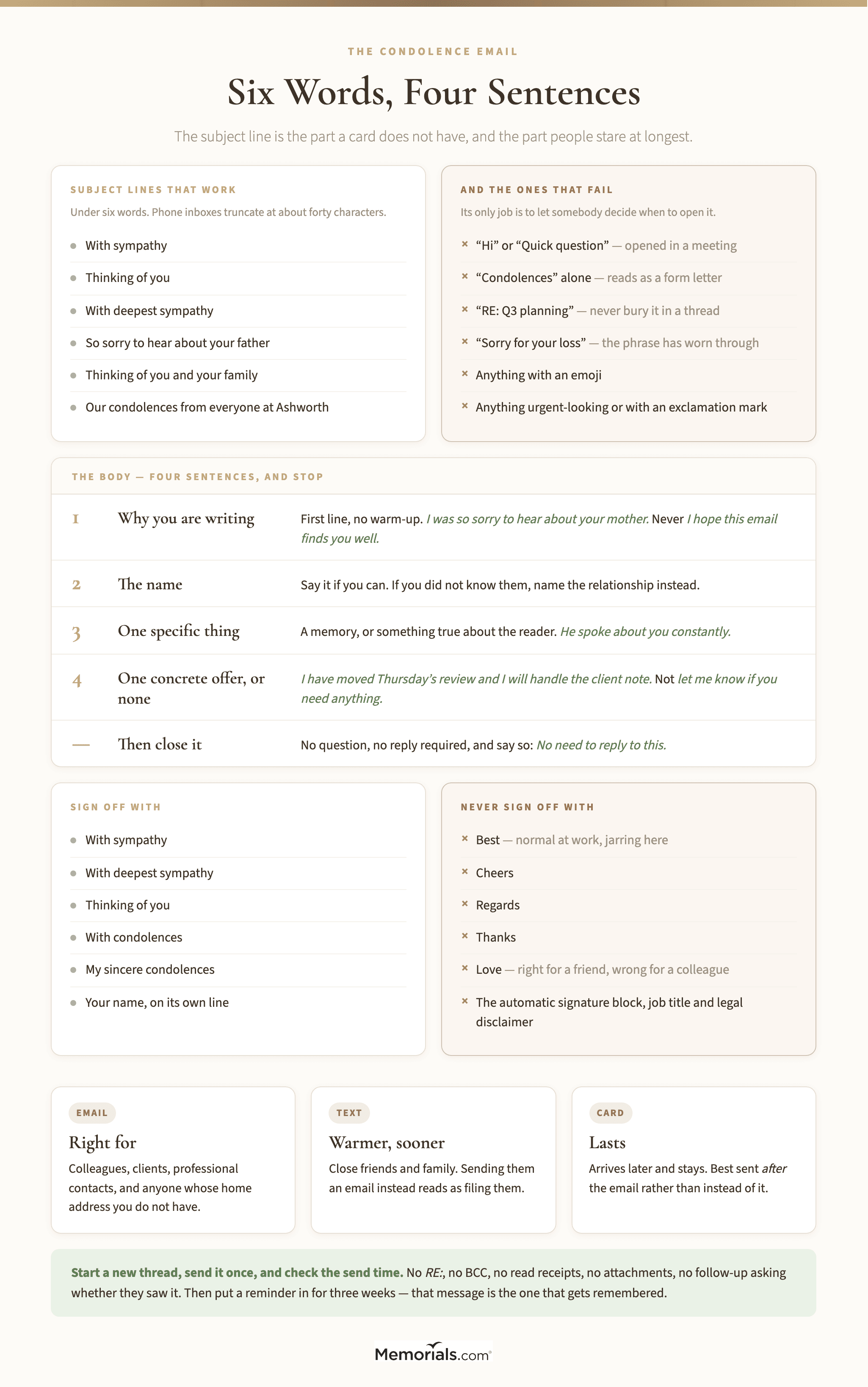
The short version: say what the email is in the subject line, keep the body to four sentences, sign off plainly, and send it once. For the sentences themselves, short condolence messages has sixty of them, and the sympathy and condolence guide is the wider starting point.
The Subject Line
This is the most-searched part of the whole subject, in about a dozen phrasings — , , , — and they all have the same answer.
Say what it is. The subject line's only job is to let somebody decide when to open it. A vague one gets opened in a meeting.
These work:
With sympathy
Thinking of you
With deepest sympathy
So sorry to hear about your father
Thinking of you and your family
Our condolences from everyone at Ashworth
Use the name if you knew the person who died.Thinking of you and remembering David is warmer than anything generic, and it tells the reader immediately that this is not work.
Keep it under about six words. Phone inboxes truncate at roughly forty characters, and a subject line that gets cut in half is worse than a short one.
These fail:
"Hi" or "Quick question" — opened unprepared, in the wrong moment.
"Condolences" alone — accurate, and it reads like a form letter.
"RE: Q3 planning" — never bury it in an existing thread. Start a new email.
"Sorry for your loss" as a subject — it is the phrase everybody uses and it has worn through. What to say instead covers the replacements.
Worth two seconds of thought, because email is right for a narrower set of people than it gets used for.
Email is right for colleagues, clients, professional contacts, people you know through work, and anyone whose home address you do not have. It is also right when you need to reach someone quickly and a card cannot.
Email is wrong for close friends and family. A text is warmer and lands sooner; a card lasts. Sending a close friend an email reads as filing them.
If a text is the right channel instead, condolences text messages covers what to send and when — including the follow-up weeks later that email handles badly.
And email is wrong when it is the only thing you do. For anyone you actually know, the email is the first move, not the whole gesture. How to offer condolences sets out the full sequence — reach out, show up, follow up.
If they are back at work already, an email is much better than raising it in a meeting or a corridor. Grief at work covers what the return is like from their side.
What to Write in the Body
Knowing how to write a condolence email is mostly knowing how short it should be. Four sentences. People overwrite this one badly, because the blank box is big and a card is small.
Say why you are writing, in the first line.I was so sorry to hear about your mother. Do not warm up. Do not open with I hope this email finds you well.
Name the person if you can.I was so sorry to hear about David. If you did not know them, name the relationship instead.
Say one specific thing. A memory if you have one; if not, something true about the reader. He spoke about you constantly.You have been carrying a great deal this year.
Offer one concrete thing, or nothing.I have moved Thursday's review to the 14th, and I will handle the client note. Concrete beats let me know if you need anything, which hands the work back.
Close it. Do not ask a question, do not require a reply, and say so: No need to reply to this.
That is how to express condolences in email in full, and the same shape works whether you are writing to a colleague, a client or someone you barely know. Searchers ask this as how to write a condolence email, as how to offer condolences in an email, and as how to express condolences in email, and the four sentences answer all three.
A sample, end to end
Subject: Thinking of you
Priya,
I was so sorry to hear about your father. I only met him once, at the summer thing two years ago, and he talked about you the entire time.
I have moved Thursday's review to the 14th and told the client you are out. There is nothing here that needs you.
No need to reply to this. Thinking of you.
Ravi
How to Sign Off
The sign-off is the second thing people get stuck on, and the honest answer is that almost anything plain is fine.
These are safe:With sympathy, With deepest sympathy, Thinking of you, With condolences, My sincere condolences, or simply your name on its own line.
These are not:Best, Cheers, Regards, Thanks — all of them normal at work and all of them jarring here. Warmly is borderline. Love is right for a friend and wrong for a colleague.
The word is doing the work in most of the safe ones. The condolences meaning is literally to suffer alongside someone, which is why it still reads as sincere in an email where sorry on its own can read as thin.
Match the sign-off to the relationship, not to the occasion. Somebody who signs Best, R to you every week can sign Thinking of you, R now; a formal supplier should not suddenly become intimate.
Cut the automatic signature block if you can. A condolence message followed by a job title, a phone number, a legal disclaimer and a Please consider the environment before printing this email undoes the whole thing.
And do not add a postscript. How to sign off a condolence email really means: stop writing. No P.S., no hope you're doing okay, no second thought appended underneath.
Cut the signature block. A condolence followed by a job title and a legal disclaimer undoes itself.
At Work: Coworkers, Clients, and the Team
Most of the people searching for this are writing a professional condolences email, and the register is the hard part.
To a coworker. A condolence email to a coworker should sound like you, not like HR. Use their first name, say the thing plainly, and take one task off them by name. Condolence messages for a coworker covers the wording in depth, including how your position changes what you can say.
A condolences email to coworker groups — the whole team at once — should come from a manager, not from a colleague, and it should say what the family has asked for. Whether flowers are wanted, whether the funeral is private, and where a card is being collected.
To a client. A condolence email to a client is shorter and stays outside the work entirely. Two sentences and no mention of the account. I was very sorry to hear about your husband. Everything here can wait — please do not think about it.
To someone senior. The same email, no more formal. Seniority does not change what a bereaved person needs to hear.
From a company account. Do not. A condolence from `noreply@` or a shared inbox is worse than nothing. Send it from a person.
And if you are the one who is bereaved, the email goes the other way — how to tell work about a death in the family has the wording for telling your manager, asking for leave, and the out-of-office.
Six words in the subject, four sentences in the body, a plain sign-off, and no signature block.
When to Send It
Within a day or two of hearing. Email is the fast medium; using it slowly wastes the one thing it is good at.
Send it on a weekday, in working hours where they are. Not because the timing matters to them, but because a 3am arrival looks automated.
If you find out late, send it anyway and say so in one clause: I have only just heard. Nobody counts the days, and a late message is far better than the silence people choose out of embarrassment.
Do not wait for the funeral details. The email is not an RSVP.
When the Email Was From Them
A situation email creates and no other medium does, and almost nobody warns people about it.
Mail keeps arriving from a dead person's address. Scheduled sends, newsletters, calendar invites, a LinkedIn birthday reminder. If you are close to the family, say nothing about it unless they raise it. If you administer the account, be careful: switching it off is somebody's decision, not an IT task.
Do not reply into their old thread to write your condolence. It will sit in the family's inbox nested under a message about a purchase order.
A recurring meeting with their name on it should be canceled by whoever owns the calendar, quietly, before the next occurrence.
And if you receive an auto-reply from a bereaved colleague's out-of-office, that is the answer. Do not follow up, and do not resend.
The Mechanics Nobody Mentions
Small things, each of which has ruined somebody's condolence email.
Start a new thread. Never reply into an existing work chain. The subject line is half the message and a RE: destroys it.
One recipient, or a considered group. Do not CC the team on a personal condolence. If it is a group message, say so in the first line.
Never BCC a condolence. If it is worth sending, it is worth sending openly.
Check the send time. Scheduled sends and time zones mean your message can arrive at three in the morning. Schedule it for a normal hour where they are.
Turn off read receipts and tracking. Watching whether a bereaved person opened your email is not a thing to do.
Do not attach anything unless they asked for it. No forms, no articles about grief, no funeral home brochures.
Proofread the name. Getting the name of the person who died wrong is the one mistake that cannot be recovered from. Read it twice.
Send it once. No follow-up asking whether they saw it.
The email is the opening, and almost everybody stops there.
Put a reminder in for three weeks out. One line then — still thinking of you, no reply needed — is worth more than the first email was. Checking in on someone who is grieving covers the long version.
Do not chase a reply. A sorry for your loss email needs no answer, and many people cannot open condolence messages for weeks. If they do reply, reply briefly and let it end.
Follow it with something physical if you knew them well. A card arriving after the email lasts in a way an inbox does not, and among keepsake gifts the small pieces are the ones that suit a colleague — sympathy gift etiquette covers what is appropriate from whom.
A card arriving after the email lasts in a way an inbox does not.
And if the team is sending something, one gesture from everybody beats eleven separate emails. Funeral thank-you messages covers what they will eventually have to write back, which is a good reason to keep the volume down.
Frequently Asked Questions
What should the subject line of a condolence email be? Something that says what it is, in under six words. With sympathy, Thinking of you, So sorry to hear about your father. Never Hi, never RE: into an existing thread.
Is it okay to send condolences by email? Yes, for colleagues, clients and professional contacts. For close friends and family a text lands sooner and a card lasts longer.
How long should a condolence email be? Four sentences. Why you are writing, the person's name, one specific thing, and one concrete offer or none.
How do I write a condolence email to my boss? The same way as to anyone else, and no more formally. Seniority does not change what a bereaved person needs to hear.
How do I end a condolence email?With sympathy, Thinking of you, or With condolences. Not Best or Regards. Cut the automatic signature block, and add no postscript.
Should I expect a reply? No, and say so in the email. Many people cannot open condolence messages for weeks, and silence means nothing.
Can I send one email to the whole team? A manager can, and it should say what the family has asked for. A colleague should not CC everybody on a personal message.
In Closing
Say what it is in the subject line. Write four sentences. Sign off plainly, delete the signature block, and send it once.
Then put a note in your calendar for three weeks, because that message is the one that will be remembered.