🏬Supersize Online Funeral Retailer🪦1000's of Headstones⚱️Over 10,000 Cremation Urns⚰️Caskets Overnight Delivery🛒Funeral & Memorial Superstore🚚FREE Shipping on ALL Orders👨👩👧👦Helping Families for over 20 Years💰Lowest Price Guarantee🏬Supersize Online Funeral Retailer🪦1000's of Headstones⚱️Over 10,000 Cremation Urns⚰️Caskets Overnight Delivery🛒Funeral & Memorial Superstore🚚FREE Shipping on ALL Orders👨👩👧👦Helping Families for over 20 Years💰Lowest Price Guarantee
🏬Supersize Online Funeral Retailer🪦1000's of Headstones⚱️Over 10,000 Cremation Urns⚰️Caskets Overnight Delivery🛒Funeral & Memorial Superstore🚚FREE Shipping on ALL Orders👨👩👧👦Helping Families for over 20 Years💰Lowest Price Guarantee🏬Supersize Online Funeral Retailer🪦1000's of Headstones⚱️Over 10,000 Cremation Urns⚰️Caskets Overnight Delivery🛒Funeral & Memorial Superstore🚚FREE Shipping on ALL Orders👨👩👧👦Helping Families for over 20 Years💰Lowest Price Guarantee
A house does feel different after someone dies in it. The rooms are the same size, the light comes through the same window at the same hour, and the place has still changed in a way that is hard to put into a sentence. Most people notice it at night, alone, standing in a hallway. If you have been quietly looking into cleansing a house where someone died, you are not being superstitious and there is nothing wrong with you. You are asking the question families have asked in every culture anyone has recorded, and almost all of them answered it the same handful of ways: open the air, wash what can be washed, bring in light, burn something fragrant, say something out loud.
This page separates two jobs that arrive together and get confused — the physical work of cleaning a room and the ritual work of marking what happened in it — and then sets the traditions side by side, which is what our funeral traditions guide exists to do. Two things worth saying before any of it. You do not have to do any of this. And you do not have to do it yet.
Why a Home Feels Different After a Death
The usual explanation is not a supernatural one, and it is worth having in front of you before you decide anything. Grief changes how a familiar room reads. The objects are exactly where they were, and the person who arranged them is not, so every ordinary thing in the room quietly becomes evidence — the reading glasses, the chair angle, the mug in the sink. Nothing about the house has altered. What has altered is that the house is now a record.
Sleep is usually broken in the first weeks too, and a tired brain is a jumpy one. Rooms feel colder, sounds carry further, and the doorway you have walked through ten thousand times reads as a threshold. Families describe this as heaviness, as stillness, as the house holding its breath. That description is honest and extremely common, and it does not require anything to have stayed behind to explain it.
Which does not mean the feeling should be argued with. It is real, it is unpleasant, and doing something deliberate about it usually helps — not because it removes anything, but because it turns a room you have been avoiding into a room you have acted in. That is most of what the traditions below are actually for.
Keepsake Boxes and Memorial Garden Stones
For the few things you set aside, and for the remembering that moves outdoors
Two entirely separate tasks land on this one question, and untangling them makes the whole thing easier.
The first is physical. Air the room out with the window fully open for an hour or more. Strip and wash the bedding. Launder the clothes that need it, wipe down the surfaces, run the vacuum, empty what has spoiled in the refrigerator. If medical equipment was in the room, arrange for it to be collected. This is not disrespectful and it is not rushing anything — a bed nobody has touched in three weeks becomes harder to approach, not easier.
There is a version of this that is not a family job at all, and it needs saying plainly. Where a death was traumatic, unattended, or went undiscovered for a period, what the room needs is biohazard remediation performed by a licensed company, not a cleansing ritual and not a relative with a bucket. Bodily fluids penetrate carpet, subfloor and drywall, and the health risk is genuine. Homeowners insurance frequently covers it, and the funeral home or the responding officer can usually name a local firm. Do not let a page about sage be the page a family reads in that situation.
The second job is the ritual one, and it is what most people mean when they search for how to spiritually cleanse a house after someone dies. Smoke, salt, water, sound, light, words. None of it is cleaning. All of it is marking — telling yourself, and the room, that the thing that happened here has been acknowledged rather than stepped around.
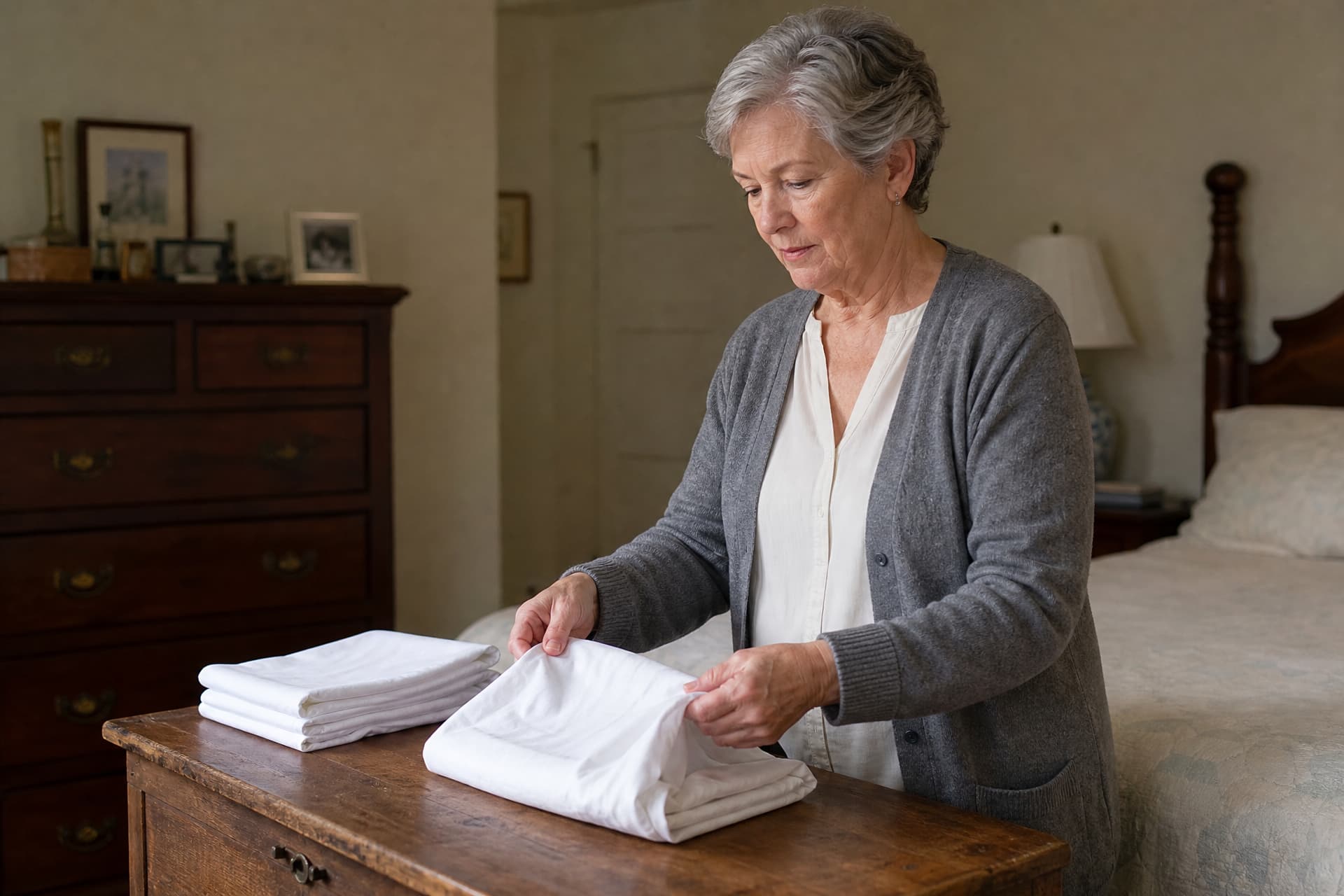
Washing the bedding is the first job and the plainest one. Families often find the room becomes approachable again at exactly this point, before any ritual has happened at all.
What Families Do in the First Hours and Days
Long before anyone reached for the word cleansing, households did specific things the moment a death occurred, and several of them survive in American homes without anybody remembering why. A window is opened in the room, sometimes within minutes. A light or a candle is left burning. Photographs are turned or laid face down. In many households the mirrors go under sheets, and in others the pendulum clock is halted at the hour of death.
Those last two carry the most folklore and have the most tangled histories. The custom of covering the mirrors has at least three separate explanations depending on which tradition you ask, and stopping the clocks is a Victorian mourning practice that acquired a superstition later. Both are worth reading about if your family did them and never explained them.
What they have in common is worth noticing: every one of them changes the house from a place that is performing normality into a place where something has visibly happened. That is the same instinct behind everything further down this page.
How to Spiritually Cleanse a House, Step by Step
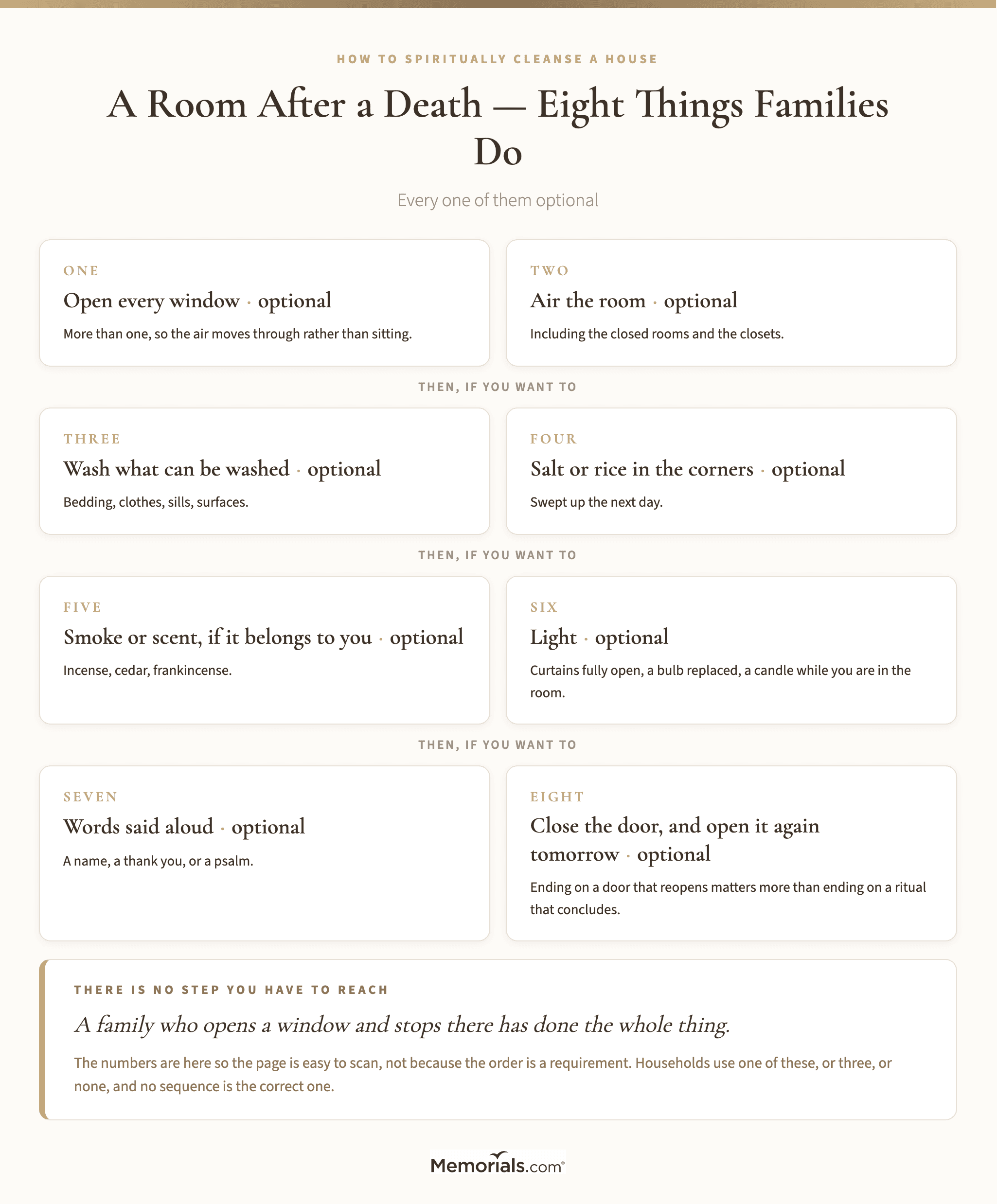
Read the following as options, not instructions. Families use one of these, or three, or none, and no order is correct.
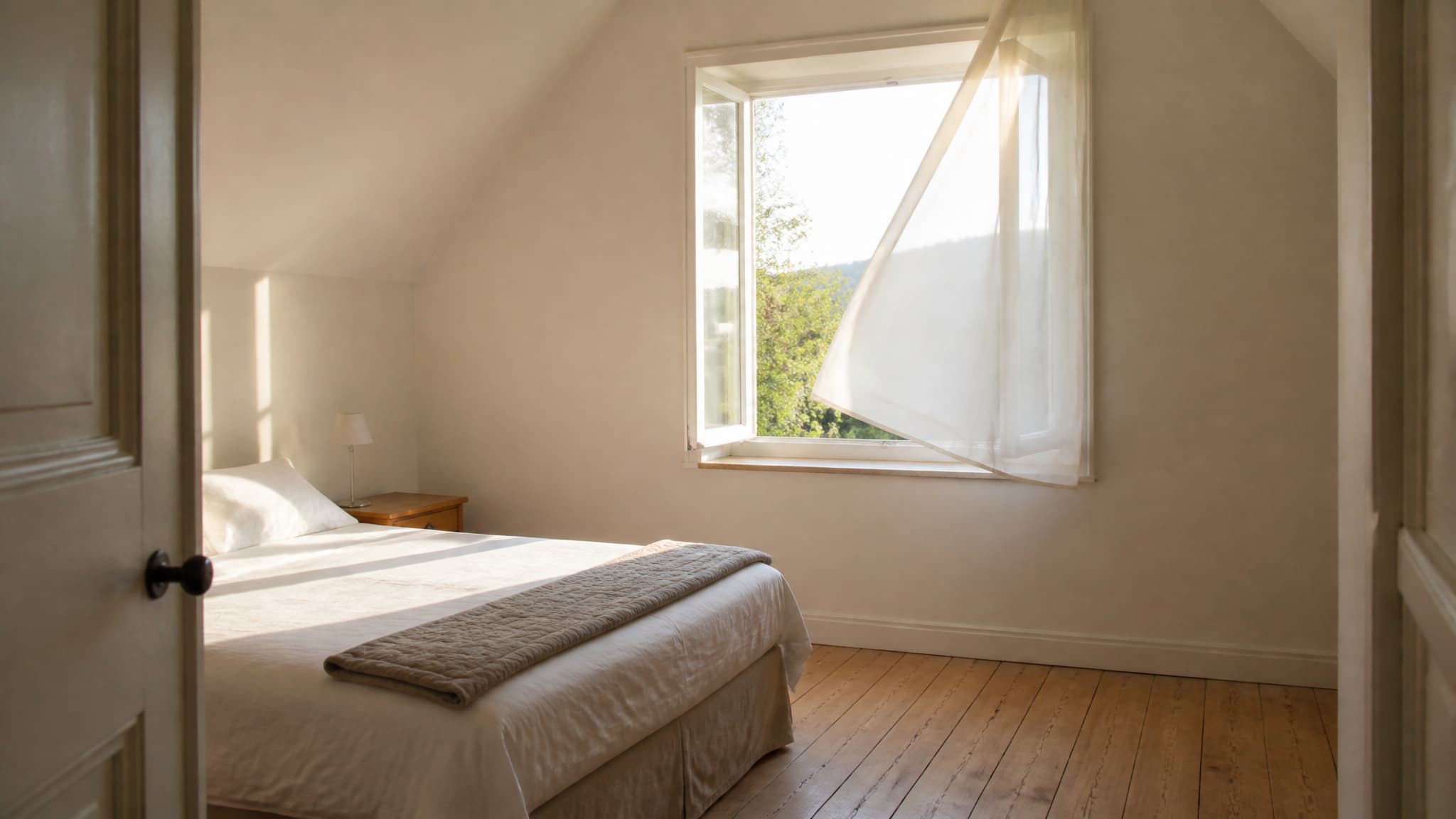
Open every window. Do it on a day with some wind if you can, and open more than one so the air actually moves through rather than sitting. Do the closed rooms too — closets, the spare room nobody has been in.
Clean the room with attention rather than speed. Wash the bedding, wipe the sills, put things back where they belong. Doing it slowly and on purpose is the point; several families describe this as the part that actually worked.
Salt or rice in the corners. Sea salt in a small dish in each corner of the room, or a handful of rice scattered and swept up the next day, appears independently in Japanese, Filipino, Caribbean, Mexican and European folk practice. Whatever you make of the reasoning, sweeping a room out afterward is a satisfying and finite task.
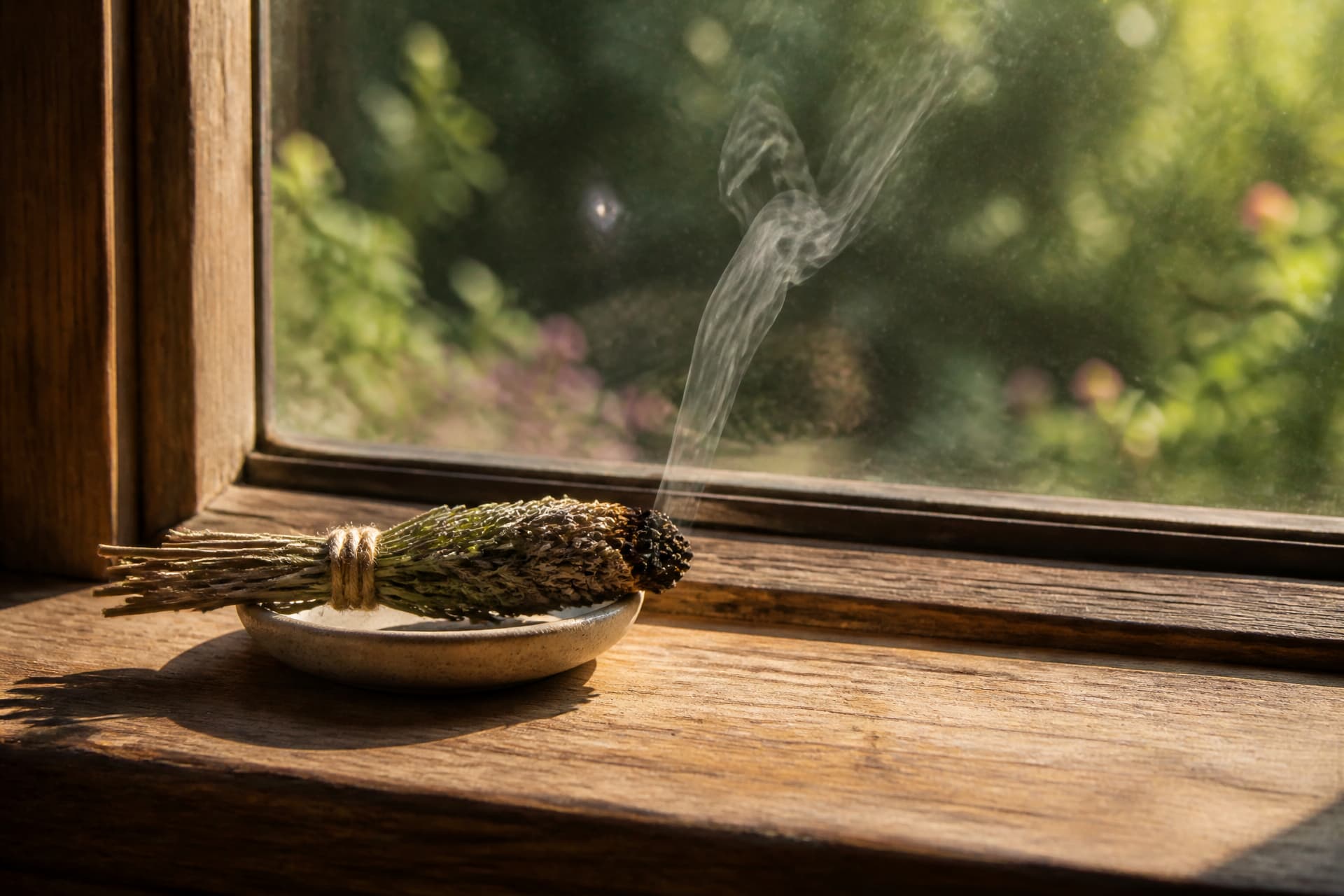
Smoke or scent, if it belongs to you. Frankincense, church incense, cedar, palo santo, a stick of whatever the family already burns. Smoke has carried this job in nearly every tradition on earth, which is also why burning paper shows up in so many of them. There is more to say about sage specifically, in the next section.
Bring light in. Open the curtains fully, replace a dead bulb, light a white candle on the sill and let it burn while you are in the room. Never leave a flame unattended in an empty house.
Say something out loud. This is the step people skip and the one they later say mattered. It does not need to be a prayer and it does not need to be good. Naming the person, thanking the room, or simply saying that you are still here is enough. Households that want a text usually reach for Psalm 91 or Psalm 121, both public domain in the King James Version and both short enough to read standing up.
Close the door, and open it again tomorrow. Ending on a door that reopens matters more than ending on a ritual that concludes.
Eight things families do, in the order they usually do them — and every one of them marked optional, because that is the honest label. A household that opens a window and stops there has done the whole thing.
Smoke does this job in almost every tradition, which is exactly why the specific plant matters less than most articles imply. Incense, cedar or frankincense will serve a family with no connection to sage.
Smudging, Sage, and Whose Tradition It Is
Nearly every page on this subject repeats the same sentence: that burning sage is "a Native American tradition" for clearing negative energy. It names no nation, cites no source, and stops there. Since smudging after a death is one of the most common things people ask about, it is worth being more accurate than that.
Smudging is a set of specific ceremonial practices belonging to specific Indigenous nations — the plants, the protocols, who may lead it and when, all differ between them, and none of it is a generic technique. What is sold in a shop as a smudge kit is usually white sage harvested commercially, and white sage is under real pressure from overharvesting on its native range in Southern California. Buying a bundle in a mall is not participation in anyone's ceremony.
None of this leaves a family without options, because the thing you actually want is smoke and a deliberate act. Frankincense and myrrh carry this in Christian and Middle Eastern practice, and Orthodox households use a hand censer at home. Japanese and Chinese families burn incense at the altar. Cedar, juniper and rosemary are burned across northern Europe. A stick of incense from the grocery store, used with attention, does exactly the job. If your family does have a connection to a smudging tradition, follow it as your community actually practices it rather than as the internet describes it.
House Blessings and Cleansing Traditions Around the World
This is where the comparison earns its place, because the practices differ far more than the summaries suggest.
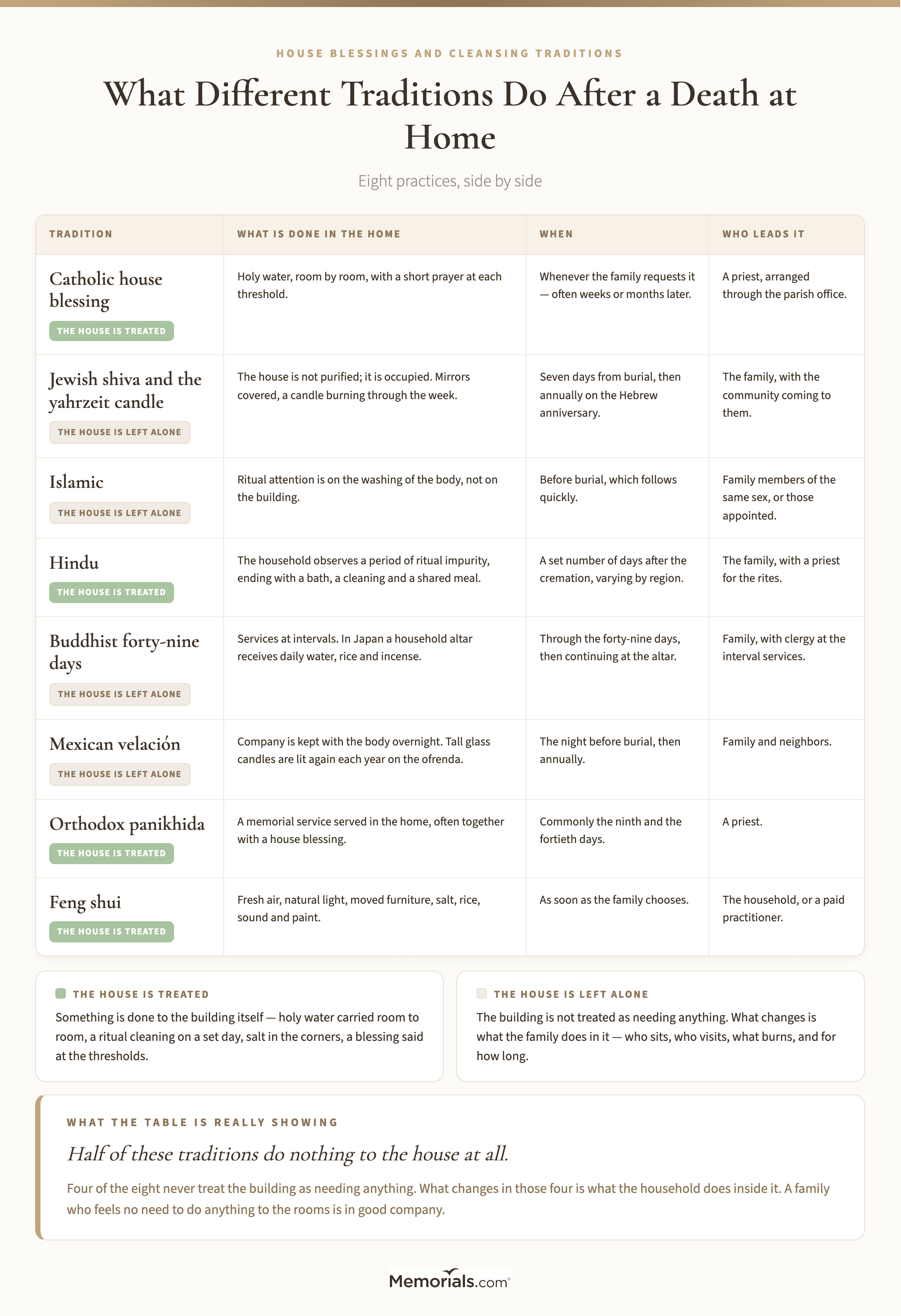
Catholic and Orthodox Christian. A house blessing is a real, requested rite: the family calls the parish, and a priest comes and blesses the home with holy water, room by room, often with a short prayer at each threshold. Orthodox households frequently combine it with a memorial service, the panikhida, served at home on the ninth and fortieth days after a death. Nobody needs to buy anything, and the parish office is the whole process.
Jewish. The house itself is not treated as needing purification. What changes is what the family does inside it: shiva is sat in the home for seven days, mirrors are covered, the mourners stay put and the community comes to them. A candle burns through the week, and every year afterward a yahrzeit candle is lit on the anniversary. The home is not cleansed; it is occupied, deliberately, until the first week is over.
Islamic and Hindu. In both, the ritual attention goes to the body rather than to the building — the Islamic washing of the deceased and the Hindu rites performed before cremation. The house is cleaned in the ordinary sense, and Hindu families in many regions observe a period of ritual impurity affecting the household, ending with a bath, a cleaning, and a shared meal on a set day.
Buddhist. Practice across Japan, Tibet, Thailand and Vietnam counts the forty-nine days after a death as the period the family observes, with services at intervals through it. Japanese homes keep a butsudan, the household altar in a Japanese Buddhist home, where offerings of water, rice and incense are made daily — an ongoing relationship with the space rather than a one-time clearing.
Mexican. The velación keeps company with the body through the night, and the candles that belong to this practice — the tall glass veladoras — are lit again each year on the ofrenda. The house is not emptied of the person; a place is made for them to return to.
Feng shui. The practice most competitor pages lean on prescribes fresh air, natural light, moved furniture, salt, rice, sound and paint. Strip the metaphysics and what is left is a decorating and cleaning program, which is probably why it feels effective.
Eight traditions, three questions each: what is done, when, and who leads it. The pattern worth seeing is that half of them do nothing to the house at all — they change what the family does inside it.
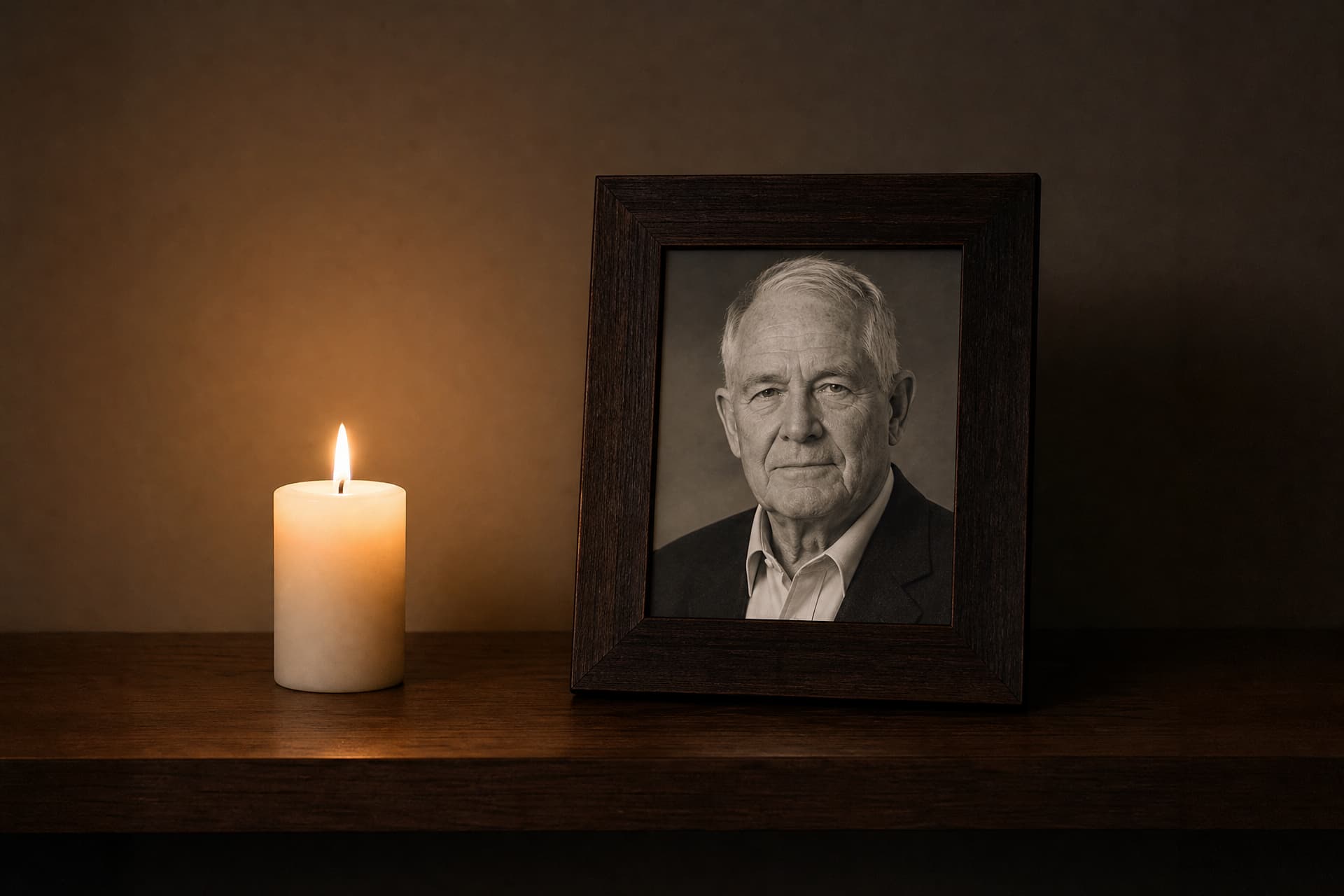
A candle and a photograph is the smallest version of every tradition on this page, and for a great many families it is the only version they ever do.
Clearing Out Belongings, and What to Keep
The advice that circulates online is to strip the house — remove the photographs, empty the closets, repaint. Read carefully, that advice is written for someone buying a property a stranger died in. It is close to the worst possible guidance for a widow in week two.
Nothing has to be cleared on a schedule. Clothes can hang in a closet for a year without harming anybody, and many families find the closet is the last thing they can face. When you do start, do it with someone else in the room, work one drawer at a time rather than one house at a time, and stop when you have had enough. The question of whether it is bad luck to wear a dead person's clothes comes up almost immediately, and the traditions genuinely disagree about it.
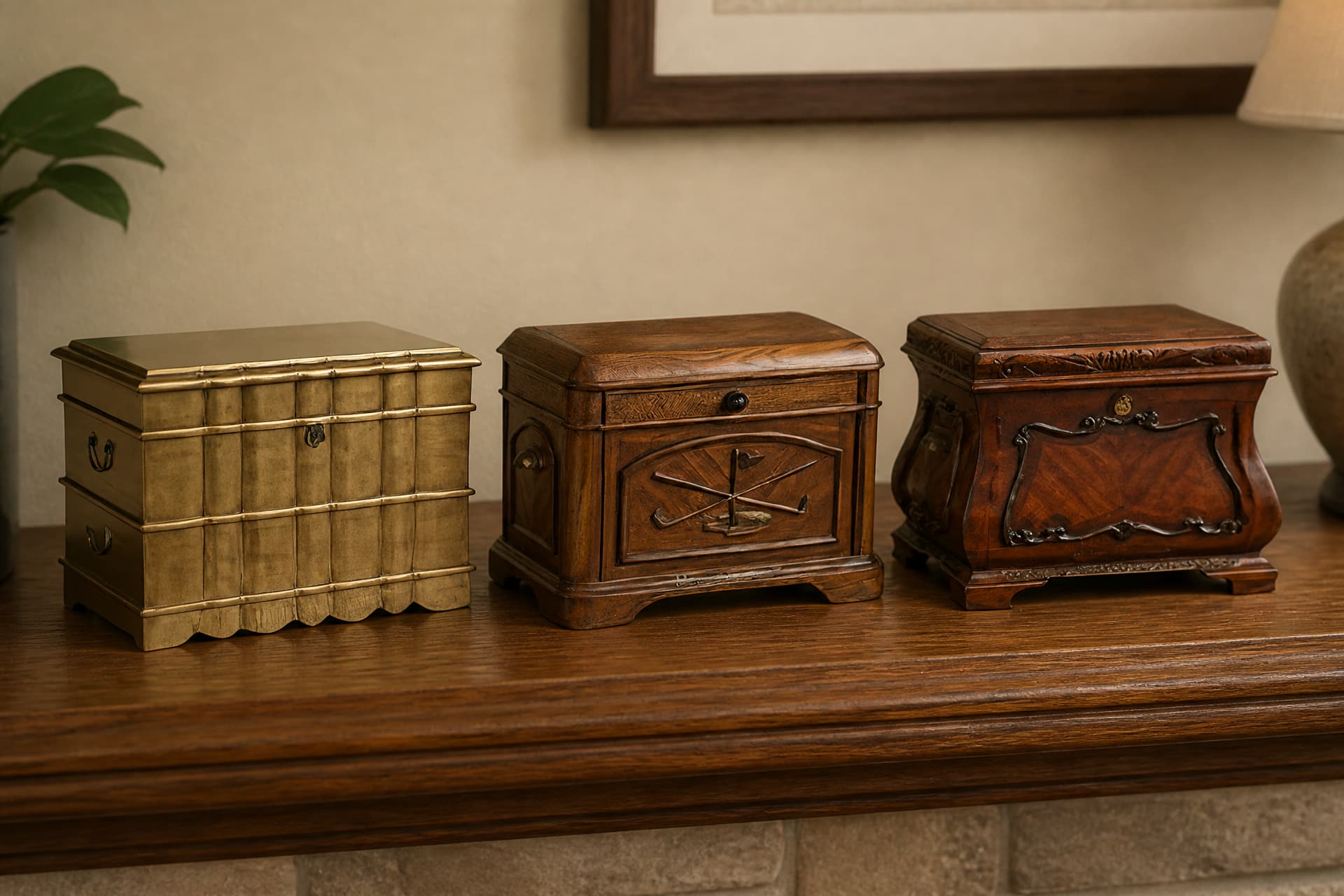
Set aside a small number of things before the donation bags come out — a watch, a scarf that still smells right, the letters, one shirt. A keepsake box with a lid that closes is more useful here than it sounds: it gives those objects a home that is neither on display nor thrown away, which is the exact status most of them need for the first year.
The traditions disagree, and the disagreement is the honest answer.
Some families do it before the funeral, so the house is ready for people coming back afterward. Jewish practice fills the first seven days with shiva in the home and does not tidy the house at all during them. Buddhist observance runs forty-nine days. Catholic house blessings are commonly requested weeks or months later, whenever the family gets to it. Feng shui practitioners will tell you the sooner the better, which is also what they are selling.
Set against that spread, "whenever you are ready" is not a dodge. There is no window that closes. If the first week after a loss has been paperwork and phone calls and you have not been in that room at all, that is completely ordinary, and the room will still be there in March.
The one exception is practical rather than spiritual: anything perishable, medical or biohazardous is handled straight away, and that is a health matter with nothing symbolic about it.
What Fills the Space Afterward
The most useful thing to think about is not what you take out of the room but what eventually goes into it.
Some families move the bed, some change nothing. A photograph that was put away in week one goes back up in month six, and that timing belongs to the household and nobody else. A home memorial space — a shelf with a photograph, a candle and one or two objects that were theirs — does what a butsudan does, on a smaller scale and with no religious commitment attached.
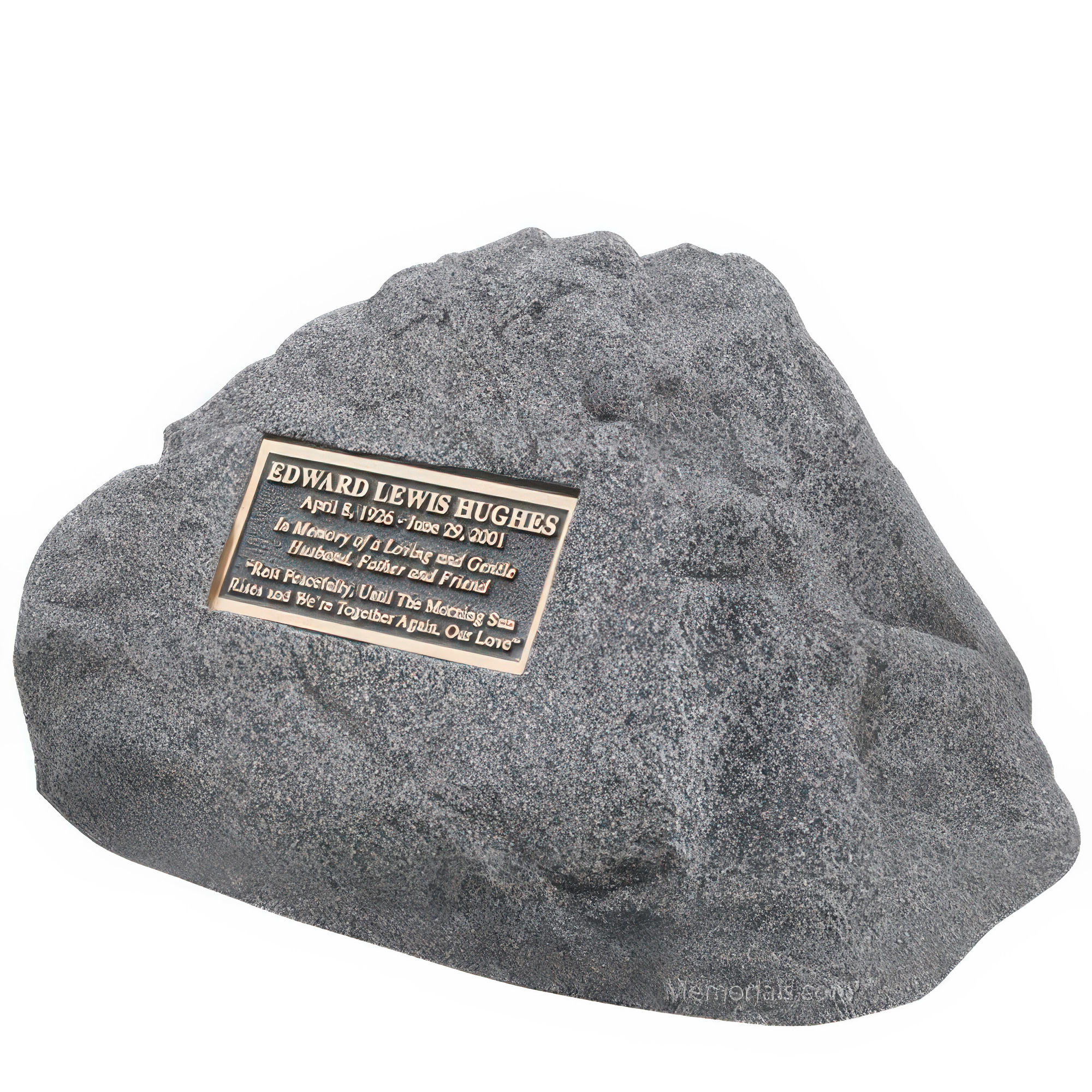
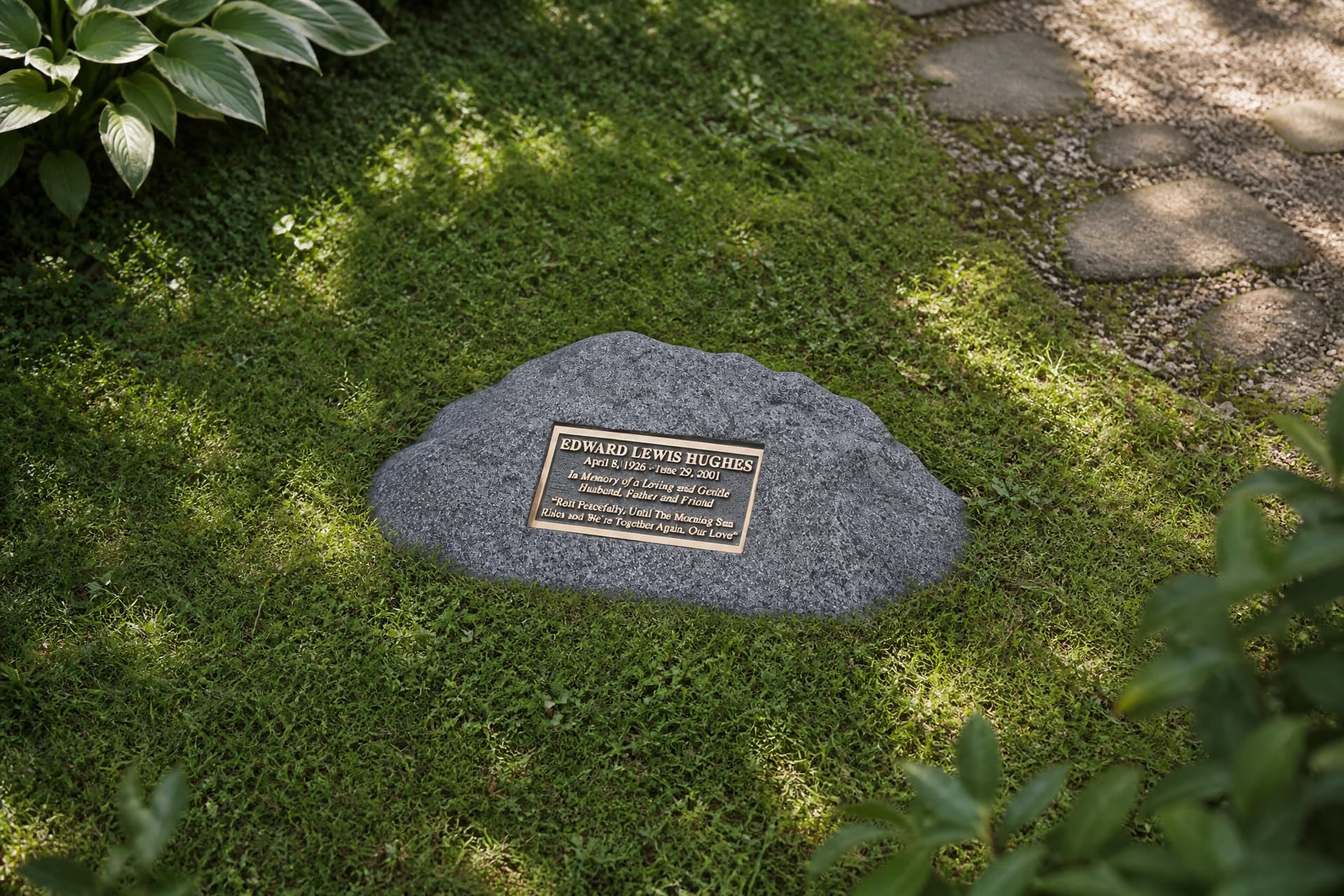
Others would rather the remembering happened outside the house entirely, where it is met on purpose instead of walked past. Engraved memorial stones for garden beds and borders serve that well, and so does a tree, a bench or a patch of planting that has to be tended. A room that had a death in it can become an ordinary room again. It usually does, and usually sooner than the family expects.
Moving the remembering outdoors suits families who would rather meet it deliberately in the yard than come across it in a hallway. Product shown: Distinction Memorial Rock.
Frequently Asked Questions
How do you spiritually cleanse a house after someone dies?
Open the windows and let the air move through, clean the room deliberately rather than quickly, and then choose whichever of these fits your family: salt or rice in the corners, incense or another smoke you have a real connection to, a candle or more daylight, and something said out loud. Households that want a religious rite can ask their parish, synagogue or temple, which is usually a phone call rather than a project.
How long should I wait before cleansing a house after someone dies?
There is no deadline, and the traditions spread across months. Some families do it before the funeral, Jewish practice runs seven days of shiva in the home first, Buddhist observance counts forty-nine days, and Catholic house blessings are often requested much later. Anything perishable or medical gets handled at once; everything else waits for you.
Does a heavy feeling mean the person's spirit is still there?
The usual explanation is grief and exhaustion rather than a presence. A room where something enormous happened is read differently by the person it happened to, and broken sleep amplifies all of it. The feeling is genuine and extremely common, and it fades for most families over the first months whether or not anything ritual is done.
Is it okay to sleep in a bed someone died in?
Yes, and plenty of people do, sometimes the same week. Wash everything, and replace the mattress if you would rather not keep it — that is a preference, not a hygiene rule, unless the death was unattended or traumatic, in which case a remediation company handles the room and its contents. If sleeping there is not possible yet, sleep somewhere else without treating it as a problem to solve. Many people move back in weeks or months later without much thought.
Is it bad luck to live in a house where someone died?
No. Deaths at home were the ordinary case for most of human history, and most older houses have had several. What sits underneath the question is usually unease rather than belief, and the customs on this page exist to give that unease something to do. The superstitions about mirrors and about a person's clothes are worth reading for the same reason: they are more interesting, and less frightening, once you know where they came from.
Take It at Your Own Pace
If you read this far looking for the one thing you are supposed to do, the honest answer is that there is not one. A family that opens a window, washes the sheets and says the person's name out loud has done everything the longest ritual on this page is trying to do. A family that does nothing at all for six months has not failed anything either.
What tends to help is small, physical and repeatable: air, water, light, a task with an end to it, and somebody else in the house while you do it. What tends not to help is a deadline, an expert who charges by the session, or the belief that the room is a problem to be fixed before you are allowed to feel better.
When the house is settled enough that you want somewhere for the remembering to live, that is the point at which a photograph goes back on the wall, a candle finds a shelf, or one of the small memorial gifts for loss that families keep out — a framed photo, an engraved keepsake, a box for the letters — starts doing its quiet work. There is no hurry about that either. The house will feel different for a while. Then, gradually, it will just be the house.